2021 Dental 3D Printing Revenues to Reach $3.1B, Says SmarTech Analysis

SmarTech Analysis has published its sixth edition of the Additive Manufacturing in Dentistry report and, noting the tumultuous experiences of 2020, projects a promising turnaround for the market in 2021. According to the company, dental 3D printing will surpass 2019 levels in terms of revenue, reaching $3.1 billion in 2021.
In a press release for its latest report, SmarTech pointed out that dental 3D printing was once “one of the most stable and fast-growing opportunities,” a keen observation given not only 3D printing’s key role in the production of patient-specific dental aligners but also the use of 3D printers in all manner of dental labs for the production of crowns and other items. This trend, however, was hindered by the COVID-19 pandemic, as was the entire global manufacturing economy. In turn, SmarTech describes how the dental industry was “negatively impacted due to acute government restrictions discouraging, or outright prohibiting, non-emergency dental care.”
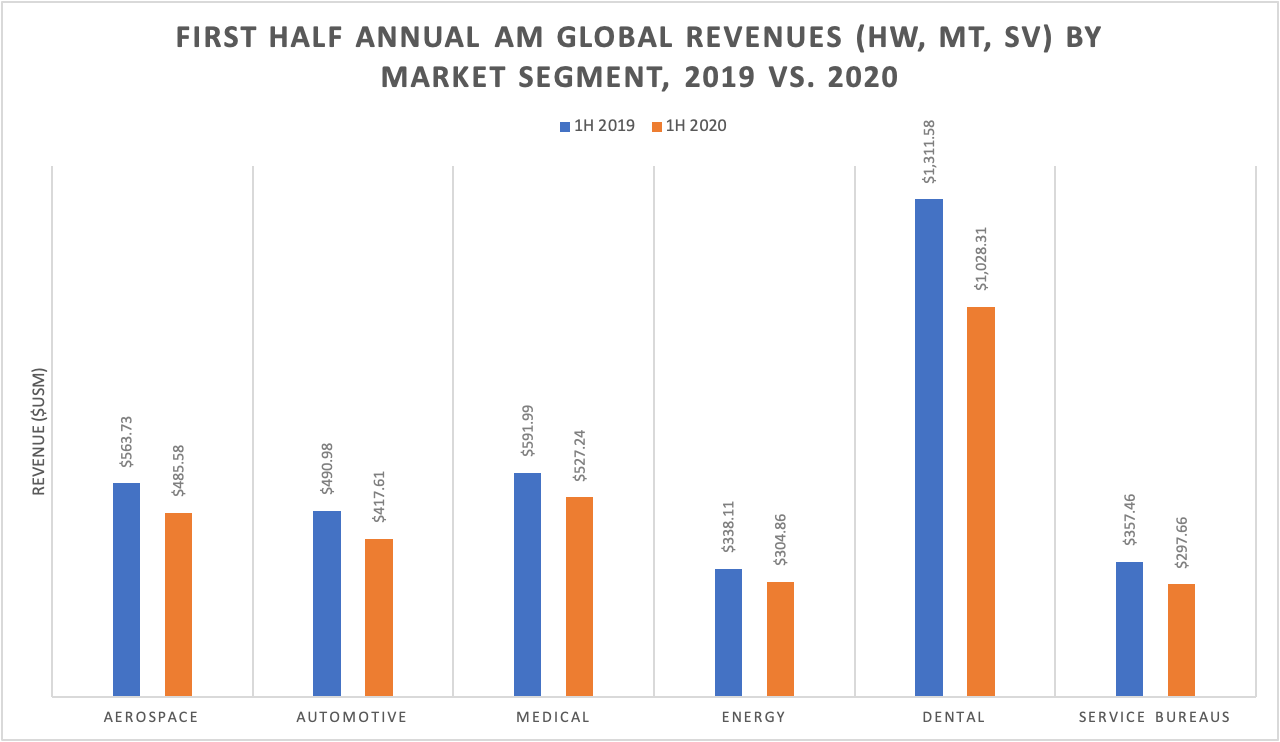
Image courtesy of SmarTech Analysis.
The 3D printing market research firm believes that the dental AM segment is poised for a rebound, however, explaining that “a quick bounce-back recovery already well underway.” Growth for 2021 will be heavily determined by exactly how national governments address the pandemic. While expectations for 2020 and 2021 are lower than previously anticipated even in early 2020, SmarTech expects the industry to recover to about 65 to 80 percent previous levels.
The report is the sixth such dental 3D printing study that SmarTech has published since its first in 2014, resulting in longest running analysis of dental AM on the market. Yet, there is nothing traditional about 2020 and this report examines how dental 3D printing has been impacted by the pandemic, including short-term market recovery forecasts along with more long-term changes in dental consumer behavior caused by COVID-19. Here, one might imagine how the inability to get routine dental care might cause some consumers to turn increasingly to mail-order dental solutions, such as direct-to-consumer invisible aligner products.

The written analysis that constitutes the body of the report is complemented by a database of dental 3D printing information, which SmarTech describes as “the most extensive database of dental 3D printing market opportunity and forecast data available, updated for the changes resulting from the ongoing pandemic impacts and expected market recovery timeline.”
Among the insights from the report is the fact that ceramic restoration 3D printing and permanent printable dental composites have advanced significantly, even in the midst of the pandemic. Rather than a minor player in the segment, ceramic 3D printing has stepped up to become “structurally significant to the dental 3D printing market,” according to SmarTech. Not only have micro-filled hybrid materials from companies such as BEGO been used more frequently for temporary crowns, but for permanent restoration has grown as well, competing with true zirconia restorations from companies like XJet and Lithoz.
In total, SmarTech expects not just dental 3D printing to recover and play an increasingly important role in the larger dental market in the wake of the pandemic, but 3D printing as a whole. To learn more or purchase the Additive Manufacturing in Dentistry report, visit the SmarTech website.
Subscribe to Our Email Newsletter
Stay up-to-date on all the latest news from the 3D printing industry and receive information and offers from third party vendors.
Print Services
Upload your 3D Models and get them printed quickly and efficiently.













You May Also Like
AM & National Competitive Advantage, Part One: the Real Problem with US Manufacturing
The problem with US manufacturing is the productivity growth rate. Depending on the source, US manufacturing productivity has either been flat or slightly declined since 2010. Before going any further...
Advanced Manufacturing at IMTS 2026: 3D Printing and AI and Drones, Oh My!
Last week’s International Manufacturing Technology Snow (IMTS) in Chicago welcomed over 90,000 attendees to the jungle that is McCormick Place. With over 1.17 million square feet of exhibit space, and...
Let the Games Begin! Xi Throws Down the Advanced Manufacturing Gauntlet
Sangmin Lee went to TCT Asia back in March and reported on the event for 3DPrint.com. He wrote two articles arguing that China’s AM industry looks “ready to scale.” This...
What 3D2GO Says About 3D Printing’s Growth in Southeast Asia
The Philippines offers an interesting case study in how 3D printing can develop in Southeast Asia, and Manila-based 3D2GO helps illustrate it. 3D printing in Southeast Asia doesn’t have to...