iFactory One 3D Printer Features Artificial Intelligence Error Protection

If I asked, what would you say are the five most common 3D printing errors? According to German 3D printing startup iFactory3D, the answer is spaghetti, detached objects, warping, stringing, and air printing, with which I’d tend to agree. But, the company is now launching what it calls the first 3D printer with an embedded artificial intelligence-based print error protection system that will render these issues, and others, moot.
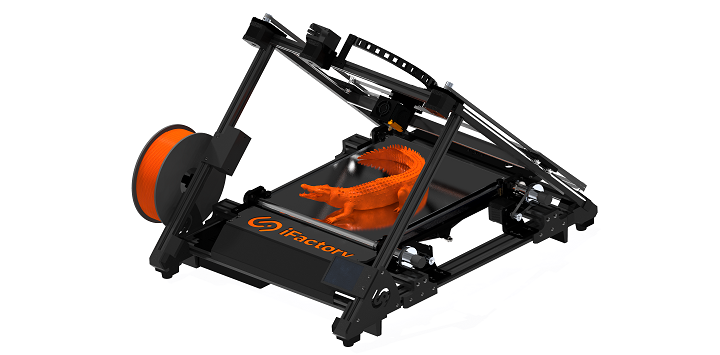
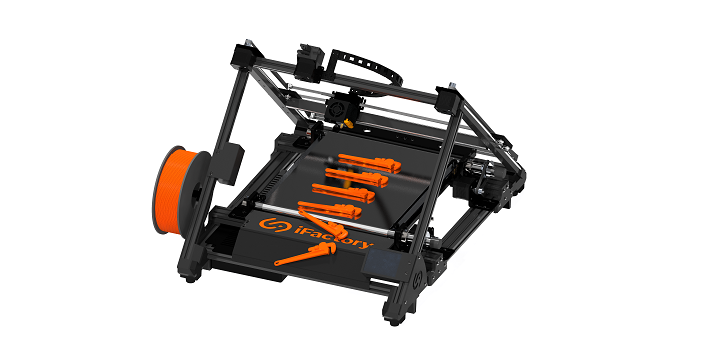
The pyramid-shaped iFactory One belt 3D printer features PrinterGUARD, a new print error protection system that can identify these five common errors. In addition, the startup also claims that its self-learning AI algorithms will soon be able to recognize up to twenty types of printing errors, all of which PrinterGUARD should be able to eliminate.
“A private poll of 1,000 3D printer users found that these printing errors occur in approximately 20% of all cases,” stated Artur Steffen, CEO of iFactory3D, in a press release. “Before the iFactory One entered the market, error diagnostics and the human aspect led to great losses for manufacturers. But the defect ratio can be minimized by means of the custom 3D solution.”

Steffen, a serial entrepreneur, started a cleantech company with inventor and chemical engineer Martin Huber in 2018 that was focused on creating an innovative sustainability system, and after an arduous R&D process, they found their answer in belt 3D printing. Unfortunately, an affordable AM belt system did not exist at the time, which is why Huber, according to the iFactory3D website, decided to “build up the open-source low-budget 3D belt project and published it at Thingiverse.”
“With the help of this newly conceptualized belt printer, Artur and Martin were able to simplify their prototyping rapidly,” the website continues.
Huber specifically thought up the idea of the iFactory One when he was busy 3D printing very expensive parts for a device. He decided to print the parts by himself, and ended up purchasing enough printers to constitute a 3D printing farm, but soon realized that supervising all of the printers would take a long time. He decided he would design a better FDM printer, and came up with the multipurpose iFactory One, which makes it possible for designers, hobbyists, and makers to print prototypes and parts of infinite length without having to be on-site to control the print process.
One of the iFactory3D founders stated, “I never wanted to be chained to my 3D printers.”

The new iFactory One can print at an angle, even with an imperfect surface, due to its pyramid shape, and could easily replace a large 3D printer farm thanks to a 45° hot end and a specially designed integrated belt mechanism. It features a build volume of 180 x 290 mm, with an infinite length, which means most parts won’t require any support structures or infill. iFactory3D’s own version of Cura Engine is used for slicing, along with its own version of Octoprint/Octoscreen for the user interface, and the printer can be used with ABS, ASA, PC, PETG, PC, PLA, TPU, and NYLON materials. More than one object in a row can be printed, as the iFactory One is a belt printer; the rotation will release completed parts, and a scraper attached to the system can be used if needed.
Other features and specs of this compact desktop system include:
- live print monitoring via an HD camera
- cloud-based remote printer control
- durable polymer belt
- heated build plate
- 20-100 mm/s print speed
- 1.75 mm filament diameter
- 0.4 mm exchangeable nozzle
- 15 kg
Steffen and Huber officially founded iFactory3D in Dusseldorf this July, and received a financial contribution last month from West German business accelerator and startup co-working space STARTPLATZ. The next step in the the development process for the startup’s iFactory One 3D printer is the launch of a Kickstarter campaign, which will start soon and aim to raise more than $100,000.
(Source/Images: iFactory3D)
Subscribe to Our Email Newsletter
Stay up-to-date on all the latest news from the 3D printing industry and receive information and offers from third party vendors.
Print Services
Upload your 3D Models and get them printed quickly and efficiently.












You May Also Like
AMPulse Asia: Creality IPO Headlines APAC 3D Printing Market Roundup
Asia’s additive manufacturing sector spent the back half of May moving capital and capacity, not just demos. Chinese desktop and consumer printer makers pushed onto public markets, metal powder producers...
Blue Origin’s New Glenn Explosion Comes During Major Manufacturing Push
Blue Origin‘s orbital New Glenn rocket exploded during a hot-fire test at Launch Complex 36 in Cape Canaveral on May 29, setting back the company’s launch ambitions at a time...
Aibuild Says New FETS Simulation Tool Is 10,000x Faster for AM
Aibuild has launched FETS for Additive Manufacturing, a Finite Element Thermomechanical Simulation tool that lets you simulate stress, distortion, thermal effects, and thermomechanical effects. The solution has been optimized for...
AI CAD Tools for 3D Printing: An Overview
There is a bevy of AI-to-CAD tools coming out. Some are finding users; some are raising millions in funding. Many new ones are coming out all the time, so we...