Sigma Labs & Northwestern Partner for In-Process Quality Assurance of DED Metal 3D Printing


This spring, AM quality assurance software developer Sigma Labs, Inc. (NASDAQ: SGLB) launched the new Production Series of its PrintRite3D software for the commercial 3D metal printing industry, not long after signing an MoU with Materialise to integrate PrintRite3D with the Materialise Control Platform (MCP) product. Now the company has announced the expansion of its market opportunity through a new partnership with Northwestern University in Illinois. As part of this collaboration, Sigma Labs will develop and grow its PrintRite3D In-Process Quality Assurance technology so it can be used with powder-blow Directed Energy Deposition (DED) 3D printing.
“OEM’s have seen an increase in demand of the directed energy deposition machine ranging from high-level R&D projects to the production of prototype and production parts, many of which are for the aerospace industry. This initiative expands our market opportunity and is the first step in Sigma’s strategy to apply our technology across a broad array of Additive Manufacturing processes,” Mark Ruport, the Chief Executive Officer of Sigma Labs, said in a press release.
The New Mexico-headquartered company believes that its software will be a major impetus for the adoption of 3D metal printing, and has been working to steadily improve upon and expand its IPQA software brand, which provides real-time print monitoring and detects and classifies anomalies and defects during the 3D printing process, so production managers know about any quality issues immediately. Last month, Additive Industries’ MetalFAB1 printers integrated PrintRite3D’s in-process melt-pool monitoring, and Sigma Labs’ first contract for its new PrintRite3D Lite In-Process Quality Assurance system, created for compact entry-level 3D printers, went to Coherent.
With this new partnership, Sigma Labs has developed the necessary hardware and software, which will be validated by Northwestern University. The first beta PrintRite3D DED software will be installed at the university’s Advanced Manufacturing Processes Laboratory (AMPL), onto a custom, open-architecture, modular DED printer called the Additive Rapid Prototyping Instrument (ARPI). The ARPI is multifunctional, made up of three separate subsystems—primary 3D printing, secondary operations, and monitoring—which can each function in an integrated manner in a command-and-control environment or as a standalone system
“ARPI provides an integrated processing platform and environment for enhancing part accuracy, surface finish, and material properties beyond the current capabilities of customary DED (currently the primary AM processing method),” Northwestern’s AMPL states on the website.
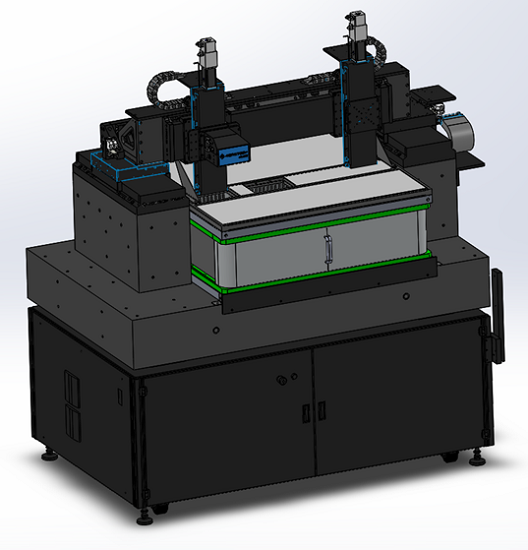
Additive Rapid Prototyping Instrument (ARPI)
According to Northwestern’s own collaborative research with Argonne National Laboratory, DED technology relies on heated powder particles, which are blown through nozzles at a high-powered laser’s focal point and melted. A motion control system moves the molten pool of metal to build up the layers of a structure. DED 3D printing is fairly versatile, as it can be used to not only print new parts but also to add on to an existing part by repairing or coating it, and it’s a good choice for hybrid manufacturing applications as well.
DED technology is becoming more popular, especially for things like parts maintenance, rapid prototyping, and structural parts, and has been used in a variety of industries, including oil & gas, maritime, medical, defense, automotive, architecture, and aerospace.
Sigma Labs is actively looking for more commercial DED machine OEM partners to expand its beta testing program, so contact the company if you’re interested.
(Source/Images: Sigma Labs unless otherwise noted)
Subscribe to Our Email Newsletter
Stay up-to-date on all the latest news from the 3D printing industry and receive information and offers from third party vendors.
Print Services
Upload your 3D Models and get them printed quickly and efficiently.













You May Also Like
PanOptimization Gets Attaboy from AFRL for PanX Software
Published in the International Journal of Advanced Manufacturing Technology, a paper titled “Part scale prediction of residual stress through thermomechanical modeling of additively manufactured Ti-6Al-4V” seems to point to the...
Zaha Hadid Architects Print 6M Model with WASP’s Robotic Arm Solutions
Zaha Hadid Architects (ZHA) have successfully used WASP 3D printers to make a 6-meter-tall model of an aircraft control tower. Zaha Hadid Architects’ Tech Lab made the tower in-house for the ZHAviation...
3D Printing News Briefs, July 1, 2026: Prosthetics, Drug Delivery, & More
We’re focused on healthcare and research in today’s 3D Printing News Briefs, including 3D printed prosthetics, patient-specific implants, drug delivery, and more. Read on for all the details! Students from...
3D Printing News Briefs, June 13, 2026: Management Changes, Project Calls, & Wheelchairs
We’ll kick this weekend’s 3D Printing News Briefs off with some advisory board and management changes, and then move on to project call news. We’ll end with some heartwarming stories...