Project Olympus: ICON Chosen by NASA to Develop Moon Base 3D Printing Tech

The hype around additive construction continues to grow. Unlike the days in which WinSun would “3D print” a six-story apartment building, we’re seeing numerous projects undertaken by a variety of firms around the world. All of this seems to demonstrate that, despite the hype, there is real technological value there. When that same value will be exhibited for the new space industry and 3D printing buildings on the moon remains unclear, but we can’t rule the possibilities out entirely.
The latest news combining the yet-to-be-fulfilled new space frontier with additive construction is called Project Olympus, a NASA-funded initiative aimed at developing a method for robotic building on the moon. Olympus is being driven by a firm that has been steadily making a name for itself in construction 3D printing: ICON. Adding to its $44 million raised from investors so far is the recent Small Business Innovation Research government contract from NASA to 3D print habitats on the moon using local materials and creating no waste.
With its partners, architecture firm BIG and new space startup SEArch+ (Space Exploration Architecture), ICON will be working with NASA’s Marshall Space Flight Center in Huntsville, Alabama, to explore additive construction of a simulant of moon soil. BIG partner Martin Voelkle suggested that the sustainability practices achieved in 3D printing on the moon with zero waste could be extrapolated to construction on Earth.
“We have explored various building forms ideal for containing atmospheric pressure and optimised for protection from cosmic and solar radiation,” Voelkle said. “The habitat will be designed with the inherent redundancy required for extraterrestrial buildings, while also using groundbreaking robotic construction that uses only in-situ resources with zero waste left behind.”
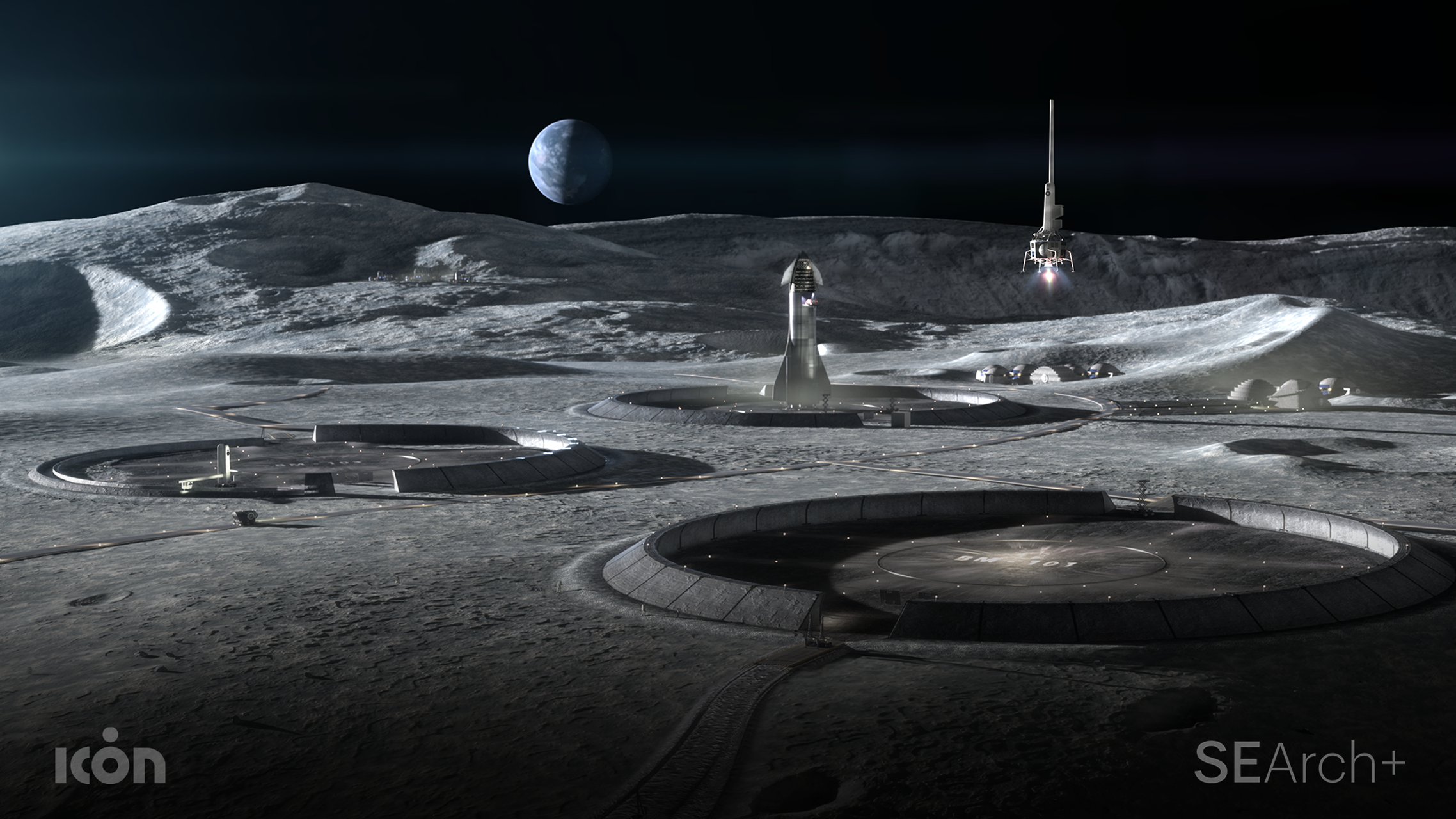
Image courtesy of ICON.
Numerous projects have been initiated to explore the possibilities of 3D printing habitats in space, including solar-powered sintering , with some endeavors stretching back to 2014. In this case, the business selected for the SBIR may be up to the task. ICON has achieved some remarkable feats, such 3D printing shelters for U.S. military vehicles and breaking ground on a 3D-printed community in Mexico. It has also built shelters for the homeless in Austin, TX.
Establishing space habitat is part of NASA’s larger Artemis project, which is not only directed toward landing astronauts on the moon by 2024, but also creating a long-term base there. Whether or not ICON’s will be the project to set the stage for a sustained human presence on the moon we can’t yet know.
Subscribe to Our Email Newsletter
Stay up-to-date on all the latest news from the 3D printing industry and receive information and offers from third party vendors.
Print Services
Upload your 3D Models and get them printed quickly and efficiently.













You May Also Like
3DPOD 316: Beehive’s Gordie Follin on 3D Printed Engines and More
Gordie Folin had deep experience in engineering at Pratt & Whitney, GE, and GE Aviation before becoming the Chief Product Officer at Beehive Industries. Among his achievements, he served as the...
3DPOD 315: Dirk Simon, from BASF to Farsoon to FKM, and now Square New Business
Dirk Simon had already spent years in the chemicals industry before joining and pioneering BASF‘s 3D printing effort. We get to hear how that firm looked at 3D printing and...
Printing Money Episode 42: Q2 2026 Public Markets 3D Printing Earnings Analysis with Troy Jensen, Cantor
Welcome to Printing Money Episode 42. Troy Jensen (Managing Director, Cantor) returns, joining Danny Piper (Managing Partner, NewCap) to review Q2 2026 publicly traded 3DP/AM company earnings reports. Troy’s quarterly...
3DPOD 314: Debinding, Sintering, and Metal Binder Jetting with Stefan Joens, Elnik Systems and DSH Technologies
Stefan Joens of Elnik Systems sells ovens. Their debind and sintering equipment powers a lot of high-volume binder jet and MIM production. We learn about Elnik and its origins. But...