Injection Printing Means 3D Printing Better Parts, Faster

One of the greatest benefits that 3D printing can offer in the fabrication of high-performance parts is speed. Users around the world continue to improve on this, reveling in both the ability to innovate like never before—as well as the rewards of cutting out the middlemen in manufacturing and tossing aside the reliance on traditional technology. This means that parts can be made exponentially faster. Conventional technology has not gone by the wayside whatsoever though and may be used with 3D printing or other hybrid technologies.
Companies like Denmark’s Addifab have been hailed for new methods like freeform injection molding (FIM), printing cavity inserts with resin, and then filling them with materials like PEEK, metal, and more. Meanwhile, other startups like Tennessee-based Collider have created the hybrid Orchid 3D printer for a similar process called Programmable Tooling. With digital light processing (DLP), they create molds that are then filled with material cartridges. Afterward, the shells and pipes are dissolved, leaving a clean, functional part behind.
Now, UMass Lowell researchers claim to have created a new 3D injection technology, detailed in “Injection printing: additive molding via shell material extrusion and filling.” With David Kazmer, a plastics engineering professor leading the project, the researchers set out to “mitigate the curse of dimensionality that plagues additive manufacturing” by using extrusion-based 3D printing with fine resolution to fill molds at high flow rates.
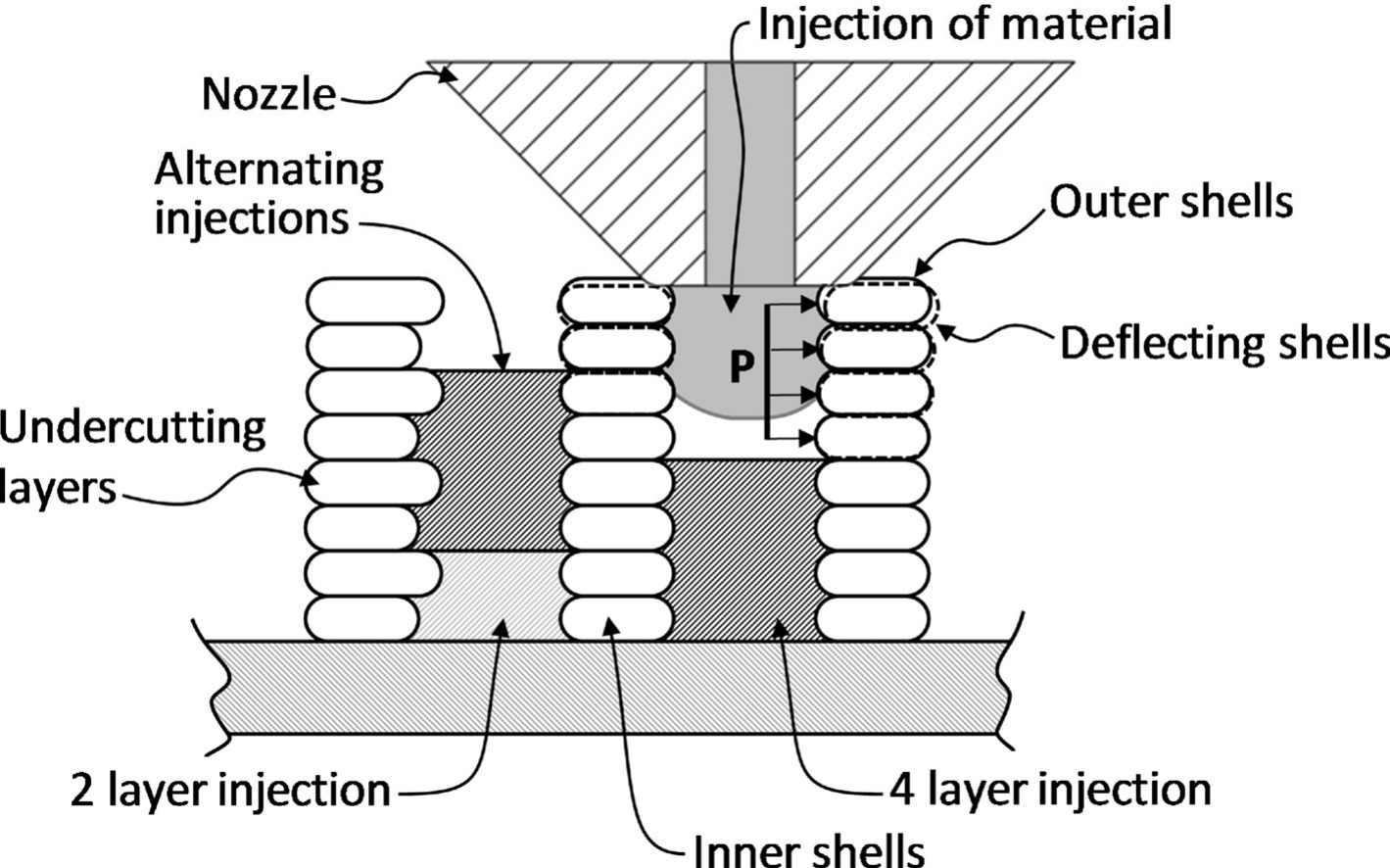
Ultimately, the goal is to fabricate more durable parts for applications like prosthetics and medical devices, as well as improving strength in parts for the aeronautics and automobile industry. The team has been working on the novel hybrid technology for 18 months, filling empty 3D printed molds with molten material. In comparison with conventional methods, they report an increase in speed that is three times faster.
“The invention greatly improves the quality of the parts produced, making them fully dense with few cracks or voids, so they are much stronger. For technical applications, this is game-changing,” said Kazmer in discussing the evaluation of research samples. “The new process is also cost-effective because it can be used in existing 3D printers, with only new software to program the machine needed.”
Samples were printed with ABS and evaluated in terms of tensile properties and impact resistance. Austin Colon, a UMass Lowell Ph.D. candidate in plastics engineering, teamed up with Kazmer for testing of the research specimens.
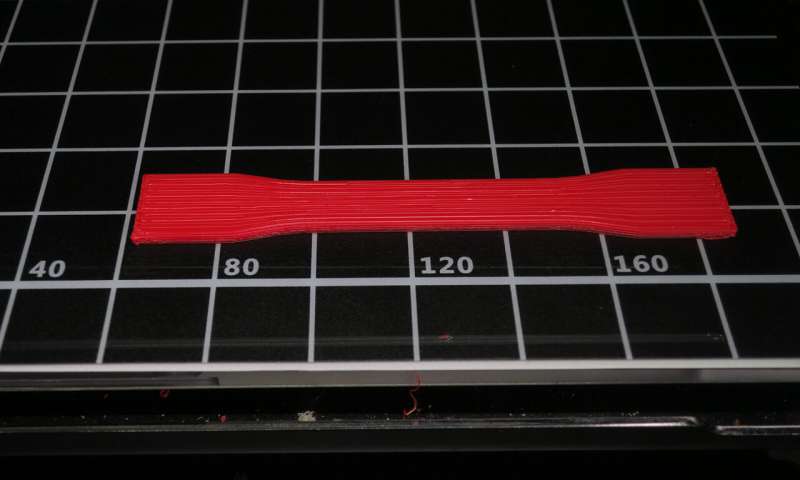
Tensile sample created for testing
There were considerable improvements as stiffness, strength, and strain were increased respectively by 21%, 47%, and 35%. Limitations due to the 3D printer itself, mainly in melting capacity, were noted; however, the researchers concluded that injection printing has proven to be applicable and accessible for refining the quality of parts and speed in production.
It appears that the researcher’s process is more similar to Collider’s technology, in that printing and injection molding occur within the same printing procedure. This is in contrast to AddiFab, which performs injection molding separately using conventional injection molding systems once the shell has been printed. However, both Collider and AddiFab rely on digital light processing (DLP) to produce their shells, while this research describes a fused filament fabrication (FFF) process.
On the one hand, this may mean the potential to convert existing FFF printers into injection printing machines. On the other, DLP is known for much higher resolution prints and faster printing overall. Regardless of the trade offs, all of these methods would substantially increase the material possibilities for polymer 3D printing given the vast portfolio of injection molding materials already on the market. These are plastics most manufacturers are already comfortable with and would be used in a mass production scenario, meaning that these injection printing technologies could be used to more accurately prototype end parts than is possible with existing printing materials.
The researchers have filed a patent on the technology. Find out more by downloading the research here.
[Source / Images: Phys.Org]Subscribe to Our Email Newsletter
Stay up-to-date on all the latest news from the 3D printing industry and receive information and offers from third party vendors.
Print Services
Upload your 3D Models and get them printed quickly and efficiently.











You May Also Like
3D Printing News Briefs, January 17, 2026: Titanium Scrap, Autopsy Analysis, & More
In this weekend’s 3D Printing News Briefs, we’ll start with government funding news from IperionX. Then, a German contract manufacturer has acquired its 6th and 7th Lithoz ceramic 3D printers....
3D Printing News Briefs, January 15, 2026: Project Call, Sports Medicine, Aluminum Alloy, & More
In today’s 3D Printing News Briefs, America Makes announced the winners of a $1.1 million Project Call, Austal USA named a new Vice President for Business Development and External Affairs,...
U.S. Navy Funds Senvol’s Machine Learning Software to Boost In-Situ Monitoring for 3D Printing
The additive manufacturing (AM) industry is well-positioned to benefit from increased incorporation of AI and machine learning (ML) into its core processes, and 2026 should provide plenty of opportunities for...
US Army Awards Contract to Phillips Federal for Containerized WAAM Factories
Everything that the U.S. Army has been doing with additive manufacturing (AM) over the last year or so suggests that the branch is getting serious about deployable production systems. One...