RIZE Announces RIZIUM Glass Fiber 3D Printing for Large Color Parts


This morning Massachusetts-based Rize, Inc. announced the release of its RIZIUM™ Glass Fiber (GF) composite. Founded in 2014 by CTO Eugene Giller (formerly of ZCorp), the 3D printer manufacturer also specializes in materials for applications like life sciences, communications, and branding. Now, the World Economic Forum (WEF) 2020 Technology Pioneer continues its commitment to color 3D printing with a new composite for large, full-color parts, offering the strength to support complex structures—while preventing issues like warping.
On a mission to redefine 3D printing, the company stated in a recent press release that they hope to continue to provide users with the ability to expand their work further with this new material. Sustainability for their users with next-generation technology has always been a focus for the Rize development team too, as they have developed proprietary materials over the years. RIZIUM Glass Fiber is compatible with all of their 3D printers (as well as printers from RIZIUM Alliance partners).
The new GF material was founded on Rize’s cyclic olefin-based matrix, offering the following features:
- Low emissions during production
- Extremely low moisture absorption
- High chemical resistance
- Strength, durability, and stability
RIZIUM GF has been “rigorously tested” and proven prior to its release, and is compatible with Rize Augmented Polymer Deposition (APD), combining inks with polymers to make new materials. Rize states that users will also be able to look forward to 3D printing “large build volumes” for many different applications.

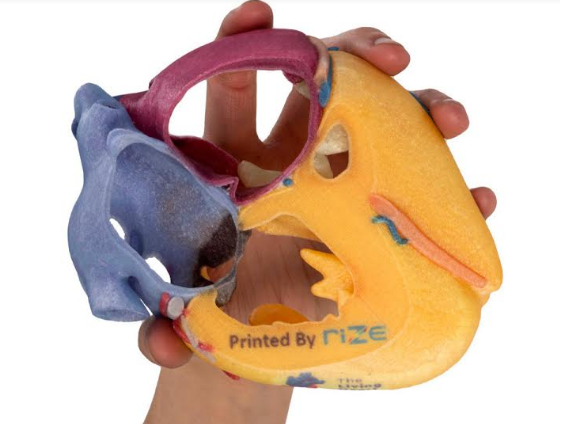
RIZE RIZIUM Glass Fiber tooling
“Until now full color 3D printing applications could only deliver weak approximations of the original, and users often avoided large parts or complex geometries because they could warp or crack,” said Andy Kalambi, CEO of Rize. “We’re delighted to help drive a renaissance in industrial manufacturing with better 3D printing materials and technology.
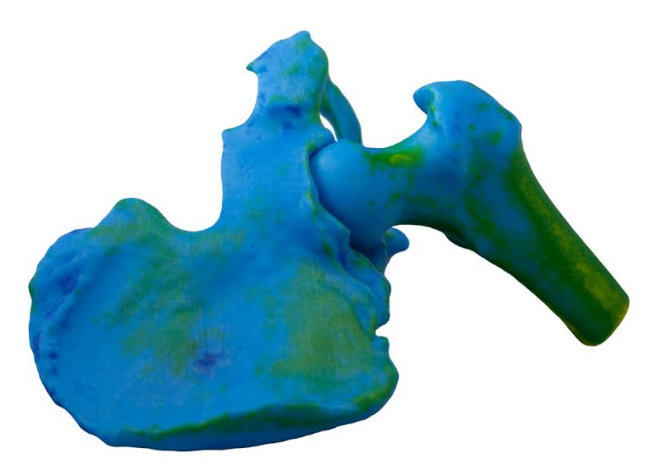
RIZE RIZIUM Glass Fiber hip assembly
This release also marks the fourth time that RIZE has received UL GREENGUARD Certification, based on the ANSI/CAN/UL 2904 Standard Method for Testing and Assessing Particle and Chemical Emissions from 3D Printers. Issues with emissions, toxicity, and safety are an ongoing concern in 3D printing and industrial AM processes, prompting research into the possibility of whether we are unknowingly poisoning ourselves, causing health hazards, as well as seeking out new solutions for users printing at home.
With the UL GREENGUARD Certification, the new materials are verified as safe for use in enclosed spaces, to include areas like schools, hospitals, and offices.
“We like the print reliability that RIZIUM Glass Fiber delivers to the Rize product line. Azoth can be confident in the quality and strength of RIZIUM GF parts. Being able to transform 3D rendered models into accurate full color parts is something our customers love,” said Ronnie Sherrer, application engineer at Azoth, an Ann Arbor based provider of technology and additive manufacturing to large manufacturers.
Other customers include NASA, PSMI, Wichita State University, the U.S. Army and Festo. Rize has also continued to evolve in the manufacturing of new hardware over the past few years from the introduction of their initial RIZE One industrial desktop 3D printer to the XRIZE 3D printer, and the adaptive desktop RIZE 2XC 3D printer.
[Source / Images: Rize, Inc.]
Subscribe to Our Email Newsletter
Stay up-to-date on all the latest news from the 3D printing industry and receive information and offers from third party vendors.
Print Services
Upload your 3D Models and get them printed quickly and efficiently.












You May Also Like
Beyond Thermoplastics: Why JuggerBot Is Betting on Hybrid AM
For years, thermoplastics have been the workhorse of additive manufacturing (AM). They are pretty easy to process, available, and compatible with many of today’s industrial 3D printers. From prototypes to...
RIC Robotics Collaborates with K4k Construction on 3D Printed ADU in Sacramento
In 2024, RIC Robotics, the additive construction (AC) firm based in Denver, completed the build of an accessory dwelling unit (ADU) in Walnut, California, which was apparently an industry first....
Printing Money Episode 40: 3DP/AM Deal Analysis and More with Matthias Schmidt-Lehr, AMPOWER
Welcome to Printing Money Episode 40. Matthias Schmidt-Lehr (AMPOWER, Executive Partner) joins Danny for this episode and we are very thankful to have him back. In Episode 40, Danny and...
Additive Manufacturing at a Crossroads
Additive manufacturing is at a crossroads. Simultaneously, we find ourselves between certain very different modalities, applications, and industries. Rather than being able to explore them all, companies will now have...