ExOne’s 3D Sand Printing Network Expands Accessibility in North America


ExOne is a pioneer in sand 3D printing, licensed since 1996 to continue developing industrial inkjet 3D printing originally created by engineers at Massachusetts Institute of Technology (MIT) for use with a variety of materials, to include sand and ceramic. Over decades, the North Huntingdon, Pennsylvania-headquartered company has evolved into one of the undisputed leaders in binder jet 3D printing technology.
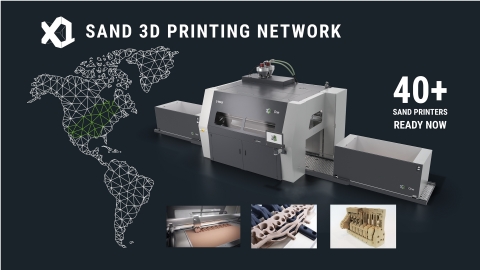
With the inception of its 3D Sand Printing Network, ExOne is solidifying its position further, along with providing greater accessibility for its customers in North America. With 40 binder jet 3D printers owned mainly by pattern shops and foundries within the US, Canada, and Mexico, S-Max and S-Print systems are available for efficient production of molds and cores (usually finished within three to five days).
Sand 3D printing—and especially on the large scale—serves as a powerful and versatile industrial tool for critical applications like automotive, aerospace, and agriculture. Particles of sand are bound together by glue, resulting in a fabricated structure—whether it is a prototype, functional part, or a mold meant for creating other items. Cores can be created in one piece, saving time, money, and eliminating the need for assembly later, as well as clean-up.
This type of technology may not be as visible in the additive manufacturing mainstream, but behind the scenes, for many companies, it is the key to the production of metal casted molds and cores which are then used to make other parts. Industrial users have the ability to create new designs not otherwise possible, along with producing quality, high-performing molds that can also be created on-demand—eliminating the necessity for storage.
“The new ExOne Sand 3D Printing network can help manufacturers easily locate an ExOne sand 3D printer that best meets their needs,” said John Hartner, ExOne CEO. “What’s more, our network can help ensure a steady supply of sand molds and cores for metal castings, especially during a crisis, as well as enable reshoring of key parts that may be difficult to ship during the ongoing COVID-19 pandemic.”
Sand 3D printers continue to expand services for companies still mainly engaged in conventional methods like CNC machining, and the technology continues to be the source of research focused on investigating the benefits, as well as improving metal molds.
[Source / Images: Business Wire]Subscribe to Our Email Newsletter
Stay up-to-date on all the latest news from the 3D printing industry and receive information and offers from third party vendors.
Print Services
Upload your 3D Models and get them printed quickly and efficiently.













You May Also Like
TCT Shenzhen 2026 Preview: What 80+ Side Events Reveal About China’s AM Market
Exhibitor lists tell you who is investing in floor space. Conference programs can tell you something different: what the market is ready to talk about. That makes TCT Shenzhen 2026...
The 3D Printing Opportunity in UGVs
In 2024, IperionX partnered with fastener firm Vegas Fasteners to jointly make fasteners for the US Army Ground Vehicle Systems Center (GVSC). That DEVCOM component has been hit by funding...
What 3D2GO Says About 3D Printing’s Growth in Southeast Asia
The Philippines offers an interesting case study in how 3D printing can develop in Southeast Asia, and Manila-based 3D2GO helps illustrate it. 3D printing in Southeast Asia doesn’t have to...
$51 Million Revenue VMP Wants to Become a Leading Additive Manufacturing Metal Powder Producer
Chinese powder producers have traditionally had little impact on the additive manufacturing market. Typically, they offer low-cost powders without much in the way of settings or application support. But China’s...