Image-Guided Surgery Solutions from Philips Feature 3D Printing and AR

At the first online meeting of the Foundation Institute of Development and Integration of Health (IDIS) Innovation Committee in Spain, Phillips presented its latest solutions in terms of image-guided surgery, including 3D printing, and new technologies for use in hybrid operating rooms, including Augmented Reality (AR), image fusion, and ubiquitous monitoring.

First online innovation committee meeting. Image courtesy of IDIS
IDIS is an organization that represents and promotes the role and contribution of private healthcare in Spain. Recently, the organization has been reporting on the contribution private healthcare providers and start-ups have made in face of the pandemic.
In this presentation, the range of benefits of 3D printing technology in producing emergency supplies (face shields) as well as custom tools (fans or grippers to reduce or minimize surface contact in hospitals, surgical wards, operating rooms and more) were explained by Dr. Antonio Luna (Medical Director of HealthTime). He also explained the benefits of such technologies in more complex processes, such as pre-surgical planning, and minimally invasive surgery in critical operations in neurosurgery or chest procedures.
“It can be of great help in surgical planning, for the inclusion or exclusion of patients, the reduction of intervention and hospitalization times, and the reduction of mortality and intra-operative complications, among other advantages,” Dr. Luna said.
In addition, the role of 3D technologies and tools in enabling minimally invasive access and intervention was explained by Juan Romero, Head of Image-guided surgery at Philips.
“The future of image-guided surgery goes through more precise diagnoses (through artificial intelligence, quantification tools and multi-modal diagnosis), excellence in surgical results (with a cone beam computed tomography to verify results and improve localization or with 3D modeling),” Romero said. “The future is also moving towards a transition to minimally invasive therapies with real-time image fusion to facilitate navigation and guidance or the use of augmented reality for hybrid procedures. ”

Image courtesy of Philips.
A pioneer in hybrid operating room technology and solutions, Phillips has developed its augmented reality surgical navigation technology, to support and improve operations in image-guided open or minimally invasive spine surgery. Since 2017, the company has installed over 750 hybrid operating rooms, and its AR image-guided solutions have been used to treat over half a million patients in over 80 countries.
In 2019, Philips partnered with Microsoft, combining the latter company’s HoloLens2 holographic computing platform with its Azurion image-guided therapy platform to showcase novel AR applications for operating rooms of the future. With its image-guided hybrid operating room solutions, Philips has helped accelerate the shift from open surgery to image-guided surgery, drastically improving outcomes and reducing costs, as well reducing the time to discharge a patient.
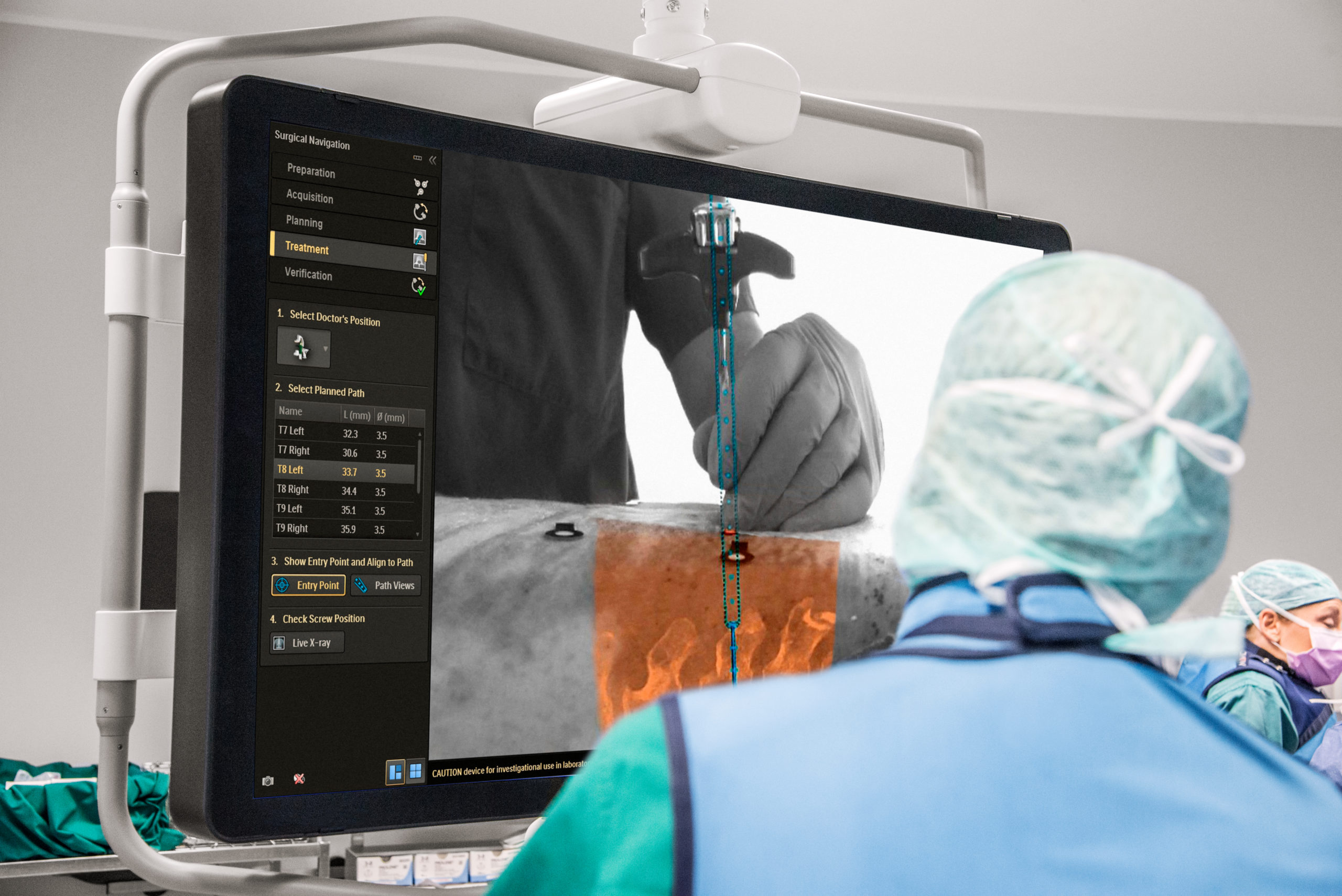
Image courtesy of Philips.
In March this year, Spain granted approval for the production of the first medical 3D printed ventilator for use in hospitals and health institutions, through a public-private project between Consorci de la Zona France de Barcelona (CZFB), Leitat, HP, Consorci Sanitari de Terrasa and the Parc Tauli Hospital (Sabadell). Researchers in Spain have also been advancing the application of 3D printing in heart surgery, for accurate surgical models and simulation, to reduce the risk of complications by 30-40%.
HP has also played a significant role of advancing the role of 3D printing in healthcare and medical applications, especially during the pandemic, in developing and scaling production of medical equipment such as door handles, breathing filters, ventilators and valves, face shields and respiratory circuits. As part of the 3DCovid19.tech initiative, local platforms were launched connecting hospitals with 3D technology solution providers in Spain – including companies such as HP, Prodpro Industrial, BCN3D, Natural machines, 3DZ, Inside Food Consulting, Origenal Story, Mornings 4, Fluidra, Nexeo Plastics, Sicnova, AsorCAD, Xtelet, Novameat, Makeat, Emes3D, Imes3D, Ames, Intech3D, Mastertec, FICK Company, BASF, FITX, Jano Factory, among others.
Companies such as BRECA and Regemat3D in Spain, are pioneering the use 3D printing for customized implants and the use of bioprinting for specific clinical applications respectively. BRECA, one of the top 10 bioprinting companies in the world, introduced the first bioprinter in Spain and is the only company in the country to design and manufacture them on-site. With such innovation in research and clinical applications, from the private sector and public-private collaborations, Spain’s healthcare system (ranked as the third best healthcare system in the world, and the best in Europe) is leading the way in advanced 3D technology solutions for healthcare, with a focus on innovation to not only improve quality of life and treatment outcomes for patients, but also to reduce delays and costs for the Spanish health system.
Subscribe to Our Email Newsletter
Stay up-to-date on all the latest news from the 3D printing industry and receive information and offers from third party vendors.
Print Services
Upload your 3D Models and get them printed quickly and efficiently.











You May Also Like
3D Printing News Briefs, March 28, 2026: TCT Asia, Distribution Agreement, FDA Clearance
We’re starting 3D Printing News Briefs this weekend with some news out of TCT Asia, and then moving on to a metal AM distribution agreement between MULTISTATION and WAAM3D. We’ll...
The Magic of AMUG as Reported by a First-Time Attendee
There’s a special kind of magic about AMUG. I’ve heard about it for years, but never experienced it myself until last week. It’s different than what you see at some...
3D Printing News Briefs, March 26, 2026: AMUK, IP Dispute, Asbestos, & More
We’re kicking off today’s 3D Printing News Briefs with an America Makes Project Call, and then moving on to additive manufacturing in the UK. Then we’ve got some legal news...
At TCT Asia 2026, China’s AM Industry Looked Ready for Scale: Part 1
Walk into TCT Asia 2026, and the first impression is density. More than 55,000 square meters across Halls 7.1 and 8.1 at Shanghai’s National Exhibition and Convention Center, over 550...