Essentium and Hephzibah Partner to Increase 3D Printing Adoption in Korea


Even though South Korea announced a plan in 2014 designed to make the country a leader in the 3D printing industry, widespread adoption of industrial-scale additive manufacturing is still slow-going there, though research initiatives are much stronger. But a new collaboration between industrial 3D printer and materials OEM Essentium and South Korean 3D printing specialist Hephzibah could help speed up the process.
Essentium recently announced a distribution partnership with the industrial 3D printer business, which has been distributing additive manufacturing solutions since 2012 and has built up a strong industrial network in South Korea. Most manufacturing firms in the country know that they could potentially save a lot of money in production costs by adopting large-scale industrial 3D printing, but there are a lot of barriers to doing so, including economics, part strength, and production speed and scale.
By combining Hephzibah’s customer support skills, excellent service, wide network, and expertise with specific AM use-cases with its own industrial High Speed Extrusion (HSE) 3D printing platform, the Pflugerville, Texas-based startup believes that the two will be able to help South Korean manufacturing firms get past these widespread adoption issues.
“The speed, scale, and economics of the Essentium HSE 3D Printing Platform present huge efficiencies and improved time-to- market opportunities for our customers,” Joseph M.G. Lee, the President and CEO of Hephzibah said in a press release. “The fact that Essentium is an open platform means that our customers will benefit from greater innovation agility.”
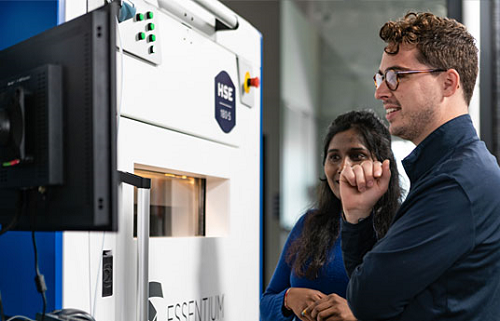
Thanks to this new distribution partnership, Hephzibah will now offer its customers a complete range of Essentium’s materials, as well as the full Essentium HSE 180•S Series of 3D printers, which the company says are able to fabricate end-use parts with five times more accuracy, and 5-15 times more speed, than other FFF 3D printing systems. The series features low, standard, and high-temperature printer models, and would be a good choice of machine to use for applications in the automotive, consumer goods, and electronic manufacturing services industries.
By taking advantage of what the Essentium 3D printers can offer, in addition to the company’s planning, installation, support services, and training center, the company states that Hephzibah’s customers can invest in adding additive manufacturing to their shop floors without a high economic risk.

Hephzibah Team with Essentium HSE 3D printer
“The South Korea manufacturing industry – from automotive to consumer electronics and, more recently, aerospace – has a best-in-world reputation for quality and innovation,” stated Essentium’s CEO and Co-Founder Blake Teipel, PhD. “The integration of industrial-scale AM onto the factory floors of this manufacturing powerhouse has hugely exciting potential. I have no doubt that the combination of the Essentium 3D Printing Platform with Hephzibah’s rich customer knowledge and service infrastructure will ensure AM makes its mark in South Korea.”
(Images courtesy of Essentium)
Subscribe to Our Email Newsletter
Stay up-to-date on all the latest news from the 3D printing industry and receive information and offers from third party vendors.
Print Services
Upload your 3D Models and get them printed quickly and efficiently.












You May Also Like
3D Printing News Briefs, June 18, 2026: Reseller, Relocation, Metal Space Powder, & More
We’ll start with business news in today’s 3D Printing News Briefs, as XJet appointed a value-added reseller in Germany, BIO INX is expanding its presence in the Italian market, and...
Scientists Use BMF to 3D Print Seal Whiskers That Track Prey Long After It’s Gone
Seals use their whiskers to hunt. Not Navy Seals, although they may in some way also, but this article is about lowercase seals. Not Seal the musician either; as far...
Researchers Combine AI and Bioprinting to Create Tiny Blood Vessel Networks
If 2026 has a theme in bioprinting, it may be blood vessels. Researchers can already print incredibly sophisticated tissues. The harder part is keeping those tissues alive. Without a network...
University of Arkansas Researchers Test Metal 3D Printing in a Mars-Like Atmosphere
If humans eventually establish a long-term presence on Mars, they will face a major manufacturing challenge almost immediately. Tools will break. Parts will wear out. Equipment will need repairs. But...