German Researchers Develop 3D Printed Hand Prosthetics Controlled by Augmented Reality Glasses

In the recently published ‘Non-contact visual control of personalized hand prostheses/exoskeletons by tracking using augmented reality glasses,’ German researchers Simon Hazubski, Harald Hoppe, and Andreas Otte (all from Offenburg University) develop a unique system for activating motorized hand prostheses with easy commands.
 Created to assist amputees, the 3D printed flexible hands are integrated with motorized exoskeletons. The only interface the patient must use is through augmented reality (AR) in the form of optical see-through glasses (OSTG), outfitted with a front camera. Markers attached to the prosthetic are either infrared LEDs or ‘glued points.’ As the markers are recognized, the coordinate systems of each device connect, due to special algorithm.
“The hand prosthesis may be any active motorized hand prosthesis or robotic arm,” stated the authors.
The design allows for direction of view to be held between the AR glasses and the prosthesis—and not the eyes, as one might naturally expect. The prosthesis also works from a control panel either superimposed on the AR glasses all the time or only as needed, depending on viewing direction.
“In the simplest case, the control panel could contain virtual ‘push buttons’ that trigger when the viewer’s gaze persists for more than one second, for example,” stated the researchers. “In addition, the user could also execute commands in the form of defined minimal movements of the viewing direction.”
Commands for this developing concept could result in the following movements: hand closing completely, movement in the opposite direction, hand opening completely, hand opening and closing halfway, and movement of the thumb. Depending on their preferences regarding functionality of the prosthetic, users can customize commands; in fact, they may be able to expand actions such as having the device cut off when triggered by specific contact and pressure.
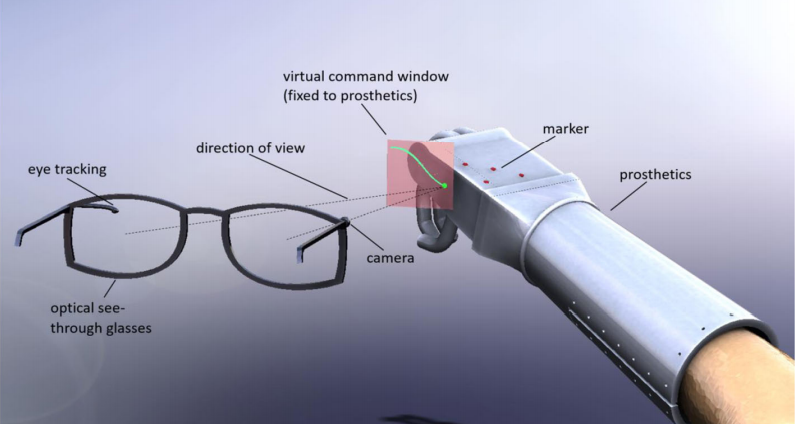
This prosthetic concept will also allow for the option of a camera set up for eye gaze tracking, resulting in better accuracy of commands from the control panel.
“Solely using AR glasses–without any other complex signal detection by EMG, EOG or EEG–to control the prosthesis or robot hand is new and may simplify usability of prosthetic devices for the patient in the near future,” concluded the researchers.
“Another step towards personalizing hand prostheses in amputees could be to use an easy-to-handle and inexpensive standard motorized exoskeleton instead of a sophisticated motorized hand prosthesis and to replace the missing hand with a LASER scan of the healthy hand (if available) or a volunteer’s hand. If a healthy hand can be scanned, the data could be mirrored to the other side of the person to replace the missing hand and 3D printed using flexible and lightweight polymer material. This personalized hand replacement could then be equipped with the exoskeleton in the same way as e.g. a tetraplegic’s hand.”
3D printing has made enormous impacts in the world of prosthetics, around the world, and especially with organizations like e-NABLE, schools and classrooms creating and distributing prosthetics, and even dogs being fitted for replacement limbs. What do you think of this news? Let us know your thoughts! Join the discussion of this and other 3D printing topics at 3DPrintBoard.com.
[Source / Images: ‘Non-contact visual control of personalized hand prostheses/exoskeletons by tracking using augmented reality glasses’]Subscribe to Our Email Newsletter
Stay up-to-date on all the latest news from the 3D printing industry and receive information and offers from third party vendors.
Print Services
Upload your 3D Models and get them printed quickly and efficiently.













You May Also Like
Oerlikon Adds ATLIX’s xBUILD 5000, Plans More for 2027
Oerlikon has installed a new ATLIX xBUILD 5000 metal 3D printer at its facility in Huntersville, North Carolina, marking the first production deployment of the system worldwide. The machine will...
The Manufacturing Race Behind the Drone Revolution
We are in the middle of a major manufacturing shift focused on the production speed and payload capacity of uncrewed aerial systems (UAS), or drones. A recent Manufacturing Dive article...
Stratasys vs. Bambu Lab: Why Europe and the U.S. Reached Different Results, Part II
Editor’s note: This is Part 2 of a two-part series by Xu Fanglei examining the technology and patent issues behind the Stratasys-Bambu Lab dispute. Part 1 looked at the $27.6...
3D Printing News Briefs, October 1, 2026: Defense, Enclosures, & More
In today’s 3D Printing News Briefs, we’re starting with defense news, first from Massivit and then from AML3D. Then we’ll move on to U.S. manufacturing of a new large-format LPBF...