3D Maps Created by IDeA Center Use Multi-Sensory Installations to Delight and Direct Everyone

 Baby, we’ve come a long way, for sure, but what about when we reach our destination? It helps me enormously to have ‘all systems go’ when I’m on the move and using my GPS, but often then it seems like a what now? scenario when approaching a venue that’s foreign and looming large. Imagine trying to navigate these daily scenarios with a visual (or other) impairment.
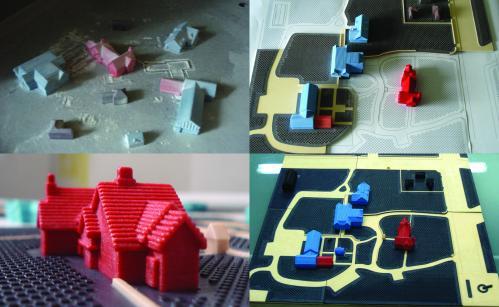
You may no longer be on your own when you hit the curb though, thanks to developers at the Center for Inclusive Design and Environmental Access (IDeA Center) at the University of Buffalo, who have used 3D printing to create tactile models for specific locations such as Perkins School for the Blind in Massachusetts, which uses conductive paint on 3D printed miniature buildings to sense pressure from a visitor’s fingers. These designs are a specialty of the IDeA Center, which is part of UB’s School of Architecture and Planning.
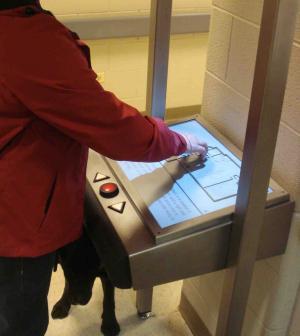 In partnership with Touch Graphics, Inc., their prototype maps featuring 3D printed miniatures of structures and offices are meant to be a help to everyone, no matter what the disability or directional issue may be. The maps aren’t just utilitarian vehicles for getting from one spot to another, they are also startlingly creative, featuring delightful and high-tech details that occur upon touch like:
- Fountains that gurgle
- Chiming bell towers
- Spotlights that shine on buildings
“It’s really about giving this audience, this population, a way to understand their environment,” says IDeA Center researcher Heamchand Subryan, who led the project with IDeA Center Director Edward Steinfeld, ArchD, and Touch Graphics President Steve Landau. “We’re providing a level of information that allows them to navigate their environment easily, without help, which gives them a sense of independence.”
It’s a basic need to have a good feel for where we are going, and to be able to do it as independently as possible.
“The touch-responsive models solve the ‘last mile’ problem for blind pedestrians, who can often navigate to a building or campus address using GPS, but then need help to get to the classroom building or doctor’s office where they need to be,” Landau says.
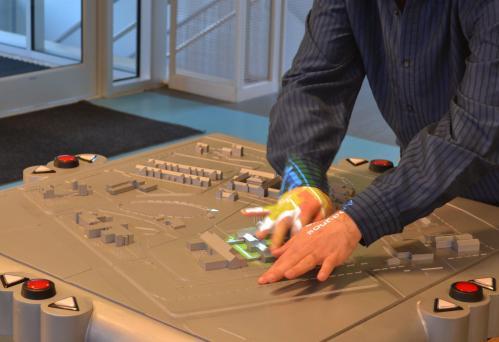 They might be thinking outside of the box but the developers of these innovative models are also setting the world right, featuring a horizontal dynamic, rather than the traditional vertical map which hangs on a wall or is encased in a plastic kiosk at the mall. The horizontal alignment allows the user to consider what they are doing more realistically, spatially.
There are also prototypes in Massachusetts at The Carroll Center for the Blind and The Technology Center. A prototype is in place at the Chicago Lighthouse for the Blind, where the model shows a two-story building’s floor plan. Plans to install a model are also in place for the Philadelphia-based Overbrook School for the Blind. All three projects employ universal design, which aims to produce buildings, spaces, and products accessible to all people instead of individual segments of the population.
I don’t know about you, but there have been a number of times when someone has asked me where I was and I had to consult my phone first, in all my directional impairment. We all need help in knowing how to get around foreign buildings and venues and most of us like to do that with a sense of independence.
When one sense is impaired, the others become magnified. So it also makes ‘sense’ that in creating tools for the visually impaired, we should appeal to both touch and sound, and inspire at the same time, whenever possible. With so any bright minds out there using innovative technology to make everything under the sun, the world of mapping and logistics should be brightly lit for everyone — and that’s what these scientists endeavor to provide.
Have you seen any of these 3D maps? Tell us about it in the 3D Maps by IDeA forum at 3DPB.com.
Subscribe to Our Email Newsletter
Stay up-to-date on all the latest news from the 3D printing industry and receive information and offers from third party vendors.
Print Services
Upload your 3D Models and get them printed quickly and efficiently.











You May Also Like
Cobra’s 3D Printed Golf Clubs Reveal What the Technology Can Do for Sports
When 3DPrint.com attended the PGA Show in Orlando this January, one booth stood out for a reason that had nothing to do with marketing hype or big-name tour pros —...
TCT Asia 2026: Empowering Asia · Connecting the World
TCT Asia, now in its 12th year, is more than just a 3D printing exhibition — it embodies its original concept: Time Compression Technology, a vision of making the entire...
3D Printing News Briefs, February 28, 2026: Sales Partner, Holographic 3D Printing, & More
We’re kicking off today’s 3D Printing News Briefs with some business news, as Meltio has announced a sales partner in the U.S. and Immensa has joined Shell’s Energy Transition Campus....
From “Magic” to Metal: How Intrepid Automation Wants to Make 3D Printing Matter at Scale
Ben Wynne still talks about 3D printing the way people do when they’ve felt that “wow” moment up close. Back in the early 2000s, he was working at HP’s advanced...