Korean Researchers 3D Print Korean Head Forms for Respiratory Protection Against Pollution

In ‘Development of Korean Head forms for Respirator Performance Testing,’ authors Hyekyung Seo, Jennifer Ivy Kim, and Hyunwook Kim from The Catholic University of Korea have created a unique and health-conscious 3D printing project—acting in the interest of the entire public—in the form of protective respiratory equipment. Head forms for this equipment is very standardized. So far they were also made with only Caucasians in mind. Now Korean researchers have used 3D printing to make head forms that fit Koreans better.
Pollution and other major environmental issues plague humans around the world; however, in South Korea, air pollution is ‘a grave social issue,’ as their levels of ‘particulate matter’ are at the highest listed among the Organization for Economic Cooperation and Development (OECD) nations.
The average particulate matter level in South Korea is 27.0 μg/m3. In most OECD countries, it is around 13.9 μg/m3, and the WHO guideline is listed as 10 μg/m3. While industry plays a large part in dispersing the pollutants that are poisoning the air, it is also caused in South Korea by China’s industrial endeavors, sand dust from both China and Mongolia, and more.
“Accordingly, the Ministry of Environment has established air quality standards considering particulate matters (PM 2.5, 35 μg/m3 over 24 h, 15 μg/m3 on an annual basis), which have been in effect since 2018,” explain the researchers. “Furthermore, the Ministry has imposed stricter regulations to control PM, by issuing alerts in cases when the PM concentrations exceeded the standard and has recommended that the general population should wear respirators when necessary.”
Previously, respiratory protective devices (RPDs) have been used by industrial workers; now, however, RPDs need a customized design for all shapes and ages—based on a form that is aligned with the structure and characteristics of the typical South Korean visage. Over time, other head forms have been used in testing, but templates were originally meant for North Americans and Europeans. For this study, facial dimensions were attained via a survey of Koreans from the Korean Agency for Technology and Standards, Size Korea. 2010–2013.
“Data of 4,583 participants (50.8% men, 49.2% women) were collected from 2010 to 2013. These participants were categorized according to their age as follows: 1,233 participants aged 7–13 years, 1,292 aged 14–19 years, 830 aged 20–39 years, and 1,228 aged 40–69 years,” explained the researchers.
Before classifying the facial dimensions to produce standard head forms, face width and length were analyzed to identify gender and age differences. The researchers also considered that the men have slightly longer and wider faces, along with other differences according to age.
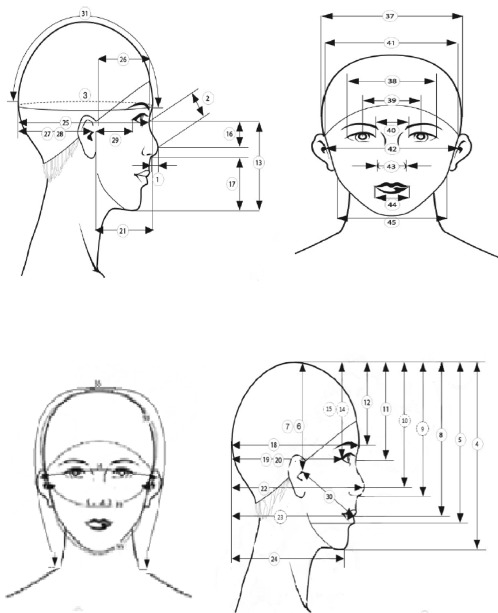
Measured facial dimensions (source: Size Korea).
Ultimately, three head forms were designed using Design X software, and printed on a Fortus 450mc.
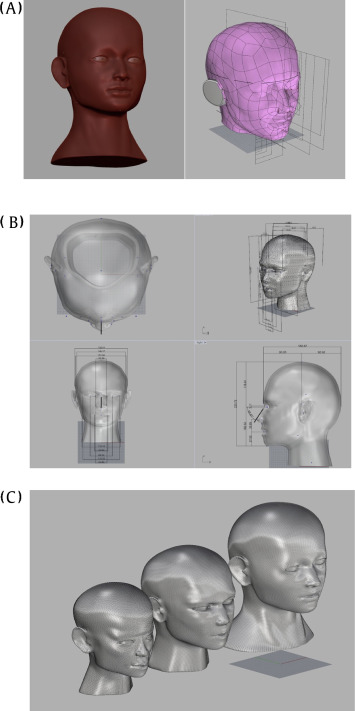
Manikin head form design. (A) stl-format file of the dummy head. (B) Completed design of manikin head forms. (C) 3D printed three head forms of small, medium, and large sizes.

Head form connected with a breathing machine. (A) A trachea tube was mounted at the front of the mouth. (B) Three completed types of head forms ready for respirator performance testing.
Once printed, the researchers sanded the forms in post-processing, ensuring a smooth finish which was then covered with a urethane rubber mimicking human skin. The forms were connected to breathing machines by tracheal tubes entering through the back of the ‘neck.’ Small, medium, and large faces were used in the design process.
“Here, we demonstrated differences in facial size between countries and ethnicities, along with differences of the same between adults and children,” concluded the researchers. “Considering this, it is evident that there is a need for head forms that account for the facial sizes of those wearing respirators. Therefore, performance testing standards for the respirators worn by Koreans must be improved.”
“According to a report by the National Institute of Environmental Research, respiratory systems of children were more vulnerable to the harmful effects of yellow dust and PM, and respirators are worn by a large population to protect their, including children and the elderly,” stated by the researchers. “Therefore, the present study is highly significant because it proposes head forms for respirator performance tests associated with the facial dimensions of Korean citizens.”
What do you think of this news? Let us know your thoughts; join the discussion of this and other 3D printing topics at 3DPrintBoard.com.
[Source / Images: ‘Development of Korean Head forms for Respirator Performance Testing’]Subscribe to Our Email Newsletter
Stay up-to-date on all the latest news from the 3D printing industry and receive information and offers from third party vendors.
Print Services
Upload your 3D Models and get them printed quickly and efficiently.











You May Also Like
From Material Maturity to Fleet Execution: What Comes Next for Additive Manufacturing in the U.S. Navy
Additive manufacturing is steadily moving from experimental use toward routine application in U.S. Navy shipbuilding, sustainment, and much more. In recent years, the Navy, working through its Maritime Industrial Base...
Industrial Additive Manufacturing Reaches Its Most Important Inflection Point
Additive manufacturing is entering the most consequential period in its evolution. After years of experimentation and uneven adoption, the industry is showing renewed momentum, shaped by supply-chain pressures, and a...
Scaling Beyond 10 Printers: When Support Becomes a Bottleneck
The leap to industrial-scale 3D printing is a support problem, not a hardware problem. A 3D print farm is a centralized facility that uses a large number of 3D printers...
Reshoring Requires Rules of Engagement
Reshoring manufacturing in the U.S. is a stated national priority. Policymakers, industry leaders, and defense planners agree that domestic production capacity is essential for economic resilience, national security, and long-term...