Why Anodizing Machined Parts is Important for Electronics Manufacturers


The practice of anodizing — a form of electrolytic passivation that thickens the oxidized outer layer of a metal part — has existed for around a hundred years. Most widely used on aluminum, anodizing can also be applied to metals like magnesium, titanium and zinc, providing those materials with a hardened, corrosion-resistant coating.
Anodizing produces a number of positive effects and is therefore used for a variety of applications. However, it can be particularly useful in the electronics industry, where CNC machined aluminum parts are required to be long-lasting, aesthetically pleasing and safe for consumer use. You can see anodized aluminum on products by Apple and other market leaders.
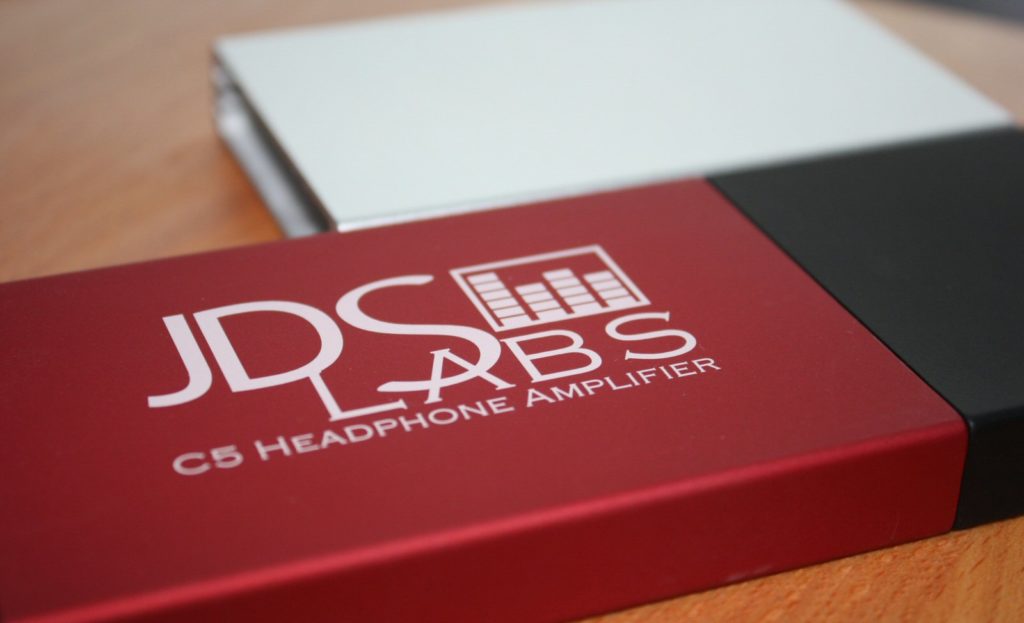
3ERP, an expert in on-demand manufacturing and surface finishing, here explains how the combination of CNC machining and anodizing produces desirable electronic components ready for the mass market.
How does anodizing work?
Anodizing is so named because, during the anodizing process, the metal part (usually aluminum) is made into the anode — a positively charged electrode — in an electrolytic cell. This means the metal part is submerged in an electrolyte (an acidic solution) at a controlled temperature, while a direct current is passed between the anodic metal part, the electrolyte and a cathode (the negatively charged electrode).
The electric current breaks down the water in the solution, and the oxygen from the water is deposited onto the submerged metal part, combining with the aluminum (or other metal) to build up an oxide film on the outer layer of the metal. When this film reaches the desired thickness, the metal part is removed from the solution and rinsed.
When the metal part is removed from the electrolyte, the oxide film is very porous. This porousness can be exploited in several ways, but the film can also be sealed — making it non-porous — by treating it with boiling water or a chemical substance.
Why anodize electronic parts?
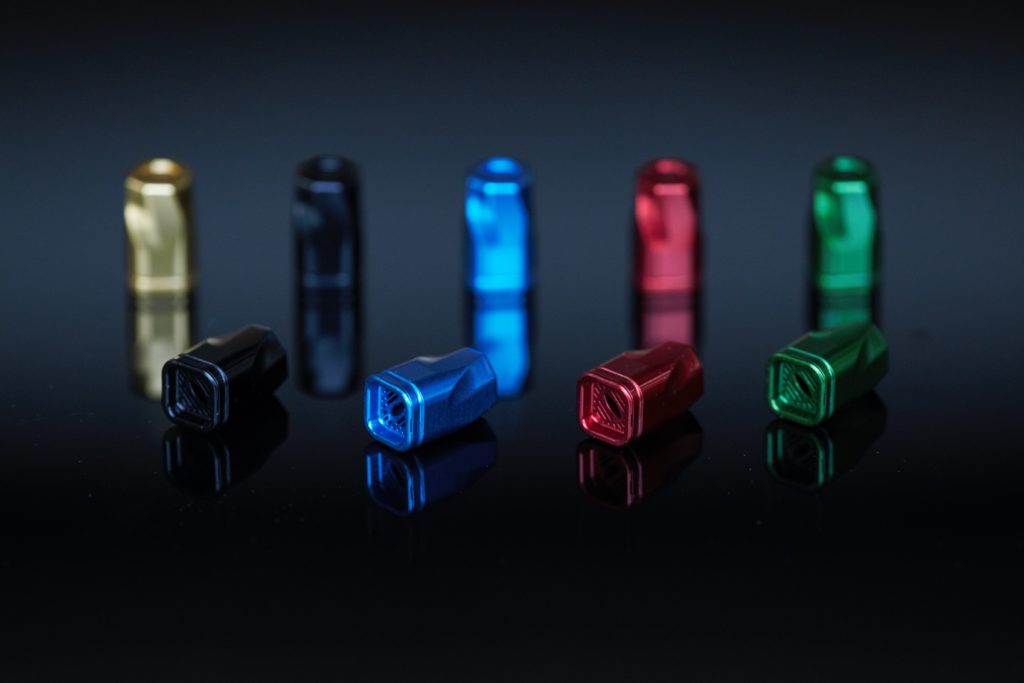
Colored consumer electronics
One of the most important benefits of anodizing is its usefulness for adding color. As mentioned in the previous section, the layer of oxide film on an anodized part is very porous, and this porousness can be used to great advantage by manufacturers of consumer electronics.
Since the porous oxidized surface can be penetrated by liquids, it is possible to introduce dyes that will penetrate the surface of the part and spread throughout the entire thickness of the oxidized layer — usually around 25 microns.
Coloring an aluminum part in this way can be preferable to simply painting a part, since the embedded dyes will not chip or flake off the surface of the part. For high-end consumer electronics parts, this aesthetic superiority can be highly valuable, leading to an attractive product with a durable outer layer.
Resistance to corrosion
Another significant benefit of anodizing is its ability to increase corrosion resistance in aluminum parts. When those aluminum parts are being used to house delicate electronic components, it’s easy to see why corrosion resistance would be a desirable quality in the eyes of electronics manufacturers.
Although not all electronics are used in corrosive environments, anodizing results in a more corrosion-resistant surface than normal aluminum. Type III anodizing — one of the more common forms of the process — creates the greatest corrosion resistance, and is therefore preferable for electronics used outside of typical work or household situations.
In some instances, anodizing can also improve wear resistance, which is a desirable property for all forms of consumer and industrial electronics, as it serves to maintain the appearance and function of the part. Type III anodizing offers the highest level of wear resistance.
Electrical insulation
Anodizing is a useful process for electronics manufacturers because the anodized outer layer of a part is a natural electrical insulator. This is important because aluminum itself is electronically conductive, which may not be a desirable property for, say, the outer casing of a smartphone.
A Type III anodized coating can produce a voltage breakdown of more than 2,000 volts, reducing the possibility of electrical interference in a machined aluminum part and potentially increasing the user safety of devices with a high voltage.
However, machined electronic components treated with the anodizing process can also be engineered to be partially conductive and partially non-conductive. This can be achieved by masking certain sections of the part prior to the anodizing process: when this masking is carried out correctly, only the unmasked areas of the part become anodized (and non-conductive).
Benefits of machining & anodizing
When creating aluminum parts for electronic devices, it can be beneficial to combine the manufacturing process of CNC machining with the surface finishing process of anodizing. This is because both processes are highly suited to the material properties of aluminum: the metal is easy to cut and reacts to the anodizing process better than any other metal.
Examples of machined and anodized aluminum parts include laptops and handheld devices made by Apple, whose long-lasting products are known for their sleek, smooth and matt appearance. Although many Apple products employ conservative color schemes, some of its old iPod Shuffle models demonstrated how anodized aluminum is conducive to dyes.
Ready to see the benefits of anodizing first-hand? 3ERP is a specialist in both CNC machining and anodizing, and is capable of handling aluminum projects of all shapes and sizes. For electronic parts and beyond, get in touch for a free quote.
Subscribe to Our Email Newsletter
Stay up-to-date on all the latest news from the 3D printing industry and receive information and offers from third party vendors.
Print Services
Upload your 3D Models and get them printed quickly and efficiently.











You May Also Like
Studio RAP Is Turning 3D Printed Ceramics into Moments of Wonder
Studio RAP has been using 3D printing and ceramics to create spaces that feel human, calm, and alive. The studio’s approach can be seen in two recent projects, one in...
Metal Powder Works & Austal USA Form Partnership Surrounding US Navy 3D Printing
There are few companies that have been more integral than Austal USA to the U.S. Navy’s ongoing additive manufacturing (AM) buildup. Among other steps that the subsidiary of the Australian...
3D Printing News Briefs, December 17, 2025: Standards, Ballistics, Dental Aligners, & More
Today’s 3D Printing News Briefs is a bit of a mixed bag, including stories about standards, ballistics 3D printing, dental aligners, and more. Read on for all the details! DNV...
Italy PM Meloni’s Bahrain Visit Spotlights ASRY and Roboze’s New 3D Printing Alliance
Bahrain is boosting its high-tech manufacturing, with Italy playing a key role. Arab Shipbuilding and Repair Yard (ASRY) and Italian 3D printing company Roboze signed a major partnership to build...