Chinese Man Receives a 3D Printed Elbow Joint After Suffering a Major Work Injury

“Look at my arm, it can stretch up to here, a few months ago, I needed to hold my left arm everyday, because there was no elbow joint.” – 20-year-old Li Xian-hui
 From knees to hips to craniums to facial bone structures, we have seen a slew of interesting 3D printed implants customized and then inserted into patients to provide them with a more fulfilling and/or less painful lifestyle. Just a couple of years ago you would have been hard pressed to find only a handful of stories related to surgeons 3D printing implants for the human body. Fast forward a couple of years, and such procedures seem to be almost commonplace.
With that said, one Chinese hospital has piqued our curiosity once again, this time with a 3D printed elbow joint. A 20-year-old Chinese man named Li Xian-hui had suffered an unfortunate work injury earlier this year. A heavy machine had crushed his left arm, including his wrist and elbow joints. The local hospital was able to save the man’s arm; however, the arm had become relatively useless because of the incredible damage it had suffered.
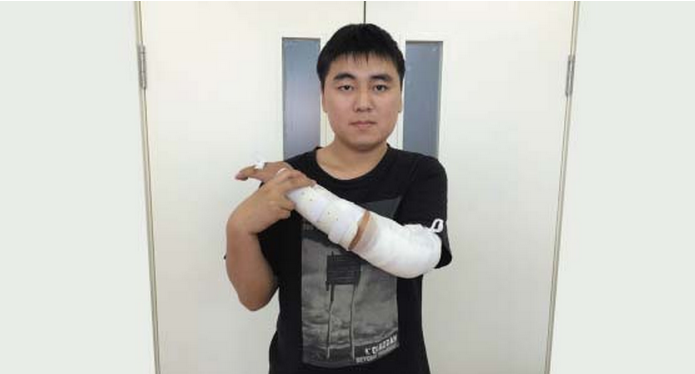
After depression set in, and the pain had become unbearable, Li Xian-hui decided something had to be done, as he could not continue living this way. He finally turned to the Hospital of Dalian Medical University for help, where Dr. Liang Hai-dong thoroughly examined his arm. After much consideration Dr. Hai-dong decided to turn to 3D printing in order to repair Li Xian-hui’s elbow.
“This is my first time to apply the 3D printing technology to the elbow arthroplasty. This is the second case in our province,” stated Dr. Liang Hai-dong
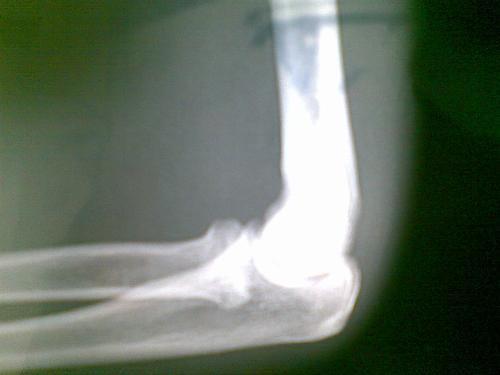
With the help of a second hospital at Jilin University, which had 3D printed a titanium pelvis implant for a cancer patient earlier in the year, Dr. Liang Hai-dong was able to move forward with preparations for Li Xian-hui’s surgery.
To start they took a CT scan of the elbow, which they sent off to a prosthetic manufacturer based in Beijing. The manufacturer turned the CT scan into a 3D printable model, and then printed it using a laser sintering method with titanium powder. The entire process took approximately two weeks to complete, from scan to final printed implant. When finished, surgeons had a near-perfect match for Li Xian-hui’s arm.
It was now time to operate. Surgeons were able to fit the 3D printed implant perfectly between Xian-hui’s humerus and ulna bones. The entire procedure took less than half the amount of time a typical elbow joint surgery would have because of the simplicity and accuracy of the implant itself. As for Li Xian-hui post-operation? He’s doing great. He now has much better movement and flexibility, and the joint is actually much stronger than that of a typical human elbow.
Let’s hear your thoughts on yet another incredible use for 3D printing within the medical field. Discuss this story in the 3D Printed Elbow Joint forum thread on 3DPB.com.
[Special thanks to Shen Hua / translation by Kitty Wang]Subscribe to Our Email Newsletter
Stay up-to-date on all the latest news from the 3D printing industry and receive information and offers from third party vendors.
Print Services
Upload your 3D Models and get them printed quickly and efficiently.













You May Also Like
Solukon Goes Big with New SFM-AT850 Depowdering System
Solukon has released the SFM-AT850 depowdering system. The German depowdering specialist has updated its product line, and this machine replaces the SFM-AT800-S and SFM-AT1000-S. Rather than many small parts, this...
The Hidden Economics of Powder Bed 3D Printing: Closing the Loop in Powder Management
Automation is a very topical thing in additive manufacturing at the moment. With renewed scale, some clients are fervently looking to automate production. Other business cases only make sense with...
Oerlikon Adds ATLIX’s xBUILD 5000, Plans More for 2027
Oerlikon has installed a new ATLIX xBUILD 5000 metal 3D printer at its facility in Huntersville, North Carolina, marking the first production deployment of the system worldwide. The machine will...
The Science Lab You Can 3D Print
Researchers at Sweden’s Umeå University have shown how desktop 3D printers can be used to make lab equipment, giving scientists a cheaper way to build tools for their research. The...