Dyze Design Introduces New 3D Printing Material Extruders – the Typhoon and the Pulsar


 Canadian startup Dyze Design is passionate about developing the best parts, components, and accessories for 3D printers, but it especially shines when it comes to extruders, such as its DyzeXtruder GT and DyzeXtruder Pro. Creator of the SENTINEL filament detector and cleaner, the company is headquartered in Montreal and focuses on, according to its website, “designing parts that undergo rigorous testing in order to provide our clients quality products.”
Now, Dyze Design is coming out with two brand new extruders – the Typhoon filament extruder and the Pulsar pellet extruder, both of which have a maximum operating temperature of 500°C for use with engineering materials like carbon fiber and PEEK.
“They are what we call internally our “high-flow rate industrial” product line,” Simon Duchaine, the Chief Marketing Officer for Dyze Design, told 3DPrint.com.
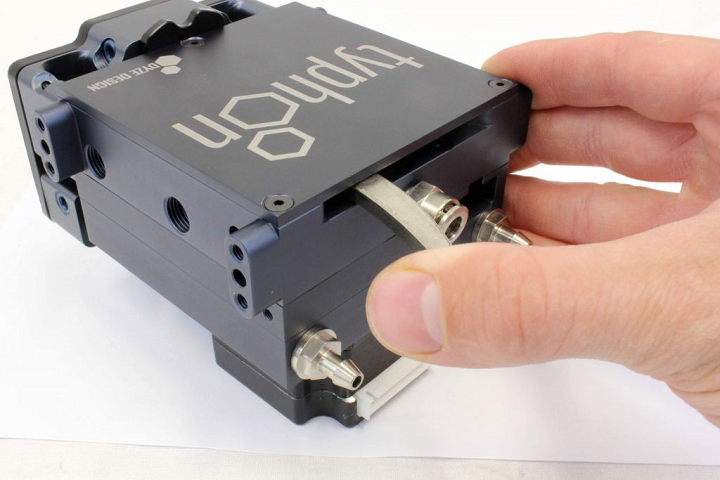
Typhoon – Easy Filament Swap
So let’s start off with the Typhoon, a high flow all-in-one 2.85 mm filament extrusion system for large-scale, industrial 3D printing systems. It has a built-in pressure sensor, interchangeable tungsten carbide nozzles (another Dyze Design specialty) that are easy to change, water cooling, and a filament monitoring and detection system. The system’s top lever moves all driving mechanisms away from the filament, which makes it possible to switch the material in just one second. The filament follower wheel has a precise resolution of 0.002 mm, and its feedback can be used as a closed loop to adjust the stepper speed.
The Typhoon extruder can output 0.9 kg an hour, or 200 mm³/s: far more than its DyzEnd-X hotend or the E3D V6 hotend can output. It features a dual heat zone design to make sure that the temperature remains constant, and it also has a quad pinch system, which offers four-point contact with the filament to ensure that there is no slipping.
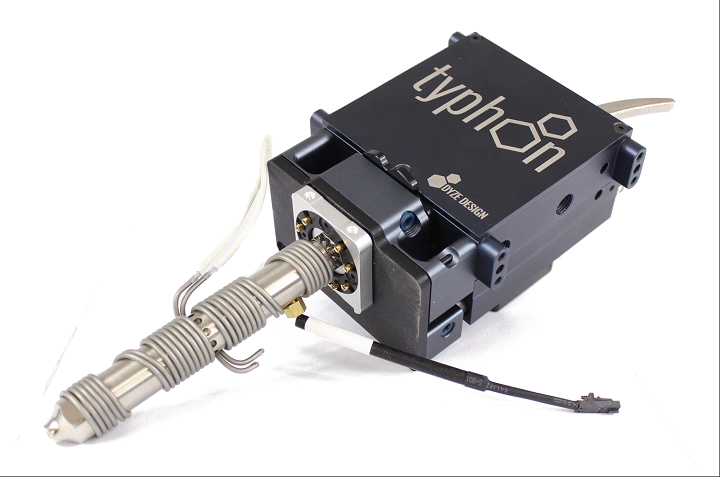
This ultra rugged extruder is compatible with standard firmware, has a strong NEMA23 motor, and is able to print with every type of 2.85 mm plastic filament on the market, from standard PLA and ABS, flexible TPE and TPU, and advanced PETG and Nylon to PEEK and PEI, PVA and HIPS supports, and even wood-filled materials.
Dyze Design’s Pulsar is a state-of-the-art high flow plastic pellet extruder with a single purpose – to quickly and cost-effectively 3D print parts of one m³ and more.
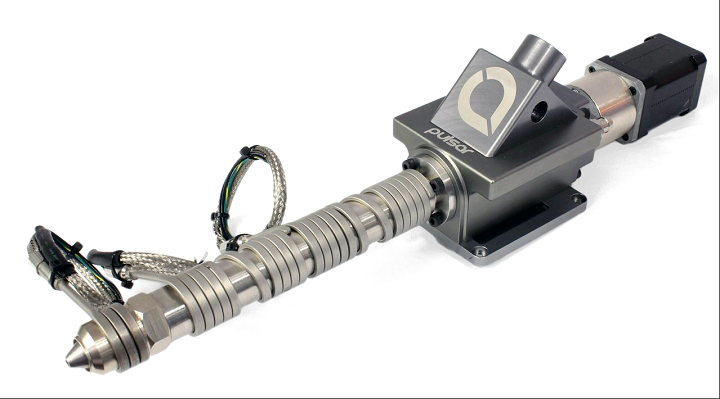
The new Pulsar has its own interchangeable ultra wear-resistant tungsten carbide nozzles, and also an interchangeable extrusion screw, optimized for 3D printing with high resolution. The extruder also features an anti-oozing mechanism, tri-zone precise, uniform heating control, and can output as much as 2.5 kg an hour, or 500mm³/s, of material.
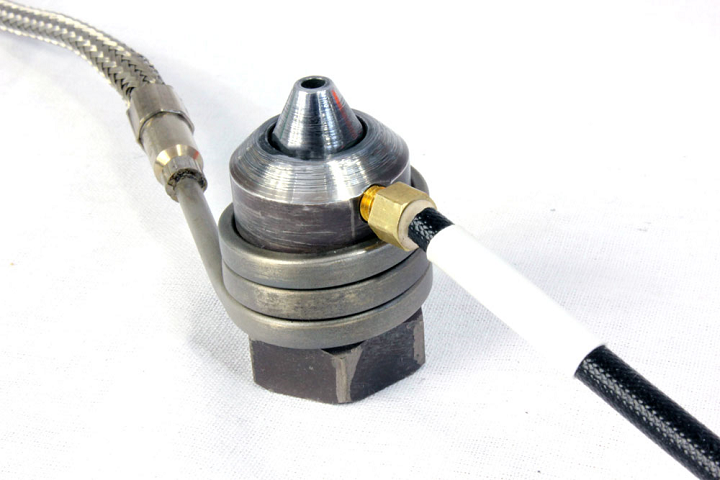
Pulsar – Melting Zone Sensor
The Pulsar’s optional, automatic feeding system can detect the level of pellets, and just like the Typhoon, it’s ready for any environmental conditions and can print using any type of plastic pellets.
Both the Typhoon filament extruder and the Pulsar pellet extruder are now in the beta testing phase with a few different partners; however, Dyze Design is still looking for new testers as well. Mass production for both of the new extruders is planned for 2020.
Subscribe to Our Email Newsletter
Stay up-to-date on all the latest news from the 3D printing industry and receive information and offers from third party vendors.
Print Services
Upload your 3D Models and get them printed quickly and efficiently.












You May Also Like
AM Asia Watch: China’s 3D Printing Boom Is Creating a New Class of Micro-Manufacturers
China’s additive manufacturing (AM) industry has spent years trying to reduce its reliance on foreign technology. In polymer 3D printing, domestic companies have already become major players. In metal AM,...
US Continues to Transfer Expeditionary 3D Printing Know-How to the Pacific
At this year’s Balikatan event, an annual joint exercise hosted by the Philippines military with participation from Western allies, the US military trained Filipino troops in expeditionary manufacturing enabled by...
DEEP Manufacturing Collaborating with Fortius Metals to Demonstrate WAAM at Scale
DEEP Manufacturing is trying to build pressure vessels and marine habitats at scale with DED technology. Using commercial robot arms and wire arc additive manufacturing (WAAM), the company is hoping...
3D Printing & the Autonomous Era: Defense Tech’s Latest Mutation
When we last checked in on the broad defense tech landscape and the role of the additive manufacturing (AM) industry in that environment, it became clear that the connecting thread...