
3D Printed Lightswarm Transforms Yerba Buena Center: Swarm of lights respond to ambient noises

Something is changing at the Yerba Buena Center for the Arts (YBCA) in San Francisco, California. In fact, it’s perpetually changing — a light installation by Future Cities Lab (FCL) called Lightswarm is continually modified in relation to auditory data collected from the lobby of the YBCA and the city beyond. The individual modules that make up the sweeping collection of luminaries were each assembled from 3D printed components with laser cut skins created from paper and recyclable PET plastic.
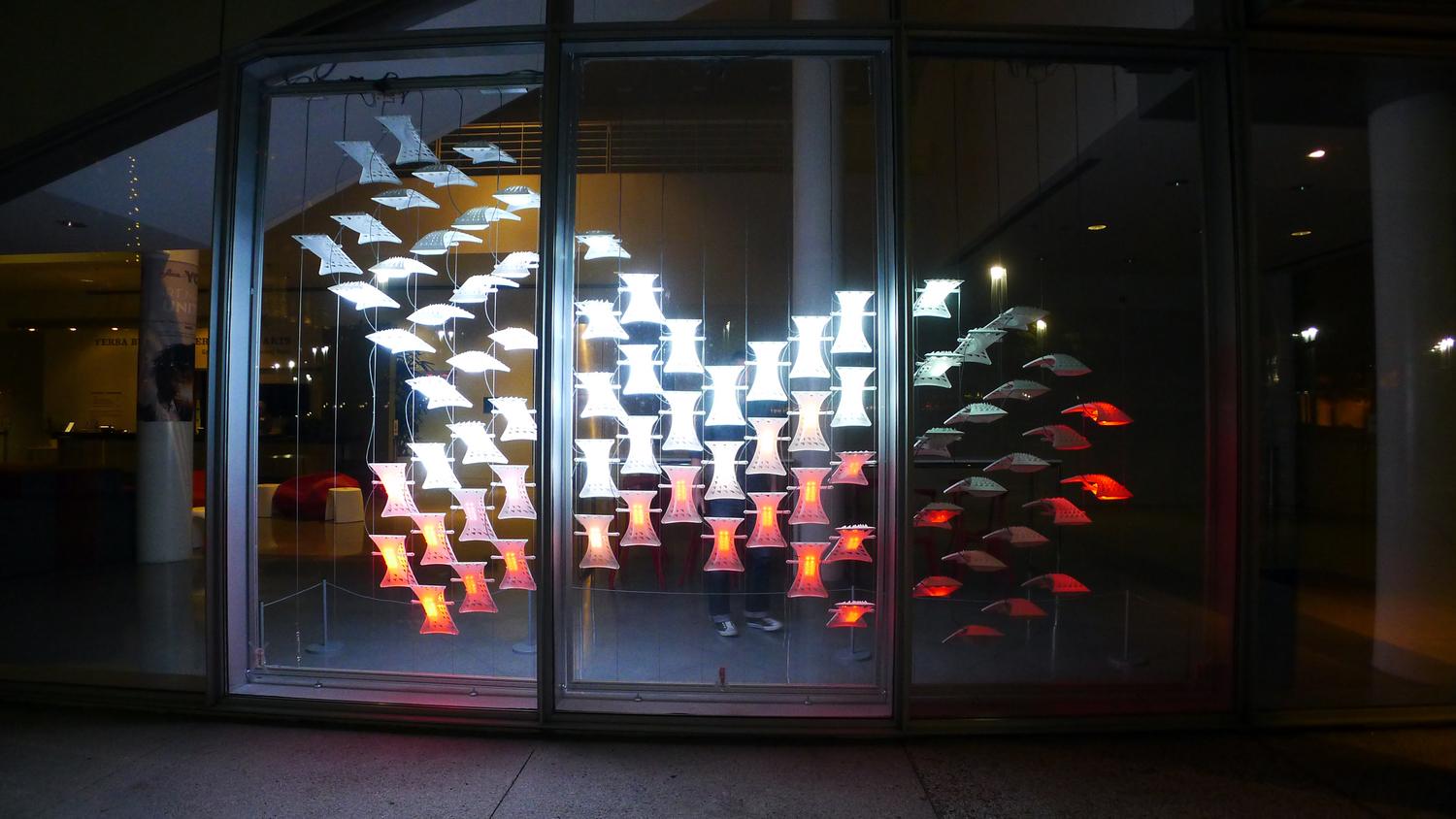 The dazzling show produced by Lightswarm is created by custom electronic elements programmed to transform sound to create visual patterns by varying the intensity and color of the light they produce. Sensors, poetically referred to as ‘sound sensing spiders,’ were attached to individual glass panels and used to collect the noise of the building and beyond. In this way, the visual information communicated through the lights acts as “urban sensors – instruments to sense the city, visualize its auditory pulse, and amplify its latent energies into cascades of light.”
The potential for light exhibits to benefit from advanced fabrication technologies is only just being realized. The ability to combine the precise modeling of 3D software with accurate lighting simulation programs gives light artists a way of pushing their visions even further. In Lightswarm, the absolute personalization of any particular lighting moment mirrors the personalization that has become such an integral part of 3D printing.
Each footstep, echoing museum cough, and oddly tuned vehicle engine feeds into a particular array that communicates the specifics of a visitor’s interaction with both the space and the world surrounding it. Rather than being timed to go through a series of changes or responding solely to large scale phenomena, each individual can impact the light created – but only to a certain degree, as they cannot separate themselves from the entirety of the sound atmosphere in which they view the installation.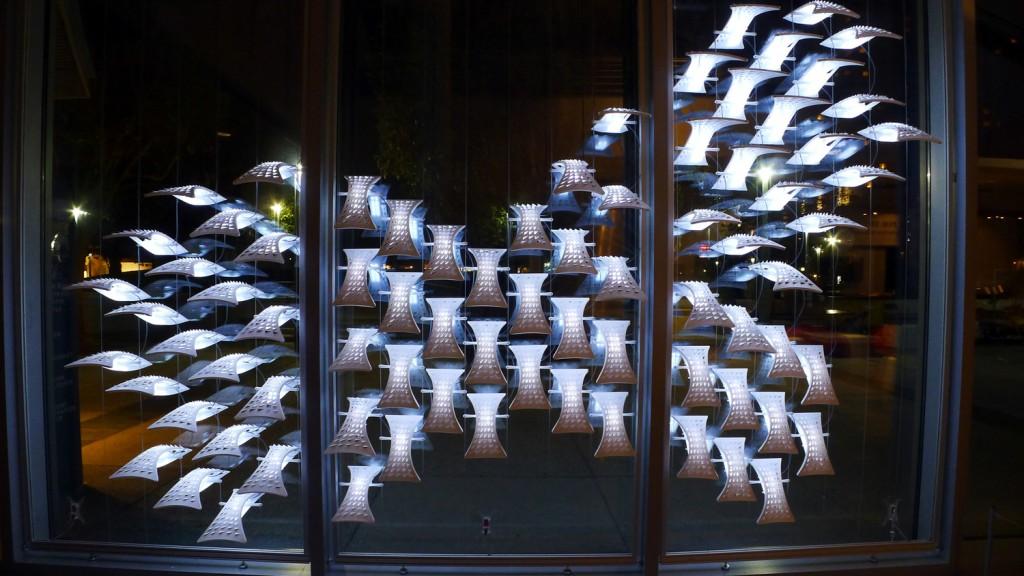
The installation piece is the brainchild of an experimental design studio, workshop, and architectural think tank Future Cities Lab. Jason Kelly Johnson and Nataly Gattegno founded the studio in 2002 in the city of San Francisco. The pair has worked on a series of award winning projects that examine the interactions among art, design, advanced fabrication, and public space. The pair currently teaches at the California College of the Arts and UC Berkeley in addition to leading workshops around the world. For the Lightswarm project, designer Ripon DeLeon, a member of their studio, also contributed.
Check out this video of Lightswarm in action responding to the sounds of its environment. What do you think? Will we be seeing more installations that interact with their surroundings like this? Let us know your thoughts at the Lightswarm forum thread over at 3DPB.com!
Subscribe to Our Email Newsletter
Stay up-to-date on all the latest news from the 3D printing industry and receive information and offers from third party vendors.
Print Services
Upload your 3D Models and get them printed quickly and efficiently.













You May Also Like
3D Printing News Briefs, September 26, 2026: Bioceramic Implants, 3D Concrete Printing, & More
In this weekend’s 3D Printing News Briefs, we’ll start with an integration between PanOptimization and AMCM, before moving on to healthcare news from KLS Martin and Lithoz, and then UltiMaker...
3D Printing News Briefs, September 24, 2026: Metallic Alloys, Nanobone, Alternative Meat, & More
In this week’s 3D Printing News Briefs, we’ll discuss some materials news: a reference material for standardizing photopolymer manufacturing, metallic alloys that help reduce energy loss in electric motors, a...
AMAsia Pulse: AM Investment Picks Up Across Asia-Pacific
The first half of September brought fresh investment and expansion activity across Asia-Pacific’s additive manufacturing sector. China’s Xinjinghe secured funding for an aerospace AM hub, South Korea’s Lincsolution outlined plans...
3D Printing News Briefs, September 17, 2026: 3D Printed Boat, UAS Development, & More
We’ll start with maritime manufacturing in this week’s 3D Printing News Briefs, and continue on to defense 3D printing. We’ll end with funding for Tripo AI. Read on for all...























































