3D Printing Bacteria Biofilms for the Construction of Living Materials

Srikkanth Balasubramanian, Marie-Eve Aubin-Tam, and Anne S. Meyer explore the idea of 3D printing with bacteria further in their recently published ‘3D Printing for the Fabrication of Biofilm-Based Functional Living Materials.’ With a focus on the power bacterial biofilms could have in a variety of applications, the researchers explain the benefits of these CD cell networks made up of proteins, lipids, polysaccharides, and nucleic acids.
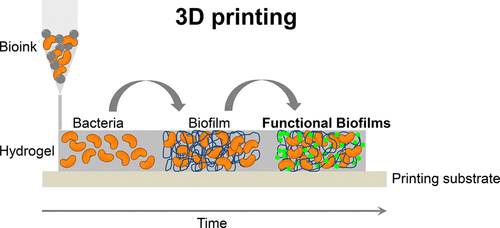
As organic platforms for production and processing of biomaterials, the bacterial biofilms not only self-assemble and settle into spatial patterning, but they are also tough, demonstrating high mechanical stiffness, and resistance to high temperatures, antibiotics, pollutants, detergents, and more. The authors expect biofilms to be beneficial for applications like the following:
- Bioleaching
- Bioremediation
- Materials production
- Wastewater purification
Synthetic biology allows researchers to refine and strengthen the performance of ‘biofilm-forming bacteria,’ with the use of additional peptides and ‘genetically tractable bacteria’ like Escherichia coli and Bacillus subtilis in use for synthetic, engineered materials. In creating such biofilms, the following must be assessed:
- Determination of optimal peptide fusion sites
- Tolerance of fusion protein to mutations
- Toxicity of new peptide tags to the bacterial cells
- Functional assays for characterization of novel biofilm functionalities
“The resultant biofilm-derived materials can exhibit marked advantages over materials fabricated by planktonic bacteria cultures, in terms of their resistance to extreme and unexpected environments, reusability, spatial multiscale patterning, and tunable properties,” state the researchers.

Possible applications of 3D-printed synthetic biofilms. Bacteria can be genetically engineered to produce structural biofilm proteins (in blue) decorated with specific functional peptides (in green) via heterologous expression in a bacterial strain that has a genetic deletion for structural biofilm proteins. By combining these engineered bacteria with 3D bioprinting, 3D-printed engineered biofilms can be created with multiple potential applications, including (A) Environmental detoxification and bioremediation, (B) Biomedical applications, (C) Tunable materials production with improved mechanical and/or conductive properties, (D) Fabrication of responsive materials, (E) Biocatalysis-driven materials processing, (F) Addressing fundamental research questions, and (G) Creation of reproducible model biofilm systems for studying the structure–function relationships of bacterial biofilms.
There are challenges and concerns in using genetically modified bacteria, obvious, with the authors stating that 3D printed devices could then potentially be toxic and a hazard to humans—and the environment—should the bacteria be exposed.
“For societal applications such as drinking water plants, contamination risks could be eliminated by 3D printing cell-free functional extracellular matrix components that were isolated from biofilms by vacuum filtration. Such components will have longer stability and reusability compared to living bacteria and would not need constant maintenance,” concluded the researchers.
“Overall, the effectiveness, stability, and versatility of 3D bioprinting approaches in combination with the distinct characteristics of bacterial biofilms offer an ideal platform for the fabrication of biofilm-derived products in materials processing and manufacturing.”
You might be surprised to find out how often 3D printing and research regarding bacteria have been connected, from studies into stem-cell engineering to manufacturing living materials to fabricating cyanobacteria.
What do you think of this news? Let us know your thoughts! Join the discussion of this and other 3D printing topics at 3DPrintBoard.com.
[Source / Images: ‘3D Printing for the Fabrication of Biofilm-Based Functional Living Materials’]Subscribe to Our Email Newsletter
Stay up-to-date on all the latest news from the 3D printing industry and receive information and offers from third party vendors.
Print Services
Upload your 3D Models and get them printed quickly and efficiently.











You May Also Like
Ursa Major, AFRL Show AM’s Role in Future Deterrence Through Draper Test Flight
The war in Iran is only about two weeks old, but countless lessons — and warnings — have already emerged for militaries across the planet and the economy in general....
3D Printing News Briefs, March 12, 2026: Linear Motor, Assistive Technology, & More
Conflux Technology’s 3D printed transmission oil cooler took to the track on a Multimatic Motorsports car; this story kicks off today’s 3D Printing News Briefs. Then, MIT researchers developed a...
Shocking! America Makes Wants to Give You Money Again
With two new project calls, America Makes would like to give you $35 million. Powered by the Office of the Under Secretary of Defense, Manufacturing Technology Office (OSD ManTech). OSD...
3D Printing News Briefs, February 28, 2026: Sales Partner, Holographic 3D Printing, & More
We’re kicking off today’s 3D Printing News Briefs with some business news, as Meltio has announced a sales partner in the U.S. and Immensa has joined Shell’s Energy Transition Campus....