Korean Startup USEED to Launch Voice Activated AI Driven 3D Printer for Kids


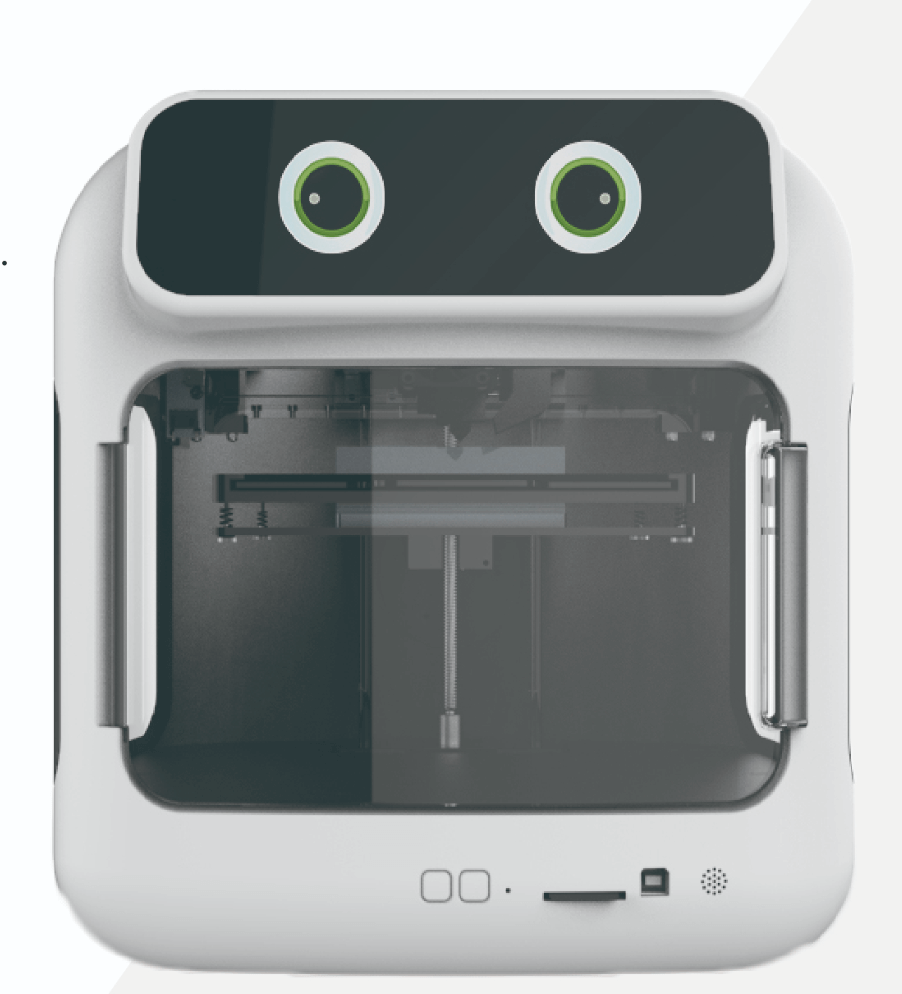
USEED is a Korean startup headed by Jung Soo Lim. The eight-person company got its start making 3D printer kits, and specializes in the education market. The firm makes robotics kits, Prusa i3 type 3D printers, its own Creator 3D printer, and even an SMT placement machine. The company designs, develops and manufactures its machines in Korea and has been expanding steadily. Now they aim to undertake a bit of a quantum leap. The firm has been designing and testing its Thingi for months now. The Thingi is one of the, if not the most, adorable 3D printers I’ve ever seen. Specially designed to be accessible, safe and easy to use for children, the Thingi is meant to let kids easily 3D print. The 125 x 140 x 190 build volume machine can print over WiFi, has a 260C capable extruder, and can print up to 60 mm/s. The printer has a new trick up its sleeve, however. The voice-activated AI-powered printer can listen to kids’ commands and prints accordingly. If the voice activation works well and the company can accordingly automate the entire printing workflow, it would make 3D printing much more accessible and easier. Potentially it would make 3D printing much easier for all of us as well. It was refreshing to finally see something innovative happening again in desktop 3D printing. The company is testing the printer now and aims to go to crowdfunding in a few months. We interviewed CEO Jung Soo Lim to find out more.
What is USEED?
Our company manufactures 3D printers and coding education kits for kids. We have 8 employees. Our company was founded to provide IT seeds that can be easily implemented if anyone has an idea.
Therefore, we are currently supplying educational 3D printers and related education services to Korean educational institutions. The big plan that our company has is to launch a voice driven AI printer. In Korea, 3D printing is not being popularized fast enough. We analyzed the of this causes through our experiences in selling technical products. There was pressure to learn 3D modeling in order to use 3D printers. Also, children between the ages of 5 and 10 want to use 3D printers. However, these purchases were not made because children had to use computers independently. With that background, our company developed the Thingi early last year and is currently preparing to mass-produce it. Also, to cover the costs of molds, we are looking for funds through crowdfunding platforms.
Our company will complete 3D printers and content that children can use for making their own toys. We hope to have is available this year at Christmas.
Why a voice-activated 3D printer?
I want kids to have fun while using 3D printers to make the things that they want. If a child wants to make a Hello Kitty patterned cup, the kid talks to our 3Dprinter. The Thingi recommends the best model file and will then print it out. We will simplify this process so that children can use 3D printers in a fun way. I think that if many people enjoy and use our products, the limitations of technology will be overcome.
Subscribe to Our Email Newsletter
Stay up-to-date on all the latest news from the 3D printing industry and receive information and offers from third party vendors.
Print Services
Upload your 3D Models and get them printed quickly and efficiently.













You May Also Like
3D Printing News Briefs, October 10, 2026: Drones, WAAM, Ceramics, & More
We have a packed 3D Printing News Briefs for you this weekend! First, America Makes celebrated the recent National Manufacturing Day with 3D printed drones, and then it’s on to...
3D Printing News Briefs, October 3, 2026: Hypersonics, Hotends, & More
We’re starting off with defense in this weekend’s 3D Printing News Briefs, as Titomic was awarded a $5 million U.S. defense contract, and VulcanForms announced a partnership with Specter Aerospace...
The Part Is Only Half the Story: Why 3D Printing Needs a Digital Thread
A 3D printed part can generate a lot of information. The challenge is keeping track of it. Manufacturers need to know which design was used, what material went into the...
Advanced Manufacturing at IMTS 2026: 3D Printing and AI and Drones, Oh My!
Last week’s International Manufacturing Technology Snow (IMTS) in Chicago welcomed over 90,000 attendees to the jungle that is McCormick Place. With over 1.17 million square feet of exhibit space, and...