3D Printed Male Chastity Device Prototype: Personal toy for men

For those couples seeking to spice up their personal lives with a bit of power play, leaving the woman in charge of the action (as it were), some inventive makers are hard at work prototyping new devices. We’ve looked recently at Dame Products’ 3D printed prototype for the female-use Eva product; now it seems to be the men’s turn for their own toy.
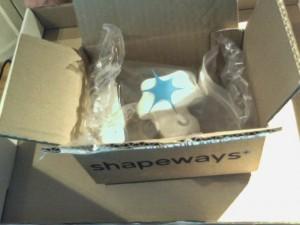
Discreet packaging from Shapeways ensures privacy in transit
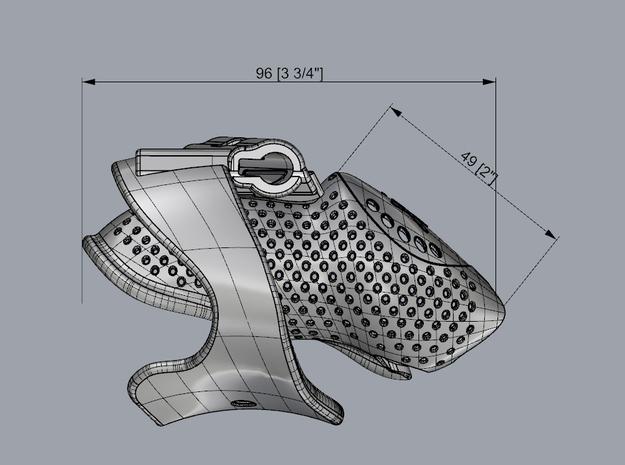
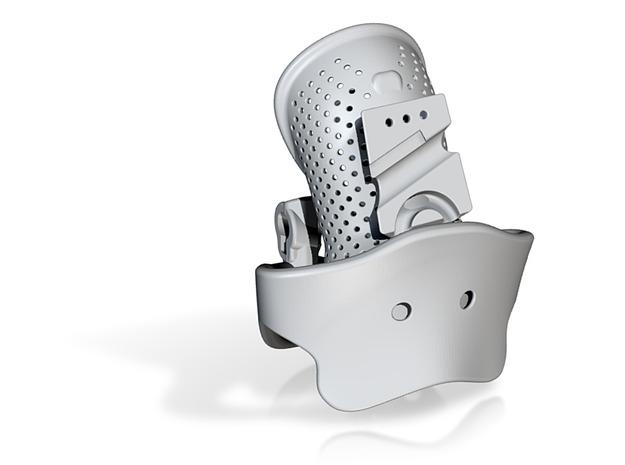
One of the latest prototypes out there, comes from Shapeways user pedro69, and has been tested out by a friend of his who runs the Become Her Slave blog, which focuses on men who want their female partners to dominate them. This new prototype — the Keyholder Dream (KHD) X3 Espresso Short — is a “male chastity device” that keeps a man’s bits securely in place and puts him at the (playful) mercy of his partner, who quite literally holds the key.
The blogger, Giles, received the prototype in the mail courtesy of his friend Pedro, and was pleased that it arrived in Shapeways’ discreet, professional packaging, already assembled. The only work to do for the piece is inserting a separately-purchased trailer hitch lock, which slides right into the crafted opening.
Of course, following completed assembly, the entire unit was washed and sanitized for use — keep in mind this is intended for intimate use in a sensitive area; hygiene first! The 3D printed material makes the device dishwasher safe.
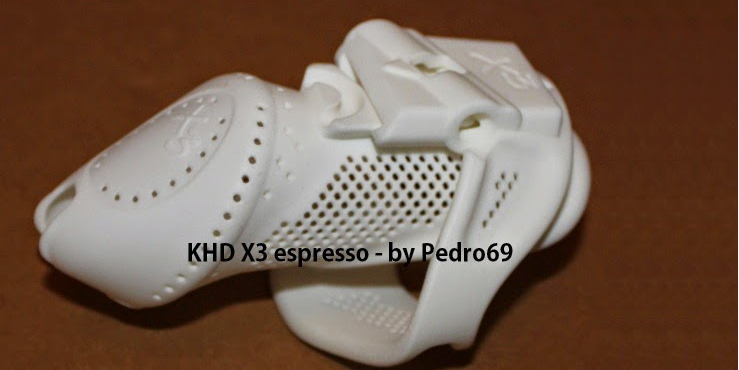
After preparing the unit, Giles tried it on. To put the device on, he found a four-step process worked best:
- Without lotion, install the base ring as snugly against the body as possible. Make sure it’s aligned right, it’s almost impossible to twist the thing once it’s on.
- Apply lotion to the penis and the upper inside surface of the tube. (He notes later that “Thanks to the espresso perforations, the lotion quickly disperses, leaving your penis dry.”)
- Install the tube. The penis should slide right to the end.
- Lock the device. 🙂
I take his use of that final emoticon as a sure sign of customer satisfaction. In comparison to another device he already owns, Giles notes that this piece is “generally comfortable to wear” and “really comfortable to sleep in”. He also notes that for its intended purposes, it provides a “wonderful sensation” when aroused.
The 3D printed material was especially favorable in Giles’ review, for both its comfort and its feasibility for production. He points out several key features pertaining to the make of this piece as he summarizes his thoughts:
“Pedro’s chastity device isn’t perfect — it’s a prototype. However, it’s nearly perfect and already much better than the cheap Chinese device I have. A few tweaks and we’ll have a cheap robust male chastity device with a magic locker and a pull-out detector, available in a huge range of styles and sizes, 3D-printed on demand.”
Some of his further thoughts reflect on the pricing of such devices and the future of their manufacture:
“Hobbyists will push down the price of chastity devices. Pedro’s betas come in at between EUR80 and EUR100 plus postage, but I doubt he could push the price any higher even if he wanted because some other hobbyist would undercut him. And 3D printing is only going to get cheaper.
The quality of male chastity devices will improve. 3D printing lets amateurs and moonlighting engineers like Pedro tinker with designs and then update their product almost immediately. Contrast that with how long it’s taking Holy Trainer to fix their design
and material issues thanks to having to change their manufacturing process, deal with contractors etc etc. The market will soon no longer support chastity devices that pinch, crack or snap.
People will soon prefer to buy 3D printed chastity devices. Not only will they be cheap and made to measure, they’ll also have the major advantage of being manufactured locally, getting around the whole import duty hazard.”
Users of these and similar devices have high quality standards and expectations, as well they should. The points brought up in this review are all sound, and very much reflect what we’ve been seeing going on in the general 3D printing industry. Starting with low-cost prototyping, final devices will continue to benefit from multiple iterations as the design is finalized and improved upon. The applications for 3D printing extend now into every aspect of people’s lives.
What do you think of this type of design? Let us know your thoughts in the Keyholder Dream forum thread at 3DPB.com.
Subscribe to Our Email Newsletter
Stay up-to-date on all the latest news from the 3D printing industry and receive information and offers from third party vendors.
Print Services
Upload your 3D Models and get them printed quickly and efficiently.











You May Also Like
3D Printing News Briefs, April 18, 2026: Educational Grants, Bambu X1, & More
In today’s 3D Printing News Briefs, SPE announced a collaboration to expand 3D printing education through its equipment grant program. Bambu Lab has retired its X1 Series of FFF 3D...
Harvard Engineering Students 3D Print VTOL Drone to Improve Marine Biology Research
With all the current focus on the boom in drones used for national security, it’s easy to forget that the civilian drone market is growing, too. In addition to the...
3D Printing News Briefs, April 2, 2026: Reseller, Submarine Parts, & More
We’re starting off today’s 3D Printing News Briefs with business from Materialise and RapidFit, and Axtra3D and MULTISTATION. Then we’ll move on to a contract for submarine components, and end...
Asia AM Watch: China’s 5 Million-Printer Export Year Signals Desktop AM at Scale
For years, a lot of the discussion around China and additive manufacturing has focused on industrial competition. Can Chinese companies move into higher-end markets? Can they challenge Western machine makers...