3D Printed Models Help Students Gain a Better Understanding of DNA Behavior


In a paper entitled “Visualizing the Invisible: A Guide to Designing, Printing and Incorporating Dynamic 3D Molecular Models to Teach Structure-Function Relationships,” a group of researchers from the University of Nebraska discusses the importance of using three-dimensional models to help students understand critical biology and chemistry concepts. Teachers, the researchers point out, often rely on two-dimensional images to teach complex three-dimensional concepts, such as the structure of molecules, but students cannot fully grasp the concepts using only 2D images. Kits with 3D models exist for teaching purposes, but they “cannot handle the size and details of macromolecules.”
3D printing, however, allows instructors to create detailed custom models of molecules of any size.
“For example, protein models can be designed to relate enzyme active site structures to kinetic activity,” the researchers state. “Furthermore, instructors can use diverse printing materials and accessories to demonstrate molecular properties, dynamics, and interactions.”
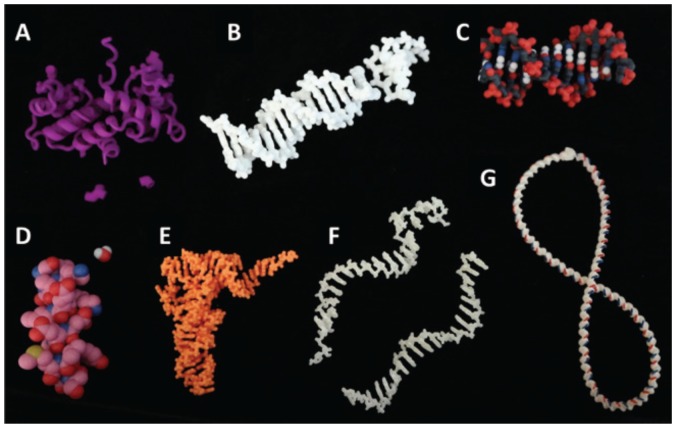
In the paper, the researchers describe the creation of a 3D model-based lesson on DNA supercoiling for an undergraduate biology classroom. They selected this particular model so that students could “feel DNA relaxation and witness contortions resulting from twists in DNA.” They designed and 3D printed flexible plastic models with magnetic ends to mimic DNA supercoiling.
“We developed a Qualtrics-based interactive activity to help students use the models to classify supercoiled DNA, predict the effects of DNA wrapping around nucleosomes, and differentiate between topoisomerase activities,” the researchers explain.
An upper-level undergraduate biochemistry class was divided into small groups of two to three students to foster peer learning, and each group was provided with one model set. The models were also made available at a library resource center. Interactive questions required the students to measure and explore physical aspects of the models. It took the students about 50 minutes to complete the activity, which was interspersed with lecture and demonstration via a digital overhead.
In interviews following the activity, the students reported that the models helped them learn because “physically seeing it makes something abstract very real.” In a survey, 60 to 70 percent of students stated that the physical models made it easier to learn the material being taught.
 The researchers go on to provide step by step instructions for creating 3D printed models for use in the classroom. They designed the models around student misconceptions, they explain, and the models were shown to be effective in clearing up those misconceptions. This study reaffirms what many researchers and educational professionals have learned – that 3D printed models are an excellent way to teach students of any age group. From preschoolers learning shapes and textures to college students learning about DNA supercoiling, having hands-on models helps to make concepts real and accessible. 3D printing is a cost-effective way to create those models, and it is capable of presenting detail in a way that other fabrication methods are not.
“Three-dimensional printing represents an emerging technology with significant potential to advance life-science education by allowing students to physically explore macromolecular structure-function relationships and observe molecular dynamics and interactions,” the researchers conclude. “As this technology develops, the cost, resolution, strength, material options, and convenience of 3DP will improve, making 3D models an even more accessible teaching tool.”
Authors of the paper include Michelle E. Howell, Karin van Dijk, Christine S. Booth, Tomáš Helikar, Brian A. Couch and Rebecca L. Roston.
Discuss this and other 3D printing topics at 3DPrintBoard.com or share your thoughts below.
Subscribe to Our Email Newsletter
Stay up-to-date on all the latest news from the 3D printing industry and receive information and offers from third party vendors.
Print Services
Upload your 3D Models and get them printed quickly and efficiently.











You May Also Like
Formnext 2026: A More Mature AM Landscape Takes Shape in Frankfurt
Formnext 2025 offered a clear view of where Additive Manufacturing currently stands: an industry that has moved well beyond its hype phase and is progressing at different speeds across technologies,...
Engineering Readiness for the Most Demanding Defense Programs
As additive manufacturing moves from innovation to execution, success is no longer defined by machine capability alone. For the most demanding U.S. defense programs, additive manufacturing must be engineered, qualified,...
From Monitoring to Measurement: Why Objective Inspection is Becoming Essential for Scalable Metal AM
Additive Manufacturing (AM) is no longer judged by its printing capabilities, but how it can print reliably, repeatedly, at scale. As metal AM continues its transition from prototyping to production,...
Cheap Printers Make Metal Powders Costly
Last year, on stage at AM Strategies, the argument was simple: additive manufacturing had to stop chasing elegance and start chasing economics. The 3D printing community had spent decades refining...