Ampower Releases Paper Discussing Sinter-Based 3D Printing Technologies

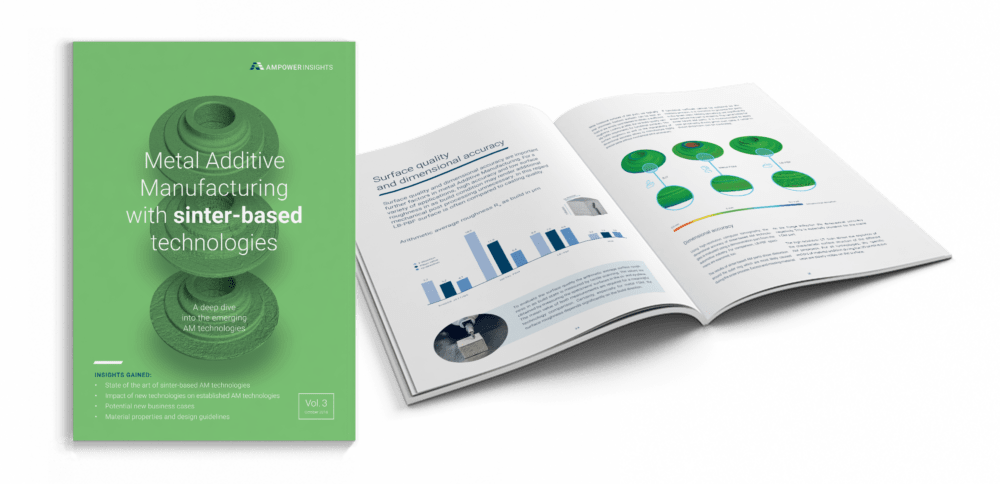 Ampower is an aptly named company, as its goal is to empower companies to benefit from additive manufacturing. The German company offers its expertise on all things 3D printing-related in order to help clients make the most out of the technology, and its advice often comes in the form of in-depth studies on additive manufacturing. Its most recent study, “Metal Additive Manufacturing with sinter-based technologies,” can be downloaded for free from the company’s website. The study offers a close look at sinter-based additive manufacturing technologies and compares them with laser beam powder bed fusion (LB-PBF) and metal injection molding (MIM).
The paper offers an overview of metal additive manufacturing technologies, comparing sinter-based technologies to LB-PBF. Test specimens from nine different suppliers were obtained and examined, including density cubes and tensile bars as well as a full automotive component.
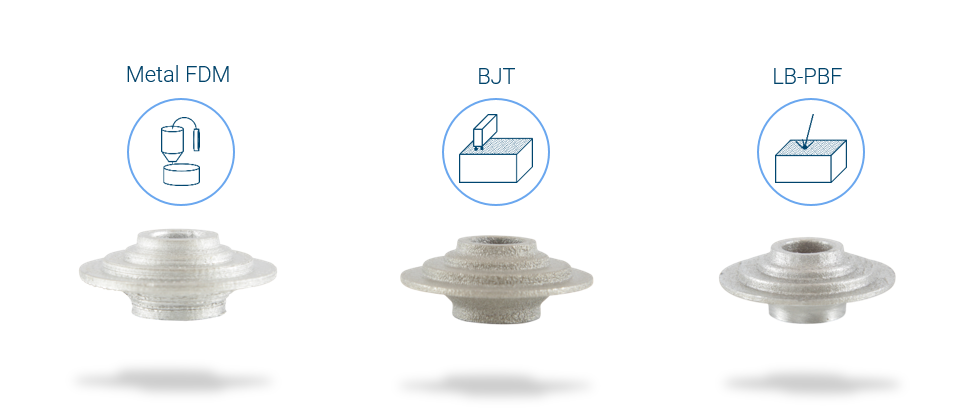
The paper goes on to closely look at the full process of sinter-based technologies, including the necessary debindering step. These include several options, including thermal debindering, thermal catalytic debindering, and solvent debindering. The authors compare the costs of theses different debindering options, as well as the costs of metal FDM vs. binder jetting and LP-PBF.
“Compared to traditional high-volume manufacturing technologies, LB-PBF is generally associated with high machine and material cost at low production speed,” the authors state. “Thus, not every part that is technologically feasible is reasonable from a business perspective. Sinter-based metal AM technologies promise to change this and lower the cost for metal parts for higher production volumes.”
The authors then examine the materials that are available for the various production technologies, noting that LB-PPF currently has a wider range of metal materials available.
“For this study stainless steel alloys 316L and 17-4PH were examined to determine the material characteristics,” they continue. These alloys are commonly available for the processes LB-PBF, MIM, metal FDM and BJT and therefore enable the best comparability. The obtained results are based on over 50 specimens from nine different system suppliers.”
 The testing included porosity analysis, in which cross sections of the pieces produced by each technology were analyzed by light microscopy. For the sinter-based technologies, the debindering and not the 3D printing itself was responsible for more of the porosity in the final parts. Higher pore distribution and larger defects were found in the parts produced by binder jetting and metal FDM than those produced by LB-PBF. Material properties were also tested.
Design potentials and limitations for each of the technologies are also discussed, and design guidelines are given. The authors point out that manufacturers currently have more of a variety of technologies to choose from than ever before, but that variety also requires that they become knowledgeable about more technologies than ever.
“Due to the debindering and sintering process challenges of large parts, binder jetting technology and metal FDM will most likely be used to manufacture small to medium-small components,” the authors conclude. “Metal FDM will cover low production volumes due to its flexibility. Binder jetting technology, on the other hand, will close the gap to very high-volume production technologies such as MIM and will become a cost efficient alternative.”

The full paper is definitely worth a read if you’re interested in the intricacies and varieties of the different methods of metal additive manufacturing, particularly sinter-based technologies. You can download the paper here. You can also visit Ampower at formnext at Booth E30 for a free hard copy.
Discuss this and other 3D printing topics at 3DPrintBoard.com or share your thoughts below.
[Image: Ampower]
Subscribe to Our Email Newsletter
Stay up-to-date on all the latest news from the 3D printing industry and receive information and offers from third party vendors.
Print Services
Upload your 3D Models and get them printed quickly and efficiently.













You May Also Like
Creality K3 Opens for Pre-Order at $849, Advancing Multi-Color 3D Printing
Creality has officially opened pre-orders for the Creality K3, its latest flagship K Series 3D printer, starting at $849 in the United States. Recognized as an IFA Innovation Awards 2026...
Beyond the Printer: HP and DyeMansion Tackle the Future of Prosthetics
Making a custom orthotic or prosthetic device involves much more than producing the final part. Patients need to be measured, devices must be designed to fit their bodies, and finished...
3D Printing News Briefs, October 14, 2026: Bolus, Aerospace Tooling, Water Filter, & More
In today’s 3D Printing News Briefs, we’re starting with medical news, as Myrava has received FDA 510(k) clearance for its 3D printed bolus. Moving on to aerospace and metals, AML3D...
Can India’s AM Push Help Make it a Viable Supplement to China?
Diversifying manufacturing supply chains to locales outside of China has nothing to do with actually cultivating “substitutes” to the Chinese economy. The real stakes are these: China is an irreplaceable...