Multiple Approaches to 3D Printed Probe Positioners

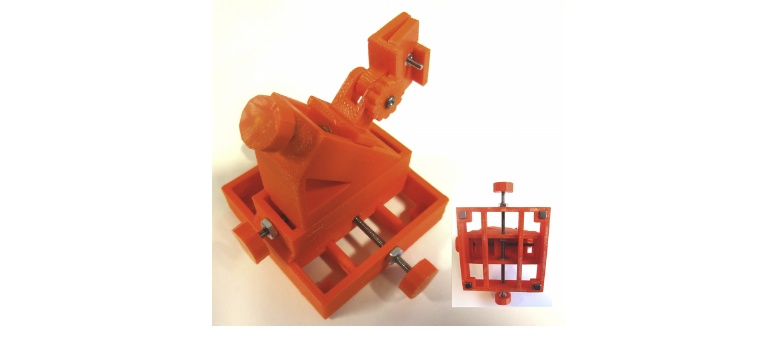 In a paper entitled “Approaches to open source 3-D printable probe positioners and micromanipulators for probe stations,” a group of researchers evaluate three types of open source probe positioning systems:
- mostly 3D printed
- partially printed using OpenBeam kinematic constraints
- a 3-level stack of low-cost commercial single axis micropositioners and some printed parts
All of the systems are easily customizable and can be fabricated with a RepRap 3D printer and off-the-shelf components. The first system can be purchased for $100 or fabricated for $5, the second can be fabricated for $25, and the third fabricated for $145. All three systems can utilize a customizable probe holder and tungsten carbide needle for $56.
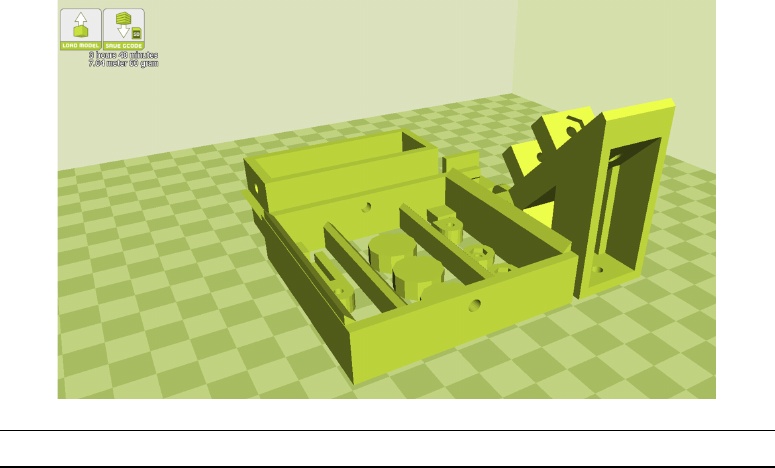
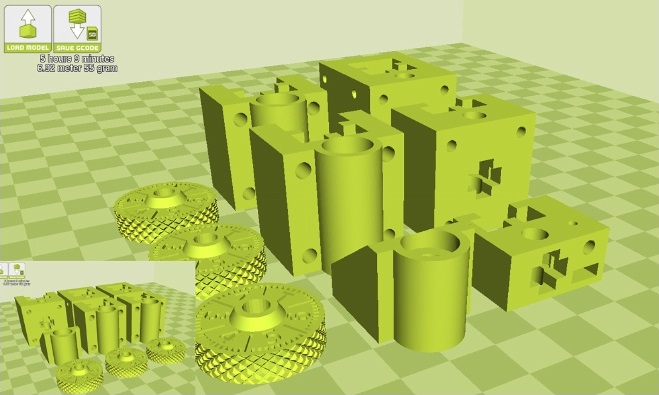
3D printable parts for system A
“A microscopic probe positioner is used to make electrical contacts to test microelectronics under a microscope and demands a level of precision of movement that cannot be achieved by the unaided human hand,” the researchers explain. “Manually adjustable probe positioners are utilized in thousands of microelectronics labs while prototyping or manufacturing in small volumes. In addition to fully automated production wafer probers, manual systems are still used in parallel for process monitoring and debugging purposes.”
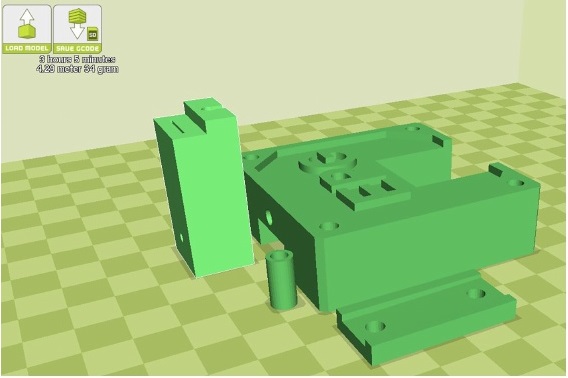
The first system can be 3D printed in under four hours using about 60 grams of filament, while the second can be fabricated in less than 30 minutes. The third system can be assembled in less than an hour after the necessary parts are 3D printed.
3D printable parts for system B
The paper contains a complete bill of materials for all three systems, as well as 3D printable files and full building instructions. All three systems are significantly less expensive than their commercial alternatives. Even the cost savings for the customizable probe holder can justify the cost of the micromanipulator-probe open source system, according to the researchers. Savings for the open source probe holder range from 80% to 90% compared to commercial probe holders.
All three micropositioners were tested in a dark cabinet with a commercial silicon wafer probe station. The wafer probe station floats on air cushions and is enclosed in a dark cabinet with a hinged access door. The micropositioners were tested for the maximum deflection that the probe head could experience.
3D printable parts for system C
“The results showed the maximum deflection for micropostioner design (a) was more than 200 μm, for (b) design 40 μm and for (c) design 10μm,” the researchers state. “These limitations were primarily caused by the designs not inherent limitations of print quality or resolution. It should be stressed that these are the worst deflections possible and that under normal operation the values are significantly less. So for example, the 3-level stack design (c) micropositioners with careful operation result in a needle deviation less than 5 μm.”
All three systems can be improved in the future, the researchers continue, and they could potentially be used in clean room environments. The first system can be fabricated with higher performance polymers and redesigned to offer greater rigidity and smaller volume, and the second system can be redesigned to be smaller and lighter. The 3D printable parts for the third system can be redesigned to reduce mass, print time and cost and improve aesthetic appearance.
Authors of the paper include Iiro Hietanen, Ismo T.S. Heikkinen, Hele Savin and Joshua M. Pearce.
Discuss this and other 3D printing topics at 3DPrintBoard.com or share your thoughts below.
Subscribe to Our Email Newsletter
Stay up-to-date on all the latest news from the 3D printing industry and receive information and offers from third party vendors.
Print Services
Upload your 3D Models and get them printed quickly and efficiently.











You May Also Like
Printing Money Episode 37: Q4 2025 Public 3D Printing Earnings Review with Troy Jensen, Cantor Fitzgerald
Welcome to Printing Money Episode 37. Troy Jensen (Managing Director, Cantor Fitzgerald) returns for his quarterly analysis of the public company earnings reports, specifically Q4 2025. Nowadays, in terms of...
3DPOD 296: 3D Printed Rocket Engines From Industrial to Hobbyist with An Duong, Morethan3D
An Duong, a former Rolls-Royce innovation manager working on 3D printed aeroengines, made an unexpected shift from aerospace to entrepreneurship. The work was challenging and engaging, and he very much...
3DPOD 295: From Product to Design at Carbon, with Kristi Eveland Smith
Kristi Eveland Smith started as a competitive soccer player before moving into consulting, operations, and 3D printing. She’s now Vice President, Design to Production at Carbon 3D and has been...
3DPOD 294: Digital Casting and More with Ben Wynne, Intrepid Automation
Ben Wynne is focused on bringing digital automation into traditional casting and heavy manufacturing through his work at Intrepid Automation. He explains how the company connects design, tooling, robotics, and...