Man Designs and 3D Prints an Incredible Robotic Parrot That Moves Like a Real Bird

 We’ve seen it before, and we will certainly see it again. Robotics and 3D printing continue to converge on many different levels. Whether it is the robotic movements of 3D printers themselves, or the creation of better robotics through the use of 3D printing for complete customization, the technologies definitely have a magnificent future together. We have seen numerous robots created through the use of 3D printing, which has allowed for their total customization, while at the same time saving hundreds or even thousands of dollars in machine and injection molding costs.
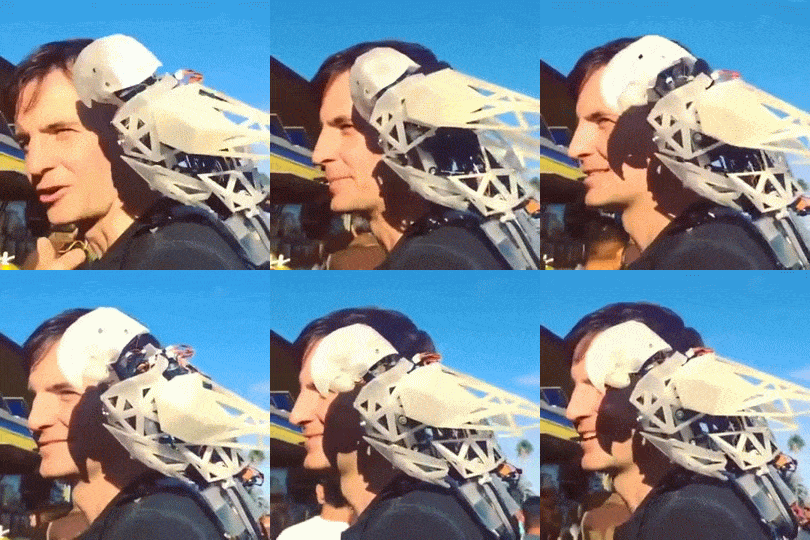
For one man, named Brian Matthews, 3D printing allowed him to create a robot unlike anything we have ever seen before. We are mostly used to seeing robots that mimic human behavior in order to make our own lives better, or resemble humans in not only their actions, but their body language and movements as well. Matthews, however, took a totally different approach for building his robot from the ground up. He decided to create a robotic parrot, and the end results are rather stunning.

Matthews, who runs a website called Flapping Sprocket, created his robot basically from scratch, as he explains some of what went into its development to 3DPrint.com:
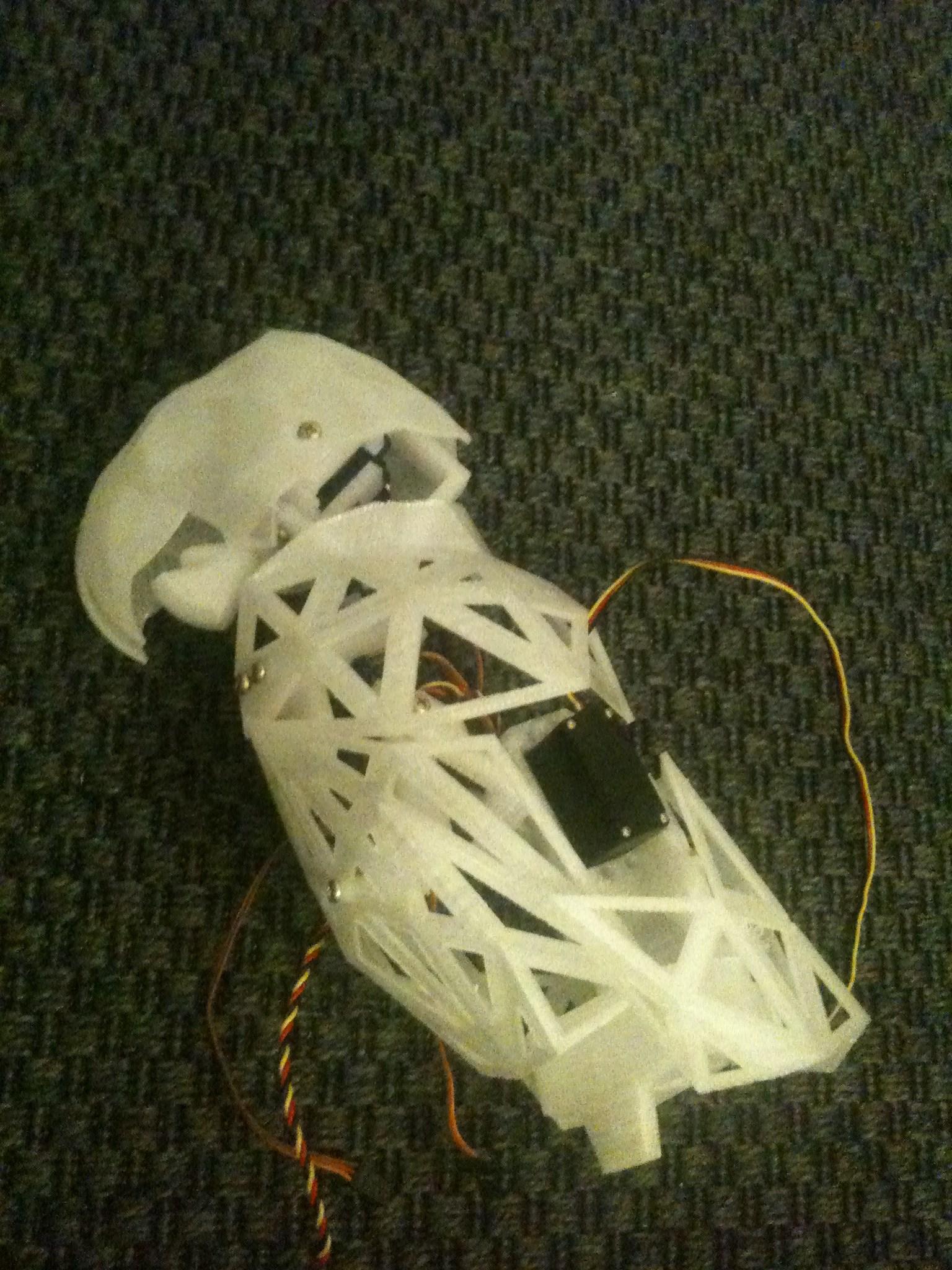
“The controller is an Arduino Mega running animation code I wrote, the servo motors are 7, HS65HB and 2, HS-5685 from ServoCity.com, it is mostly [3D printed in] ABS except for the wings that are PLA. The Battery is from Robot Marketplace, custom 6 volt battery layout maker, and the IR distance sensor from Adafruit. The parrot was printed on an Afinia 5x5x5″ bed. I used the 3D drawing program Sketchup to design all the parts.”
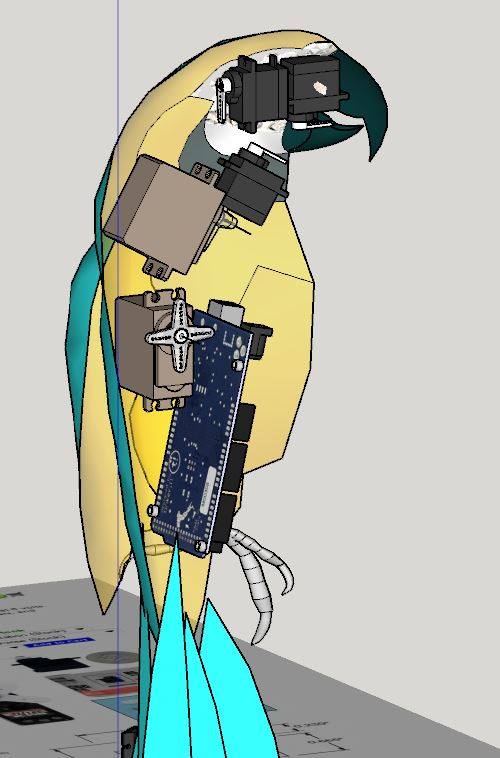
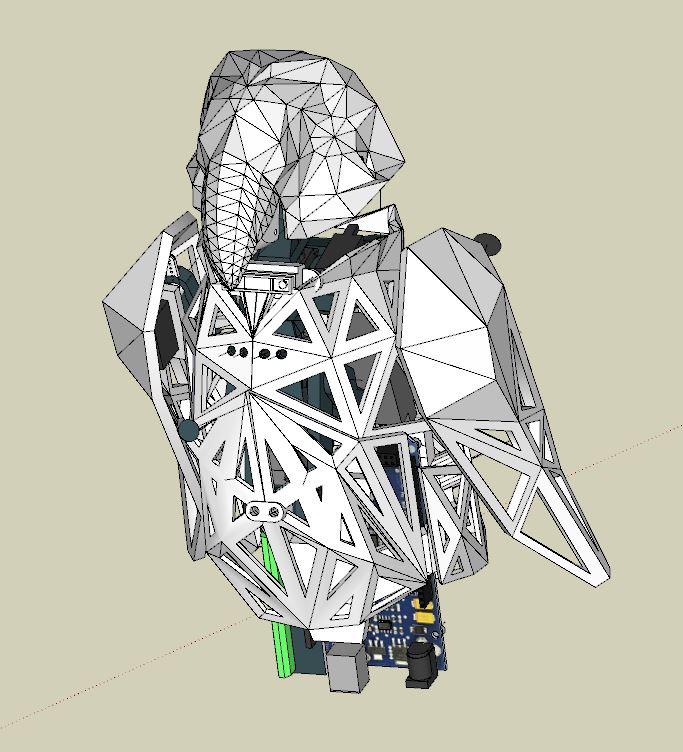 Matthews tells us that he started with the shell, and in order to get a basic version of what a 3D parrot looks like, he downloaded an already drawn version from the Sketchup 3D Warehouse. He also spent a lot of time watching YouTube videos depicting real-life parrots in action, as well as viewing multiple photos of the lovely birds. Once he thought he had a good idea of what a parrot should look and act like, he dumped his original downloaded model and started from scratch by tracing profile and front views of a parrot drawn from internet photos imported to Sketchup.
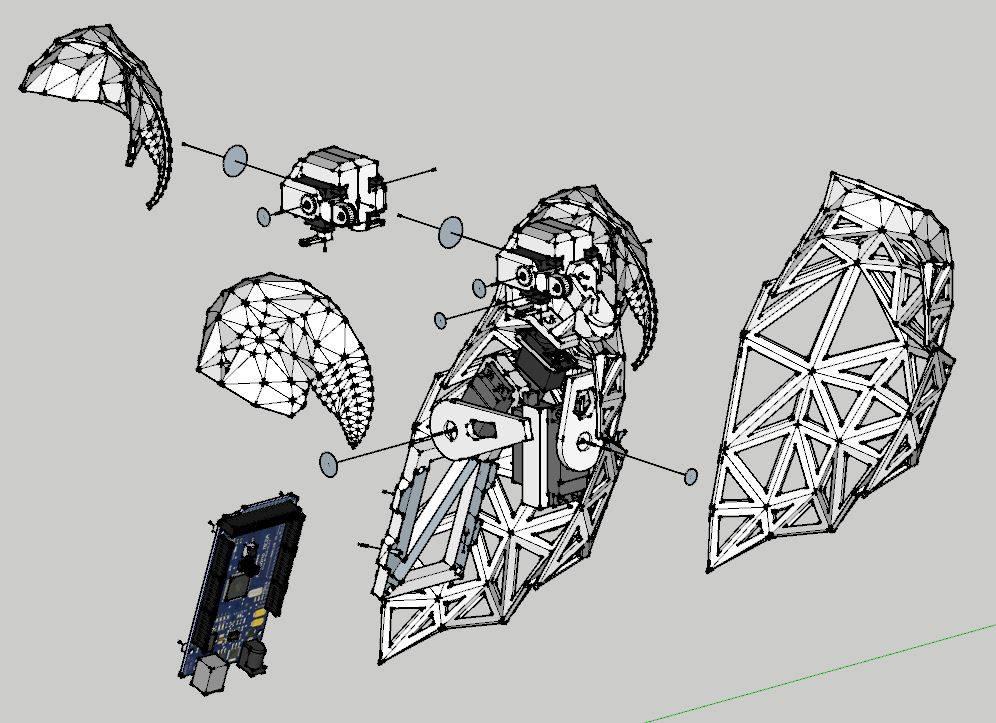
“Using those, I placed the servos inside the shape where I thought it needed pivots and where the essential actuation need[ed] to be to match those goofy goofy birds,” Matthews tells us. “For the insides, the 3D printed parts just needed to either hold a servo, or mount onto its arm. So designing parts to jump from servo to the next was fairly easy once the servo positions seemed right. For the shell around the bird I hand drew in all the mesh triangles using the traced picture outlines as guides. Artitian plugin is useful here for sculptural tools working with triangular meshes. Three plugins that were essential were the .STL export, Fredo’s Junction push-pull, and TIG’s Smart Offset plugin. After the thin membrane triangulated shape was good and adjusted to fit all the servos even when they move, I would use the multiple offset tool plugin to make internal outlines on all the triangle surfaces. Then I used the Junction Push Pull plugin to turn that thin triangulated framework into a thickened shell so there was something of thickness to actually print.”
In the end, Matthews’ hard work paid off, as he created what is probably the world’s first 3D printed robotic parrot, and it is really incredible (as seen in videos). The movements are very reminiscent of a real live parrot.
What do you think about this intricately designed robot? Would you have done anything different? Discuss in the 3D printed robotic parrot forum thread on 3DPB.com. Check out the video and photos below.
Subscribe to Our Email Newsletter
Stay up-to-date on all the latest news from the 3D printing industry and receive information and offers from third party vendors.
Print Services
Upload your 3D Models and get them printed quickly and efficiently.











You May Also Like
Critical Alloy Powder Manufacturing: CAPP Prioritizes AM Feedstocks and Advances U.S. Materials Leadership
Scaling additive manufacturing (AM) supply chains, particularly for metal powder-based processes, depends on the economic viability of products. The development of critical high-temperature metal alloys in powder form requires customer...
Subaru’s Adoption of T25 High Speed Head Reinforces Stratasys’ Dominance in 3D Printed Automotive Tooling
Last September, AM Research published a white paper sponsored by Stratasys on the role of additive manufacturing (AM) in enabling point-of-need tooling production across various industries. The white paper, “3D...
The Future of Metal Parts for Aerospace and Defense
Aerospace and defense manufacturing is entering a pivotal era. The demands placed on metal parts have never been higher, driven by rising performance expectations, increasing system complexity, and an operating...
Xometry President Sells $1.7M in Shares in Pre-Planned Transaction
After a strong year for its stock, Xometry (Nasdaq: XMTR) is back in focus after a recent insider share sale. The transaction has also renewed interest in how investors are...