MakerBot Announces Latest Updates: Welcome to MakerBot Desktop 3.3, Firmware 1.4

 After laying out a plan for an exciting several months going forward, Makerbot has today begun rolling out that plan by announcing their latest software releases.
MakerBot Desktop and MakerBot Replicator 3D printers are the beneficiaries of the latest updates from the company, and in addition to improving upon previously available technology, they lay a solid groundwork for the already-anticipated next upgrade. Why wait?
MakerBot Desktop 3.3 sets the stage for improvements in print quality that will be released in Desktop 3.4 for sure, but it also hosts a bevy of its own new capabilities. Desktop 3.3 is meant for use with Fifth Generation firmware 1.4, connected to the MakerBot’s Fifth Generation 3D printers.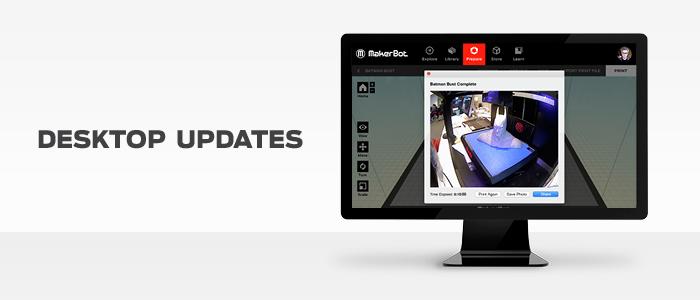
Among Desktop 3.3’s new and/or improved features are the following:
- A communications overhaul between the printer, Desktop, and MakerBot Mobile app
- Automatic filament loading after receiving an Out of Filament error
- Ability to change Smart Extruders during a paused print and resume printing
- Improved assisted leveling process
- Faster camera streaming over wi-fi or Ethernet, and added USB capabilities
- Expanded Device Preferences dialog for advanced users
- Print History added to the Library tab
- Print from file with .MakerBot files
MakerBot also notes that “after a Fifth Generation printer is reset to factory settings, users should power cycle the printer before setting up wi-fi,” as a known issue.
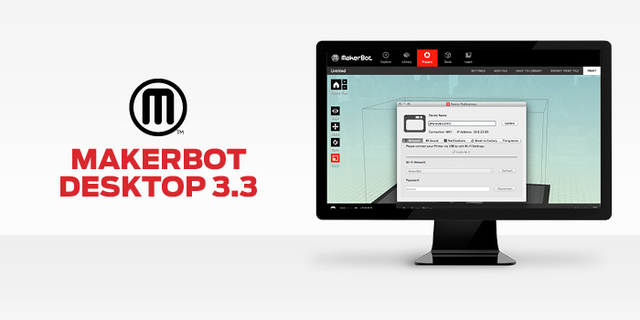
MakerBot offers the following simple steps to upgrade to MakerBot Desktop 3.3:
- Upgrade to MakerBot Desktop 3.3
- Connect MakerBot Replicator 3D printer
- Upgrade to Firmware 1.4 to keep your MakerBot Replicator running in top condition
Firmware 1.4, for its part, offers an update to MakerBot 3D printers. Updating to this latest version will ensure that the printer continues working at its best, in line with updates to other MakerBot platforms.
MakerBot continues to look forward:
“MakerBot Desktop 3.3 is an important release because it sets the stage for the 3.4 release where we will make some significant changes to the way we manage synchronizing the extruder advance to the movements of the gantry. The heavier computational requirements of our new extruder-advance modeling required us to refactor the communications protocol to make room.”
Expect many more updates in the months ahead as MakerBot ramps up their software. Have you downloaded the latest updates? What do you think about MakerBot Desktop 3.3? Let us know in the MakerBot forums!
Subscribe to Our Email Newsletter
Stay up-to-date on all the latest news from the 3D printing industry and receive information and offers from third party vendors.
Print Services
Upload your 3D Models and get them printed quickly and efficiently.











You May Also Like
“A More Complete End-to-End Solution”: Stratasys Launches Post-Processing Partnership Program
I think it’s safe to say that post-processing is no longer considered the “dirty little secret” of 3D printing that it once was, with users realizing that finishing is just...
Why SiC-Dedicated Additive Manufacturing Is Gaining Industrial Relevance
Silicon carbide is not a material problem—it’s a manufacturing one. Silicon carbide (SiC) has become a critical material across semiconductors, aerospace, energy, and defense. Its exceptional thermal stability, chemical resistance,...
Championing a Made-in-America Future for Additive Manufacturing
As the additive manufacturing industry continues its rapid global evolution, one theme has risen to the top of strategic conversations: the importance of strengthening domestic production to support national competitiveness...
Friendshoring and Additive Manufacturing: Turning Australia’s Research Strength into Commercial Impact
Global supply chains are being re-written. After decades of globalisation driven primarily by cost efficiency, geopolitical tensions, trade disputes and pandemic-era disruptions have exposed the risks of concentrating manufacturing and...