Rize Introduces Digitally Augmented Parts, Enhancing Compliance and Traceability in 3D Printed Parts

 Additive manufacturing company Rize Inc., headquartered in Boston, introduced its industrial Rize One 3D printer nearly two years ago. The hybrid 3D printer, with virtually no need for post-processing, combines FFF 3D printing and piezo material jetting into an inclusive, multi-material technology called Augmented Polymer Deposition (APD), which has been used to make isotropic, industrial strength parts like system components for medical testing equipment and functional prototypes of handles for medical instrumentation.
But now, the award-winning company is introducing its latest 3D printing innovation – the first Digitally Augmented Parts in the industry that integrate Industry 4.0 technologies.
“A significant challenge in the additive manufacturing industry are parts that are non-compliant due to design changes, piracy, counterfeit and obsolescence, that adversely impact the user and customer experience and result in rework, recalls and loss of brand value,” Julie Reece, VP of Marketing for Rize, told 3DPrint.com.
“We are pleased to announce that we have developed the additive manufacturing industry’s first Digitally Augmented Parts. With new capability, our voxel-level APD additive manufacturing process embeds Digital Rights Management into isotropic-strength, functional 3D printed parts for compliance, authenticity and traceability.”
 One of the biggest challenges in the 3D printing industry is non-compliant parts, whether it’s due to counterfeit and piracy or design changes and obsolescence. This can cause a major negative impact on the experience between user and customer, as it results in loss of brand value, redesign and rework, and recalls. But Rize’s Digitally Augmented Parts allows users to augment functional 3D printed parts with digital information.
As we see more and more intelligent products on the market, we’re also seeing more necessary parts for these products that need variable materials, including chemical, electrical, and mechanical properties.
The patented APD process can fuse these materials into unified parts, and can now also be used to 3D print industrial parts that contain embedded markers. This will help in creating a fixed connection between the digital part and the physical part: creating a useful bridge between both the real world and the virtual one.
“This is the first step towards embedding intelligent capabilities within the part and connecting them through a digital thread into the digital twin of the part. Rize is leading the integration of additive manufacturing into the digital ecosystem which will redefine the user and customer and experience and ultimately scale the technology to an entirely new segment of commercial and industrial users,” said Andy Kalambi, President and CEO of Rize Inc.
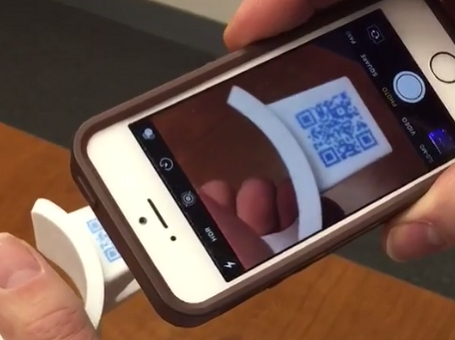
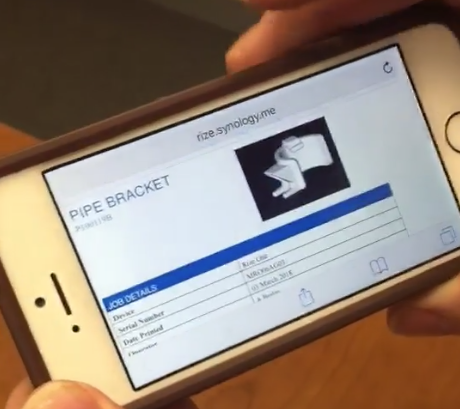
Thanks to the company’s voxel-level APD 3D printing, which includes Digital Rights Management into physical 3D printed parts for authenticity, compliance, and traceability, users can actually set up a digital thread between the physical part and its digital partner. For example, users can 3D print secure information, like a QR or bar code, on an industrial part with this new capability. Then, a smartphone app can quickly and easily scan this part code, and the corresponding digital information will instantly pop up online.
 This would allow, for example, an engineer to digitally store all of the information for a specific part, while also maintaining any digital augmentation for the part for the rest of its lifecycle. This capability can definitely help speed up important Industry 4.0 technologies such as AR/VR applications and blockchain.
Additionally, Rize’s new Digitally Augmented Parts capability will also enhance use of the 3D printing 3MF file format, which, according to the company, “carries significant intelligence on the additive part that can now be carried from the digital world into the physical world.”
At this week’s Additive Manufacturing Users Group (AMUG) conference at the St. Louis Union Station Hotel in Missouri, Rize will demonstrate its new capability to manufacture important Digitally Augmented Parts. If you want to see it for yourself, visit the company at booth P5.
What do you think about this new capability? Discuss this and other 3D printing topics at 3DPrintBoard.com or share your thoughts in the Facebook comments below.
[All images provided by Rize]
Subscribe to Our Email Newsletter
Stay up-to-date on all the latest news from the 3D printing industry and receive information and offers from third party vendors.
Print Services
Upload your 3D Models and get them printed quickly and efficiently.













You May Also Like
Solukon Goes Big with New SFM-AT850 Depowdering System
Solukon has released the SFM-AT850 depowdering system. The German depowdering specialist has updated its product line, and this machine replaces the SFM-AT800-S and SFM-AT1000-S. Rather than many small parts, this...
The Hidden Economics of Powder Bed 3D Printing: Closing the Loop in Powder Management
Automation is a very topical thing in additive manufacturing at the moment. With renewed scale, some clients are fervently looking to automate production. Other business cases only make sense with...
Oerlikon Adds ATLIX’s xBUILD 5000, Plans More for 2027
Oerlikon has installed a new ATLIX xBUILD 5000 metal 3D printer at its facility in Huntersville, North Carolina, marking the first production deployment of the system worldwide. The machine will...
The Science Lab You Can 3D Print
Researchers at Sweden’s Umeå University have shown how desktop 3D printers can be used to make lab equipment, giving scientists a cheaper way to build tools for their research. The...