Sage, The Intuitive 3D Modeling & Printing App for iPad has Launched


 There is no doubt in my mind that the future of 3D design will be incredibly intuitive. Up until recently, CAD software was something used within business settings by users trained on the software for years. These individuals possess talents far exceeding mine. The software was not meant for people like myself, who can barely hand draw something as simple as a pumpkin or even a football.
Then 3D printing emerged, giving ordinary people like you (well most of you) and I the ability to fabricate pretty much any design we wish. With this new technology comes the desire by many to create their own unique 3D models for printing. Over the last year or two, CAD software has improved, and new applications for smartphones, tablets, and computers are emerging with intuitive interfaces that even your grandma could figure out.
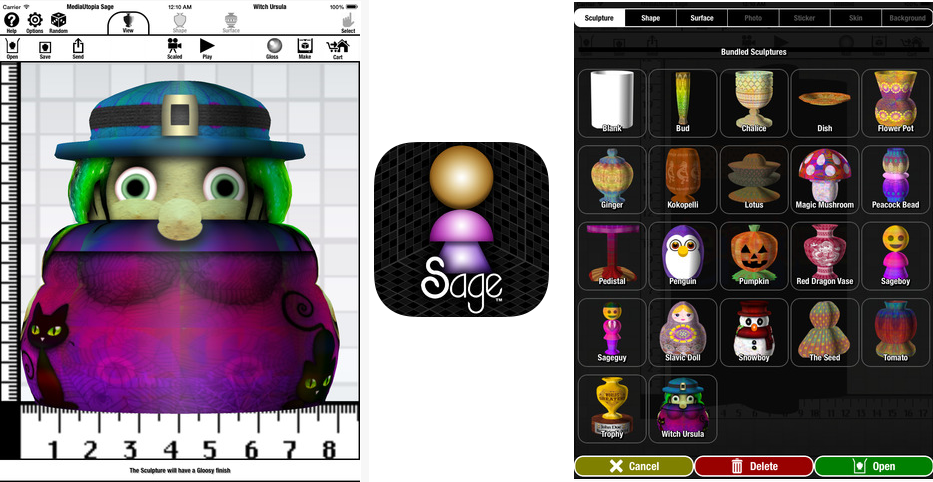
One such software comes in the form of a new iOS application for use on Apple’s iPad, produced by a company called MediaUtopia. The app, called Sage, allows for the creation of unique 3D models using a  simple touchscreen interface. Once a user has created something that they wish to print, no 3D printer is necessary. Through a partnership with iMaterialize, Sage will allow its users to pay a fee and have their creations shipped right to their doorsteps.
As for the the Sage application itself, which can be downloaded here, I spent a little time playing around with it this morning. I’m not great with directions, so I skipped them and dove right into the app. Within a few minutes I had figured out how to use the main features of the design tool.
There are already a number of interesting models which one can work off of. Once selected, the user is able to use a variety of tools to quickly, easily and intuitively shape that object anyhow they’d like. There is also a pretty interesting ‘Surface’ feature which will allow for the coloring of an object with a few simple tools. One of my favorite options within Sage, however, is the ‘Random’ icon. 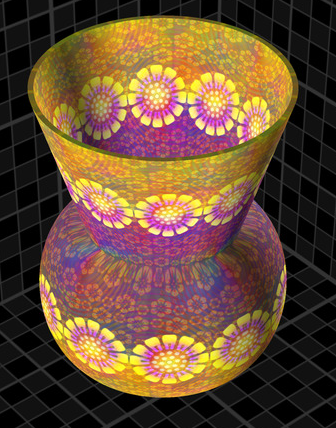 When selected, whatever model a user has on their screen will randomly transform both its shape and surface colors. I could literally sit here for an hour watching new colorful designs appear on my iPad screen, and when the ‘Play’ feature is activated, those models begin rotating in all directions almost putting the user into a trance.
Once a user is happy with their model, they can save it, share it via their favorite social networks, or ‘Make” it. When the ‘Make’ icon is selected the system will automatically calculate a price for iMaterialize to 3D print that specific model. If the user agrees, they can simply ‘check out’ and have that model shipped to them.
There are a number of applications out there which enable some of the same basic features. It really depend on the person, which one will suit them best. Sage is free to download, and will provide hours of fun even if you don’t have a desire to actually print out any of your designs. If you do, however, please share them with us in the Sage 3D Modeling App forum thread on 3DPB.com.
Subscribe to Our Email Newsletter
Stay up-to-date on all the latest news from the 3D printing industry and receive information and offers from third party vendors.
Print Services
Upload your 3D Models and get them printed quickly and efficiently.













You May Also Like
Mosquito Dreams Part 3: Kelly Johnson & The Starfighters
Chair manufacturer Thonet pioneered bending wood, mass production, and composites. Then a strange wooden airplane takes to the skies and, against all expectations, does well. It takes on many roles and...
Mosquito Dreams Part 1: Thonet, A World History
As a child, I lived in Kenya for a while. When we went to Mombasa, wafting breezes, crunchy white powder that sounds like snow underfoot, beaches bordered by many unseen...
At This 3D Printed Petting Zoo, the Mistakes Are Part of the Fun
Pip the Rabbit has a glowing belly and ears that wiggle when you press his paw. Inchy the Caterpillar crawls when you clap. Plate the Armadillo can curl himself into...
When Data Becomes the Differentiator: Qualified Material Data is Changing the Future of Structural Additive Manufacturing
For years, additive manufacturing has promised engineers greater design freedom. The challenge wasn’t printing the part—it was proving the part belonged on an aircraft. Designing a lightweight bracket or consolidating...