Providing Opportunities for Marines to Use 3D Printing


The Marines are never ones to shy away from new opportunities in hands-on problem solving. They have a strong history of making, including The Seabees, a famed construction battalion responsible for creating hundreds of miles of roadway and airstrips in combat theaters since WWII. So it comes as no surprise that the military branch would be very interested in the opportunities for their members to utilize 3D printing to solve on-site problems. And this is exactly what is underway with the 7th Marine Regiment and Combat Logistics Company 13 in California.
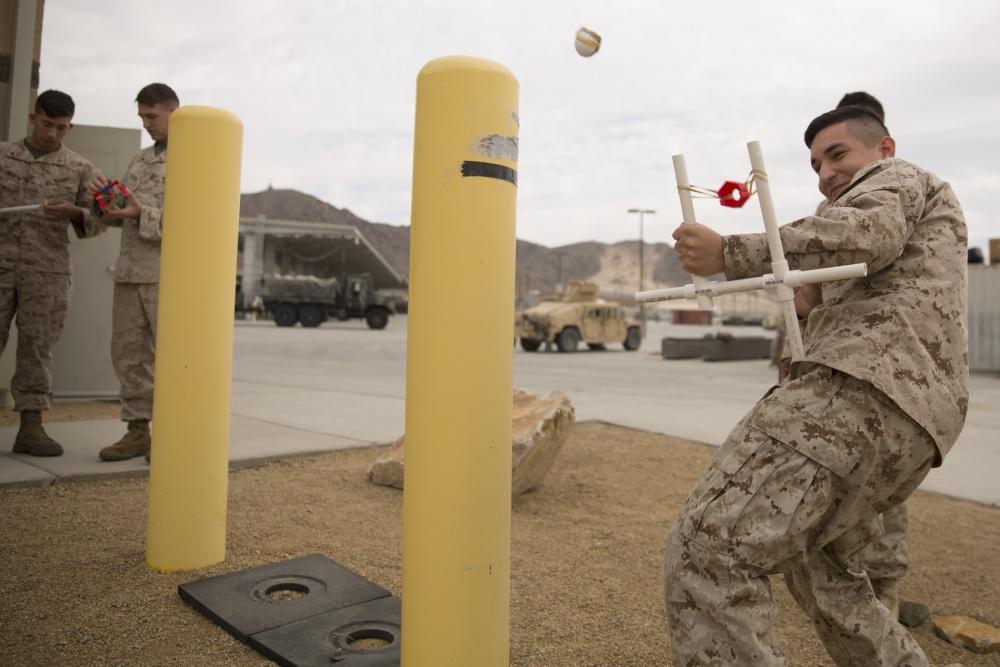
Lance Cpl. Jose Marroquin, electrical optical ordnance repair, 1st Battalion, 7th Marine Regiment, launches a ping-pong ball with a 3D printed slingshot. [Image: Cpl. Medina Ayala-Lo]
“I’m a firm believer in giving the warfighters as many tools as possible at their disposal. With this class, they are able to engineer solutions on the battlefield that might otherwise take months or years to solve. I love this stuff and I feel very strongly about it because when you’re in the field you have to be innovative and even if you don’t have these tools with you at least your mind is open to other things.”
 The class itself lasted for three days and was delivered in the style of a series of team challenges. The Marines were divided into several groups and, after a day spent becoming familiar with the technology, asked to create solutions to address two small, but realistic, challenges. The first project they undertook was to craft a shower head by 3D printing a piece that would connect a hose and a plastic water bottle. The second project saw them designing and creating a ping pong launcher. In both cases, the Marines were given free range to create the solutions that they saw fit with the hopes that even if they don’t have access to a 3D printer in the field, they might be able to use the creative thinking it encourages to see new solutions. That’s exactly what Staff Sgt. Benjamin Crain, the facilities manager for the 7th Marine Regiment, is hoping for:
“The idea was to get the majority of the Marines who are deploying to become familiarized with this process. Not only will the Marines be able to perform their primary jobs, but if need be they can also produce products for their unit. We’re all about trying to minimize the amount of time but maximize the impact.”
This isn’t the first connection that has been made between the usefulness of 3D printing and military endeavors, and it most likely won’t be the last. The quick turn around, flexibility, and relative ease with which the machines can be used in the field continues to make it one of the tools that can help make soldiers’ jobs easier. Discuss in the 3D Printing Marines forum at 3DPB.com.
[Source: DVIDS]
Subscribe to Our Email Newsletter
Stay up-to-date on all the latest news from the 3D printing industry and receive information and offers from third party vendors.
Print Services
Upload your 3D Models and get them printed quickly and efficiently.













You May Also Like
3D Printing News Briefs, July 1, 2026: Prosthetics, Drug Delivery, & More
We’re focused on healthcare and research in today’s 3D Printing News Briefs, including 3D printed prosthetics, patient-specific implants, drug delivery, and more. Read on for all the details! Students from...
3D Printing News Briefs, June 18, 2026: Reseller, Relocation, Metal Space Powder, & More
We’ll start with business news in today’s 3D Printing News Briefs, as XJet appointed a value-added reseller in Germany, BIO INX is expanding its presence in the Italian market, and...
CEO Yoav Zeif on Why Stratasys’ Markforged Acquisition Is Really a Bet on Industrialization
When Stratasys announced plans to acquire Markforged, the immediate focus was on the deal. Markforged is one of the most recognizable names in additive manufacturing (AM), known for its continuous...
Stratasys Acquires Markforged, Analysis of AM’s Latest Consolidation Move
A very long time ago, in 2023, the additive manufacturing (AM) industry was enraptured over the attempts by a large chunk of its publicly traded original equipment manufacturers (OEMs) to...