Arcam Demonstrates CoCr Process for Q10plus 3D Printer at formnext

 As formnext chugs along in Frankfurt this week, offering quite a show for visitors from all over the world, one industry leader after another is showing us the technology of the near future. Arcam, headquartered in Sweden, is certainly no exception as they show off their new Arcam CoCr process for Arcam Q10plus, continuing in their mission to provide affordable 3D printing solutions for metal component manufacturing.
A material that is unlike most we’ve generally had exposure to, CoCr is in great demand in the orthopedics and aerospace industries, along with titanium. Currently the ‘prime material’ used in these industries for 3D printing, CoCr allows Arcam’s EBM technology to be used to its fullest potential. CoCr provides parts that are unique in the following:
- High resolution
- Production level productivity
- Impeccable material properties

3D printed parts on display at Arcam’s formnext booth. [Image: Sarah Goehrke for 3DPrint.com]
- Arcam xQam – this is an X-ray based detection system, new and completely innovative, created for automatic calibration and improved beam control.
- EBM Control 5.0 – Arcam has created an all new software platform that not only adds functionality, greater efficiency, and accurate beam control, but also new melt strategies, improving build speed and precision.
- MultiBeam – Arcam’s proprietary technology for parallel melting.
As formnext proceeds on, Arcam will be both demonstrating additive manufacturing via Arcam EBM, and corresponding metal powders through AP&C.
“It is exciting to be at Formnext with our teams from the EBM business and the AP&C powder business exhibiting in concert. Arcam is determined to serve the industry through cost efficient solutions thus converting traditional manufacturing into Additive Manufacturing,” says Magnus René, CEO of Arcam.
 AP&C, headquartered in Canada, has actually just built a new facility for the manufacturing of their titanium powders meant for 3D printing. This construction was due to the high demand for their powders, and will provide:
- Manufacturing redundancy
- Short term capacity increase
- Long term expansion capability
With their AP&C plasma technology, the company is able to take raw materials and then convert them to valuable metal powders that offer a wide range of properties to include flowability, density, chemistry and traceability. It is currently estimated that the company will be offering a powder manufacturing capacity of 750 tons per year, or even more.
Are you at formnext this week? If so, be sure to check out what Arcam has to demonstrate in Hall 3/F20, and also see the AP&C products on display in Hall 3/G08. Discuss in the Arcam forum at 3DPB.com.
Arcam offers EBM systems through Arcam AB in Sweden, powder metals through AP&C in Canada and implant contract manufacturing through DiSanto in the U.S. The company is listed on Nasdaq Stockholm and the Head Office is located in Mölndal, Sweden.
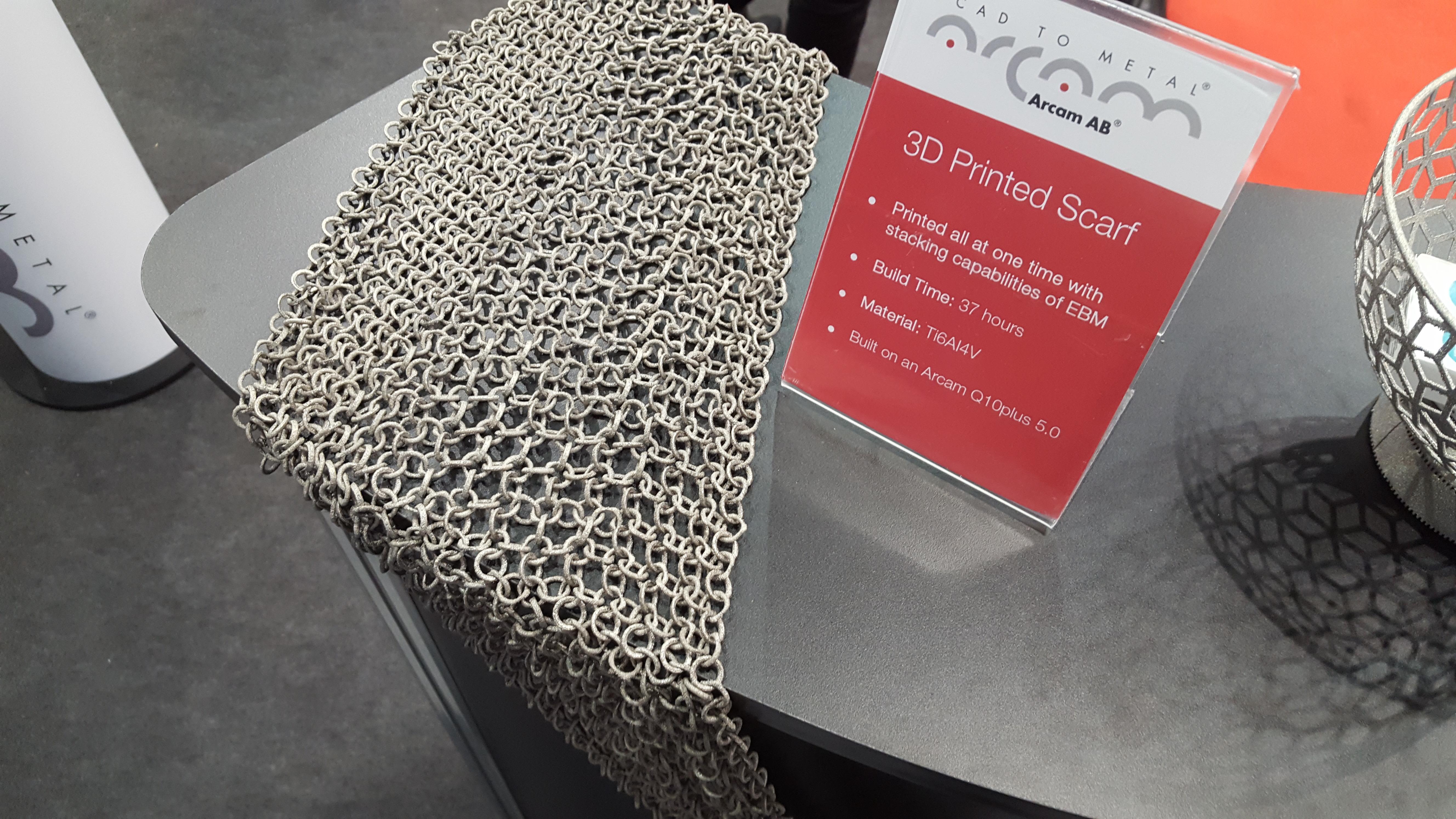
This incredible 3D printed scarf was produced with an Arcam Q10plus [Image: Sarah Goehrke for 3DPrint.com]
Subscribe to Our Email Newsletter
Stay up-to-date on all the latest news from the 3D printing industry and receive information and offers from third party vendors.
Print Services
Upload your 3D Models and get them printed quickly and efficiently.













You May Also Like
The Money Behind AM: What to Watch at AM Investment Strategies 2026
For years, simply being a 3D printing company could attract attention from investors. New machines, new materials, faster speeds, and the promise of mass production were often enough to get...
3D Printed Football Helmets Are Amazing Business. They’re Also So Much More
NFL football is by far the most popular sport in the US, followed by college football (a state-of-affairs oddly similar to the fact that the world’s largest air force is...
Continuous Composites Wins Navy SBIR for 3D Printed UAVs
In a diversification effort, Continuous Composites has decided to seek work outside of the courtroom. The company that has been successful in defending its patent portfolio in composite 3D printing...
When Data Becomes the Differentiator: Qualified Material Data is Changing the Future of Structural Additive Manufacturing
For years, additive manufacturing has promised engineers greater design freedom. The challenge wasn’t printing the part—it was proving the part belonged on an aircraft. Designing a lightweight bracket or consolidating...