ORNL Researchers 3D Print Permanent Magnets for Clean Energy Applications, Saving Time, Cost and Material

 At this point, it’s no longer a surprise to hear that 3D printing something results in better performance, strength, etc. compared to traditionally manufactured equivalents. The fact that it’s no longer a surprise, however, doesn’t make it any less exciting – especially when the product or component in question is something that has never been 3D printed before. Last month, a group of researchers from Technische Universität Wien (TU Wien) revealed that they had used 3D printing to create strong permanent magnets, offering the potential for the design and production of magnets with complex customized shapes and fields. The discovery opened up new possibilities for the design of advanced sensing systems.
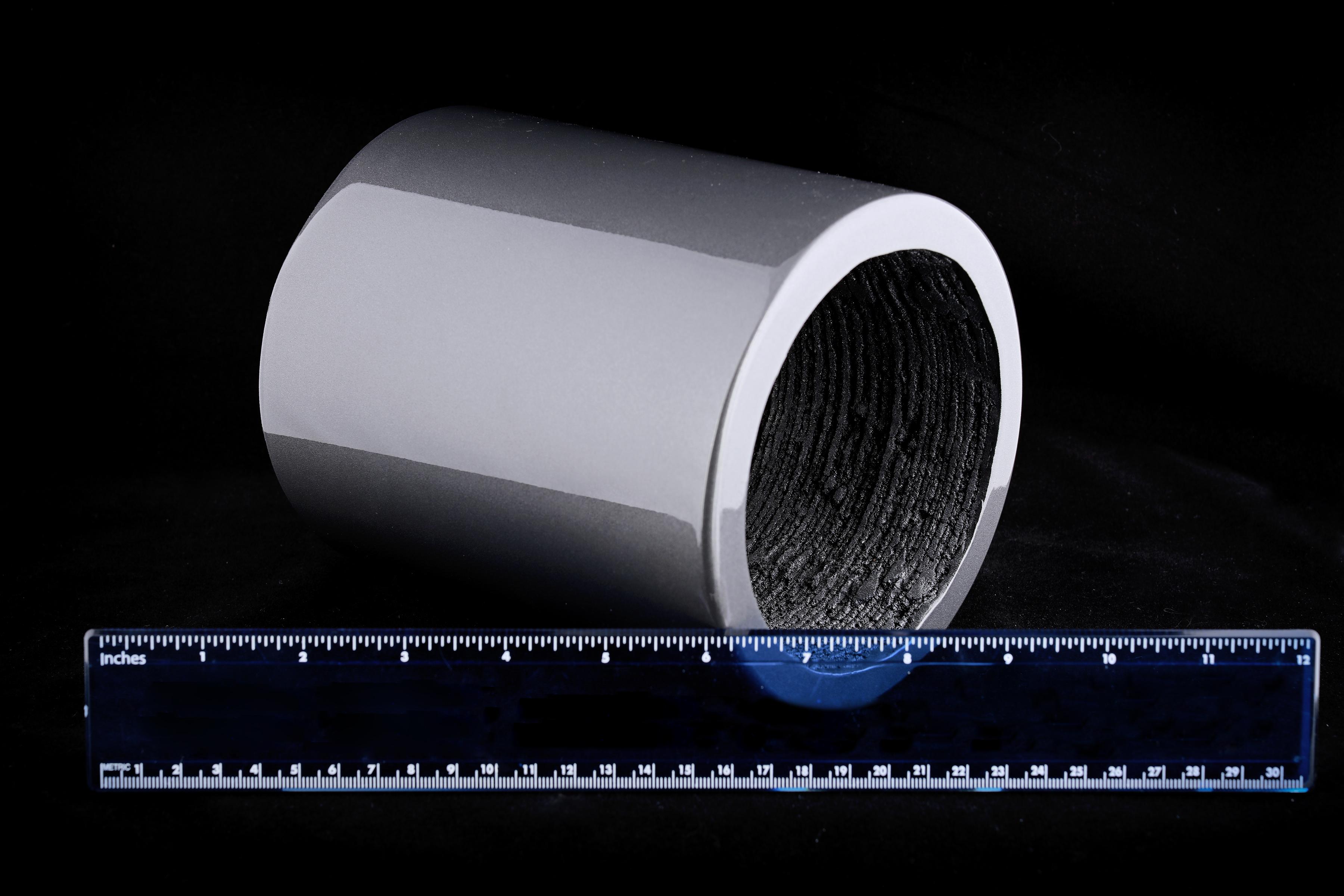
Now, researchers at Oak Ridge National Laboratory have released their own study discussing how 3D printed magnets can outperform permanent magnets created by traditional means, while also conserving rare materials. In a paper entitled “Big Area Additive Manufacturing of High Performance Bonded NdFeB Magnets,” the research group documents how they used the Big Area Additive Manufacturing Machine (BAAM) to 3D print isotropic, near-net-shape, neodymium-iron-boron (NdFeB) bonded magnets.
The team used composite pellets, manufactured by Magnet Applications Inc., composed of 65% isotropic NdFeB powder and 35% polyamide, or Nylon 12. They experimented with printing the material both with a binder jetting machine and with the BAAM, but it was the BAAM that, unsurprisingly, delivered the most dramatic results, with its ability to print at almost 200 times faster than other additive manufacturing technologies with no size or shape limitations. The resulting magnets had comparable or even better magnetic, microstructural and mechanical properties than bonded magnets produced with the same composition via injection molding.
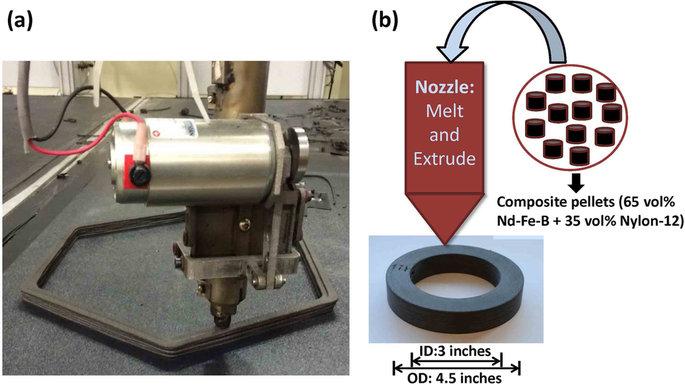
The research was funded by the Department of Energy’s Critical Materials Institute with the goal of developing powerful magnets for use in clean energy technologies such as windmills, generators, motors and electric vehicles. NdFeB magnets are the most powerful magnets in existence, and 3D printing them, the research team discovered, not only allowed for complex shapes and large sizes but produced much less material waste. According to Parans Paranthaman, principal investigator and a group leader in ORNL’s Chemical Sciences Division, conventional magnet manufacturing can result in 30% to 50% material waste, while additive manufacturing results in nearly zero, thanks to its ability to capture and reuse materials.
 In addition, the cost of manufacturing magnets is greatly reduced compared to traditional injection molding, said Ling Li, a co-author on the study. A customer may easily require 50 different magnet designs for a project, and instead of having to create a separate mold and tooling for each one, they can be quickly and easily 3D printed for much less expense.
“The ability to print high-strength magnets in complex shapes is a game changer for the design of efficient electric motors and generators,” said Alex King, Director of the Critical Materials Institute. “It removes many of the restrictions imposed by today’s manufacturing methods.”
In the future, the researchers plan to experiment with the 3D printing of anisotropic, or directional, bonded magnets, which are stronger than isotropic magnets and have no specified magnetization direction. They will also study the effects that different binder types, the loading fraction of magnetic powder, and processing temperatures have on the mechanical and magnetic properties of the printed magnets.
“This work has demonstrated the potential of additive manufacturing to be applied to the fabrication of a wide range of magnetic materials and assemblies,” said study co-author John Ormerod of Magnet Applications. “Magnet Applications and many of our customers are excited to explore the commercial impact of this technology in the near future.”
Additional contributors to the study include Angelica Tirado, Orlando Rios, Brian Post, Vlastimil Kunc, R.R. Lowden, Edgar Lara-Curzio, I.C. Nlebedim, Thomas Lograsso and Robert Fredette. You can access the full study here. Discuss in the 3D Printed Magnets forum at 3DPB.com.
[Source: ORNL]
Subscribe to Our Email Newsletter
Stay up-to-date on all the latest news from the 3D printing industry and receive information and offers from third party vendors.
Print Services
Upload your 3D Models and get them printed quickly and efficiently.











You May Also Like
2026: The Year of the Low Cost Print Farm
The rise of high-speed, reliable desktop Material Extrusion and Vat Polymerization systems by Creality, Bambu, Elegoo, and Prusa Research, the onward march of Formlabs in Pro LPBF and VP, as...
3DPOD 287: 3DP/AM Market Data and Applications with Scott Dunham, AM Research
Scott Dunham models all the data at Additive Manufacturing Research. He has been predicting the growth of the 3D printing market in segments, materials, and applications for over a decade....
3D Printing Stocks in 2025: Performance and Market Trends
In 2025, the best-performing 3D printing stocks weren’t mostly the classic Western printer makers. Some of the strongest performers were digital manufacturing platforms and software-intensive players; these are businesses that...
Who Merged, Who Was Acquired, and Who Disappeared in 3D Printing in 2025
2025 was a year of change for 3D printing, with much of the year’s activity coming from mergers, acquisitions, restructurings, and company exits. Together, these moves indicate a broader shift:...