The 3-2-1 Liftoff! ULA Rocket Hardware Challenge Launches Through GrabCAD Community

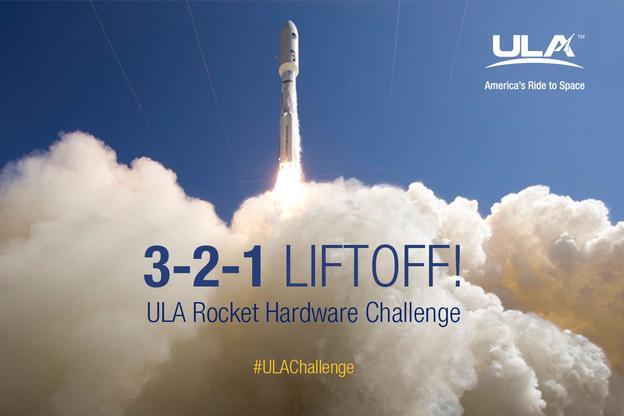 3D printing has had major impacts in the aerospace industry. Some of the most brilliant engineering minds have been put to the test designing parts for rockets that one day may blast off to carry astronauts as far as Mars. But there has been quite an outpouring of talent from those outside of NASA as well, with more on the way currently in the 3-2-1 Liftoff! ULA Rocket Hardware Challenge launched earlier this week through GrabCAD Community Challenges.
For this challenge, those participating are invited to design a launch support attachment bracket for the United Launch Alliance’s current Atlas V rocket. ULA acts as a leader for launch services and has sent at least 100 satellites into orbit so far. These satellites have been responsible for helping military personnel, meteorologists, enabling GPS devices—and most importantly, helping us to understand our solar system further. And while it’s exciting just to fall into the top designs chosen in a challenge like this, the winning design will actually be examined for use on the Vulcan Centaur, a next-generation rocket.
“We are transforming the future of space launch, and additive manufacturing is one of the innovative techniques we’re using to make space more affordable, accessible and commercialized,” said Tory Bruno, ULA president and CEO. “The ULA Rocket Hardware Challenge invites people familiar with the industry and new to aerospace to participate in that transformation – the opportunity to design rocket hardware that will deliver critical technologies to orbit.”
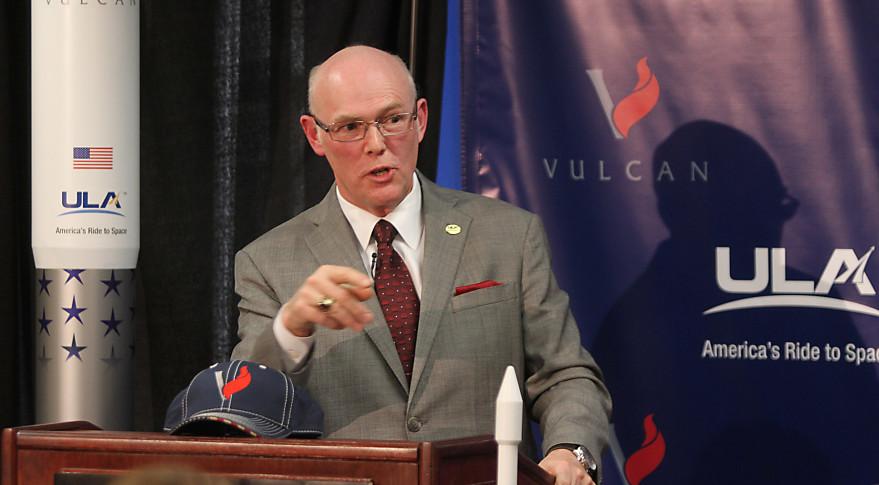
ULA CEO Tory Bruno
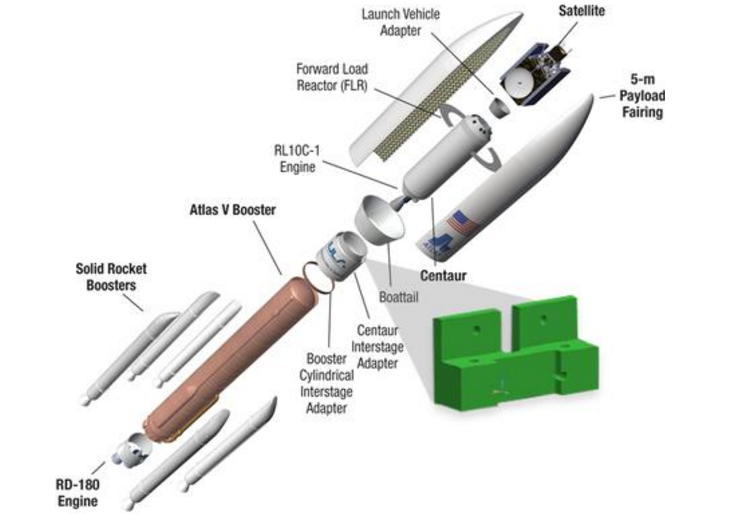
This particular bracket is meant to act as support at the base of the Atlas V payload fairing, used during ground processing. While it will also remain with the upper stage of the powerful rocket during its flight, the bracket acts as a point of support for the work platforms being employed in the days before launch occurs.
The best three designs will be chosen, and judges include Tory Bruno, as well as engineers from both ULA and Stratasys, which partnered with ULA earlier this year to develop several 3D printed components for the Atlas V. Specifications follow from GrabCAD, with more technical information here as well.
“All portions of the bracket must remain within the envelope shown in the Part Design Envelope drawing (see Download Specification button). The part will be fastened to the vehicle interface at datum A using 4 bolts shown as holes (marked Hole Pattern D) in the envelope drawing. A load from the work platform will be applied uniformly on a surface located at datum B and will be fastened using 2 bolts shown as holes (marked Hole Pattern E) in the envelope drawing. The minimum edge distance surrounding all bolt holes shall be 2 times the diameter of the bolt hole.”
Your entry must include:
- Description of the bracket
- STEP/IGES formatted files
- Renderings
- Mass, Volume
- Load calculations
- ULA Compliance Certification form
Prizes are:
- 1st Prize – $3,000 and ULA merchandise prize pack
- 2nd Prize – $1,000 and a ULA hat
- 3rd Prize – $500 and a ULA T-shirt
Those interested in submitting designs must have them in by October 23, 2016. To learn more, go to GrabCAD. Discuss further in the 3-2-1 Liftoff 3D Design Challenge forum over at 3DPB.com.
Subscribe to Our Email Newsletter
Stay up-to-date on all the latest news from the 3D printing industry and receive information and offers from third party vendors.
Print Services
Upload your 3D Models and get them printed quickly and efficiently.













You May Also Like
Solukon Goes Big with New SFM-AT850 Depowdering System
Solukon has released the SFM-AT850 depowdering system. The German depowdering specialist has updated its product line, and this machine replaces the SFM-AT800-S and SFM-AT1000-S. Rather than many small parts, this...
The Hidden Economics of Powder Bed 3D Printing: Closing the Loop in Powder Management
Automation is a very topical thing in additive manufacturing at the moment. With renewed scale, some clients are fervently looking to automate production. Other business cases only make sense with...
Oerlikon Adds ATLIX’s xBUILD 5000, Plans More for 2027
Oerlikon has installed a new ATLIX xBUILD 5000 metal 3D printer at its facility in Huntersville, North Carolina, marking the first production deployment of the system worldwide. The machine will...
The Science Lab You Can 3D Print
Researchers at Sweden’s Umeå University have shown how desktop 3D printers can be used to make lab equipment, giving scientists a cheaper way to build tools for their research. The...