Tecnica’s CASA SLS Printer Blows the Competition Away, Prints Up to 250 Times Faster

 As far as professional needs go in the world of 3D printing, it would seem that the CASA Printer has it all. And you can bet that as you read each word here, somewhere else a competitor is doing the same but also wondering how in the blazes they are going to measure up to this leapfrog of a release for professional 3D printing. And so it goes in the world of technology, with Tecnica looking very good right now.
The CASA, due to be released in late December, was seen earlier in the year at Inside 3D Printing New York, held in April 2016. The Tecnica team explains that the CASA SLS printer was designed as a separate line from their Optima 3D printer, which uses Direct Metal Laser Sintering (DMLS), allowing for production of metal prototypes as well as functional parts. Because that technology is often far too cost-prohibitive for smaller or even mid-sized businesses, they’ve also made the CASA for non-metal 3D printing, priced under $20K.
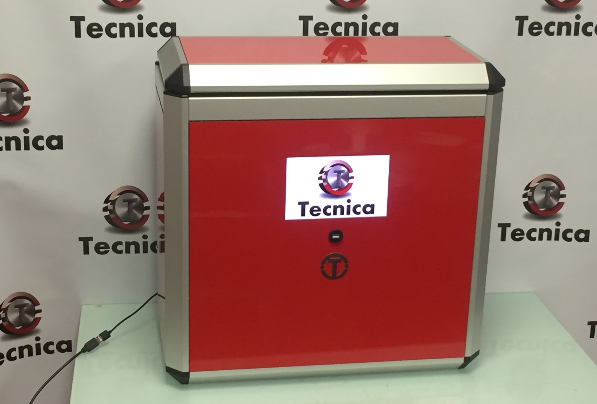
Compact enough for the desktop, this professional printer prints in a resolution better than 0.07 mm over print size of 92 x 100 x 150 mm. Both the Optima and CASA printers use the Titan Print-head. This allows the Tecnica to print at a speed that is a stunning 250 times faster than any other printer, thanks to the print head technology.
Charles Bibas, CEO and founder of Tecnica.
“Our patented print head is a game changer,” stated CEO and founder Charles Bibas. “At Tecnica, we measure print speed in hundreds of meter per second in a market where the speed limit is at about 6 meter/second.”

A powerful 25-watt laser with an internal cooling peltier system and a positive pressure airflow allow for printing in a pre-set temperature range. Users are able to both monitor and control the process of 3D printing via a color touchscreen featuring high resolution on a ten-inch monitor. Not only can you see your print being made in 3D, but also statistics regarding the part such as temperature, processed layer, elapsed printing time and more. The CASA also features automatic locked closing, as well as easy maintenance and cleaning due to a thoughtfully considered design.
Whether using the CASA or Optima, the Tecnica development team sees this new technology as being one that will benefit industries such as aerospace and NASA, defense companies, and automotive manufacturers—all who will be able to benefit from high performance, high quality parts, and better savings on the bottom line in the long run.
“Schools and universities, manufacturers, prototypers, jewelers and designers can all afford a professional grade 3D printer for a hobbyist price,” stated the Tecnica team in their latest press release.
The patent, number 9,435,998 awarded from the United States Patent and Trademark Office, was granted on September 6th, marking the second patent granted in 2016 to Tecnica for 3D printing technologies. See Tecnica for more information on their lineup of 3D printers, and head over to the Tecnica 3D Printer forum to discuss this new technology further at 3DPB.com.
Subscribe to Our Email Newsletter
Stay up-to-date on all the latest news from the 3D printing industry and receive information and offers from third party vendors.
Print Services
Upload your 3D Models and get them printed quickly and efficiently.













You May Also Like
Creality K3 Opens for Pre-Order at $849, Advancing Multi-Color 3D Printing
Creality has officially opened pre-orders for the Creality K3, its latest flagship K Series 3D printer, starting at $849 in the United States. Recognized as an IFA Innovation Awards 2026...
Beyond the Printer: HP and DyeMansion Tackle the Future of Prosthetics
Making a custom orthotic or prosthetic device involves much more than producing the final part. Patients need to be measured, devices must be designed to fit their bodies, and finished...
3D Printing News Briefs, October 14, 2026: Bolus, Aerospace Tooling, Water Filter, & More
In today’s 3D Printing News Briefs, we’re starting with medical news, as Myrava has received FDA 510(k) clearance for its 3D printed bolus. Moving on to aerospace and metals, AML3D...
Can India’s AM Push Help Make it a Viable Supplement to China?
Diversifying manufacturing supply chains to locales outside of China has nothing to do with actually cultivating “substitutes” to the Chinese economy. The real stakes are these: China is an irreplaceable...