Vader Systems Poised to Become the Leader in Liquid Metal 3D Printing


 By the time the Buffalo, New York-based engineer Zack Vader reached the age of 18, the young maker began developing his idea for a cutting edge technology that he thought could be a game changer in the 3D printing industry. That was back in 2011. Fast forward to today, and the continuous research and development conducted by Zack and his father, a fellow 30-year career engineer named Scott, has culminated into Vader Systems, one of the two companies in the world to manufacture liquid metal 3D printers.
The other liquid metal 3D printer manufacturer, an Israel-based company XJet, has staked their claim in the patented Nano Metal Jetting technology, which was recently showcased at RAPID 2016. XJet’s version of liquid metal printing uses a nanotechnology to create specially formulated metal liquids that can be printed as easily as inks, and is capable of 3D printing fully formed metal objects quickly and accurately. Meanwhile, the Vader family has been cooking up a unique 3D printing system of their own, the Mk1, which utilizes their patent pending MagnetoJet technology.
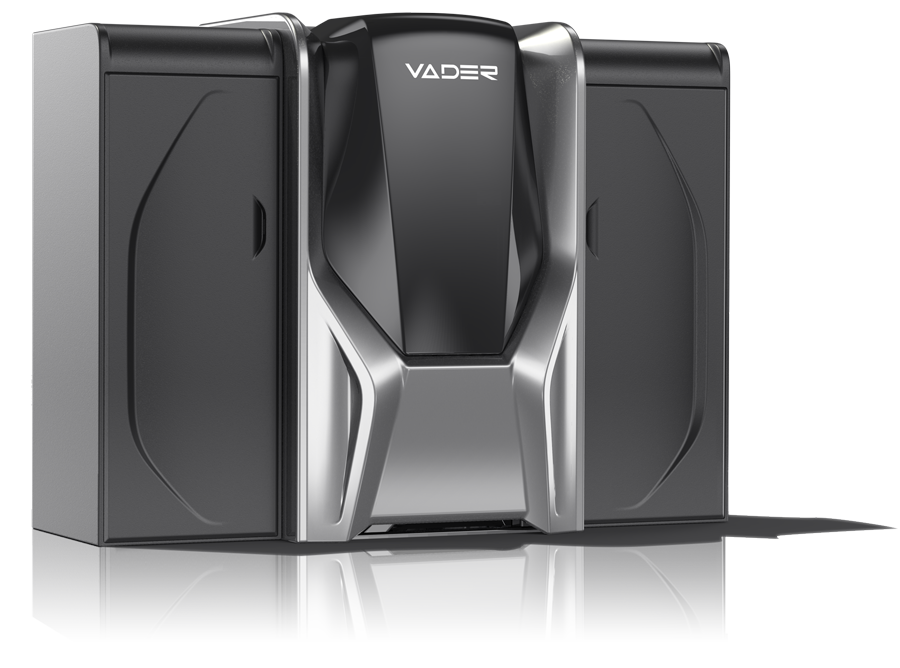 Essentially, the Vader system is an inkjet printer for liquid metal material. To develop this, Zack Vader merged Magneto Hydro Dynamics (MHD) and Liquid Metal Jet Printing (LMJP) together into one unique technology, which has come in the form of the Mk1 3D printer. The Mk1 utilizes a spool of raw metal-based material, which is first fed into a chamber that is heated up to 800°C in a ceramic chamber, and then, using electromagnetic pulses, that molten aluminum is dispersed into individual droplets. These liquid metal droplets are cleanly ejected and formed with pinpoint precision.
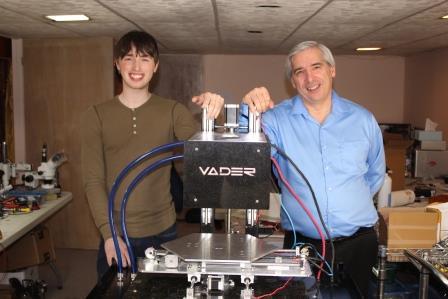
Zack and Scott Vader
Although it took a hefty amount of trial and error to adequately develop the MagnetoJet 3D printing technology, the Mk1 is already proving itself to be a viable system. They’ve already completed a deal with the New York-based machine shop Aurora Machine, which has purchased their liquid metal 3D printer to produce aluminum-based parts. The journey began when Zack was looking to produce a micro-gas turbine generator, but found manufacturing costs to be prohibitive. After realizing that the powders used for metal 3D printing were too expensive and time-consuming, the Vaders decided to drop everything and focus on developing their unique technology.
In order to help pursue this new technology with his son, Scott Vader actually left his longtime career as an engineer to become the CEO of his son’s endeavor, leaving Zack with the time and resources to focus on product development. The family business has come a long way since their first prototype failed, and are now reportedly gaining interest from major companies like Lockheed Martin and others. The first official purchaser of the MagnetoJet technology, Aurora Machines, is expected to receive the first liquid metal 3D printing system in early 2017. With that, Vader Systems may soon radicalize the way that metal products are 3D printed. Discuss further in the Mk1 Metal 3D Printer forum over at 3DPB.com.
[Source: Vader Systems]Subscribe to Our Email Newsletter
Stay up-to-date on all the latest news from the 3D printing industry and receive information and offers from third party vendors.
Print Services
Upload your 3D Models and get them printed quickly and efficiently.













You May Also Like
HeyGears G1 Passes $14M on Kickstarter with Full-Color 3D Printing
HeyGears was started in 2015 and has been making value-driven Vat Polymerization systems for dental and home use. The company is marketing savvy and very driven. Now the firm has...
3D Printing News Briefs, August 26, 2026: Meshy 7, 4D Printed Implants, & More
We’re kicking things off today with software news, as the new Meshy 7 is now live. Then we’ll move on to business, with ExOne and voxeljet now operating as a...
Hi3D V3.0 Launches Industry’s First Commercial 2048³ Ultra-High-Precision AI 3D Model, Free for 48 Hours
Hi3D, the all-in-one AI 3D creation platform, has launched Hi3D V3.0, the industry’s first commercially available AI 3D model with 2048³ voxel resolution. The new version is designed to dramatically...
One Machine, Three Worlds of Creation: Inside the HeyGears G1 Series
Turning a digital idea into a finished full-color physical product often requires several machines, multiple software tools, manual coloring, repeated positioning, and outsourced production. For creators and small businesses, this...