Ford Announces Plan to Have Automated Driverless Cars on the Road by 2021

 A lot can happen in five years, although that amount of time seems to fly past nowadays. 2011 seems almost disturbingly recent, so 2021 might as well be just around the corner – which makes Ford‘s assertion that they will have automated, driverless vehicles on the road by that time even crazier to think about. Despite the fact that several major automotive manufacturers, including Ford, have been developing and testing driverless cars lately, the technology is still something that seems very far away, in terms of actually seeing it in use in most cases. Now that Ford has given an actual, relatively near-future date for the full implementation of driverless technology, it’s suddenly much more real.
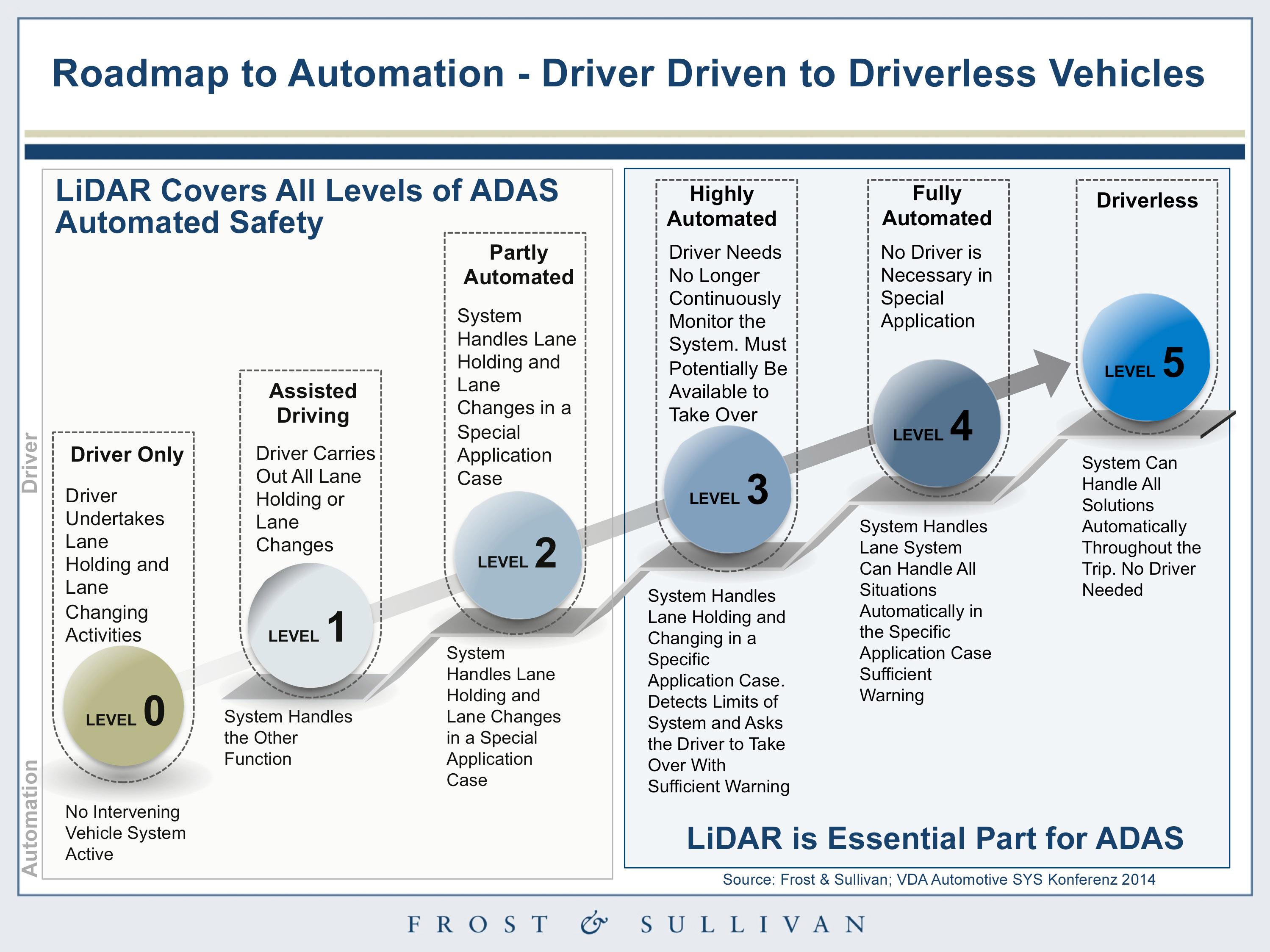
Don’t start saving to buy a new automated car just yet, though. Ford won’t be selling their vehicles to the average consumer for a while; instead, they plan to introduce them as part of an automated ride-sharing system: Uber without drivers. The cars will be SAE Level 4 autonomous – one of the highest levels in a grading system based on how much of a vehicle’s function is automated. Level 4 is defined as “high automation,” meaning that it won’t even include a steering wheel or pedals; all that’s required of a human passenger is inputting the destination.
Ford is very serious about the 2021 goal; the company plans to double the number of employees at their research and development facility, as well as adding two new buildings and 150,000 square feet of lab space to their Research and Innovation Center in Palo Alto. They’ve also invested a lot of cash already, including $75 million in leading LiDAR (Light, Detection and Ranging) technology manufacturer Velodyne.
 LiDAR is one of the primary technologies that makes driverless cars work – it’s how the cars “see” what’s around them. Laser-based sensors, combined with complex algorithms, process data from the car’s surroundings and create high-resolution digital 3D images used for mapping and localization, object identification and collision prevention. Velodyne is responsible for some of the sharpest LiDAR technology out there, capable of producing anywhere from 300,000 to 2.2 million data points per second with a range of up to 200 meters and centimeter-level accuracy, making it a favorite among developers of autonomous vehicles.
“From the very beginning of our autonomous vehicle program, we saw LiDAR as key enabler due to its sensing capabilities and how it complements radar and cameras,” said Raj Nair, Ford Executive Vice President, Product Development and Chief Technical Officer. “Ford has a long-standing relationship with Velodyne and our investment is a clear sign of our commitment to making autonomous vehicles available for consumers around the world.”
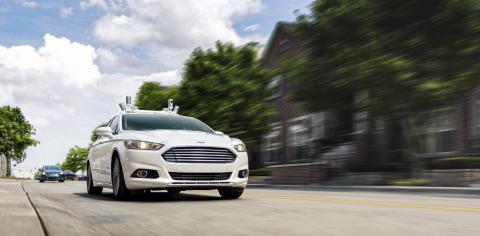
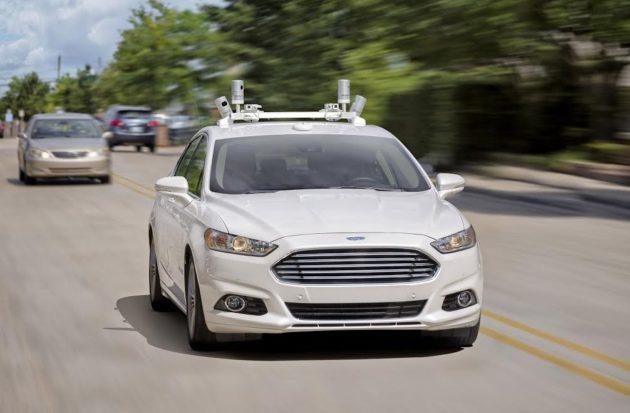
Ford’s autonomous Fusion Hybrid research vehicle
Ford isn’t the only one with eyes on Velodyne: Chinese search engine provider Baidu, Inc. has also invested $75 million in the LiDAR company. Essentially the Google of China, Baidu is working on their own driverless car technology, and is already testing an autonomous fleet – as are many companies, including Uber itself. It’s a competitive race to be the first company to get driverless cars on the road, so it makes sense that Ford is so drastically multiplying their efforts.
 Those efforts include an investment in 3D mapping company Civil Maps and a partnership with Cornell-based machine vision organization Nirenberg Neuroscience. They’ve also acquired Israeli computer vision and machine learning company SAIPS. In addition, Ford is tripling the size of their autonomous research fleet, with plans to triple it again next year.
“The next decade will be defined by automation of the automobile, and we see autonomous vehicles as having as significant an impact on society as Ford’s moving assembly line did 100 years ago,” said Mark Fields, Ford President and CEO. “We’re dedicated to putting on the road an autonomous vehicle that can improve safety and solve social and environmental challenges for millions of people – not just those who can afford luxury vehicles.”
The 2021 goal is part of the larger Ford Smart Mobility plan, which aims to make Ford the leader in not only autonomous vehicles, but also in data and analytics, connectivity and mobility. Discuss further in the Ford Driverless Cars forum over at 3DPB.com.
https://youtu.be/lITdVxm_hD0
Subscribe to Our Email Newsletter
Stay up-to-date on all the latest news from the 3D printing industry and receive information and offers from third party vendors.
Print Services
Upload your 3D Models and get them printed quickly and efficiently.











You May Also Like
2026: The Year of the Low Cost Print Farm
The rise of high-speed, reliable desktop Material Extrusion and Vat Polymerization systems by Creality, Bambu, Elegoo, and Prusa Research, the onward march of Formlabs in Pro LPBF and VP, as...
3DPOD 287: 3DP/AM Market Data and Applications with Scott Dunham, AM Research
Scott Dunham models all the data at Additive Manufacturing Research. He has been predicting the growth of the 3D printing market in segments, materials, and applications for over a decade....
3D Printing Stocks in 2025: Performance and Market Trends
In 2025, the best-performing 3D printing stocks weren’t mostly the classic Western printer makers. Some of the strongest performers were digital manufacturing platforms and software-intensive players; these are businesses that...
Who Merged, Who Was Acquired, and Who Disappeared in 3D Printing in 2025
2025 was a year of change for 3D printing, with much of the year’s activity coming from mergers, acquisitions, restructurings, and company exits. Together, these moves indicate a broader shift:...