Australian Company Fastbrick Robotics Introduces a Robot That Can Build a House 4X Faster than a Human


Hadrian’s Wall
In the year 122, the Roman emperor Hadrian began building a stone wall that would eventually stretch more than 70 miles across Northern England. Constructed as a defensive fortification around the Roman-controlled province of Britannia, the wall took about six years to build; parts of it still stand and are a popular tourist attraction in England today.
Today, Hadrian’s namesake is building walls at a much faster rate – much faster than any human can, in fact. Hadrian 105 is a robot developed by Australian company Fastbrick Robotics, and it’s capable of laying bricks at a rate of 225 bricks per hour. For a human to lay that many bricks, it would take about half a day – and the Hadrian 105 is just a precursor for a much larger and faster robot to be named Hadrian X, which Fastbrick Robotics is currently working on.
The company describes the robots as “3D automated robotic bricklaying technology.” It’s not exactly the same as most 3D printing techniques we’re used to seeing, as the bricks are already made – no raw materials are being extruded or sintered. It does meet the definition of additive manufacturing, though, as material is being deposited, one layer at a time, following a computer aided design.
“From the computer aided design ( CADCAM ) of a house structure, this 3D robotic end to end bricklaying system handles the automatic loading cutting, routing and placement of all the bricks course by course. The high level accuracy of the finished product allows following trades to pre-fabricate from the CAD design then simply install,” Fastbrick Robotics describes on its website.
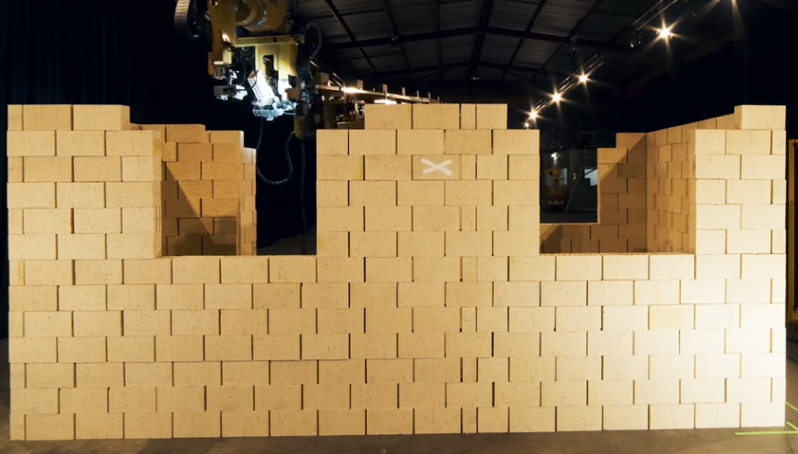
Hadrian 105’s wall
The whole process is automated. Bricks are fed onto a conveyor belt that travels along a long robotic arm, or telescopic boom. The bricks travel along the boom and are gripped by a clawlike device that lays them out methodically, directed by a laser guiding system. Until the brick shell is finished and the house’s other elements need to be added, the structure never needs to be touched by human hands.
There are a lot of advantages to such a system – reduced time, reduced cost, and reduced waste, plus improved safety. The adjustable arm can accommodate bricks of any size, and it’s extremely accurate. The Hadrian X is expected to drastically improve upon the current model, too, with a bricklaying speed of 1,000 bricks per hour. All necessary materials will be delivered to the building site on a truck attached to the robotic arm.
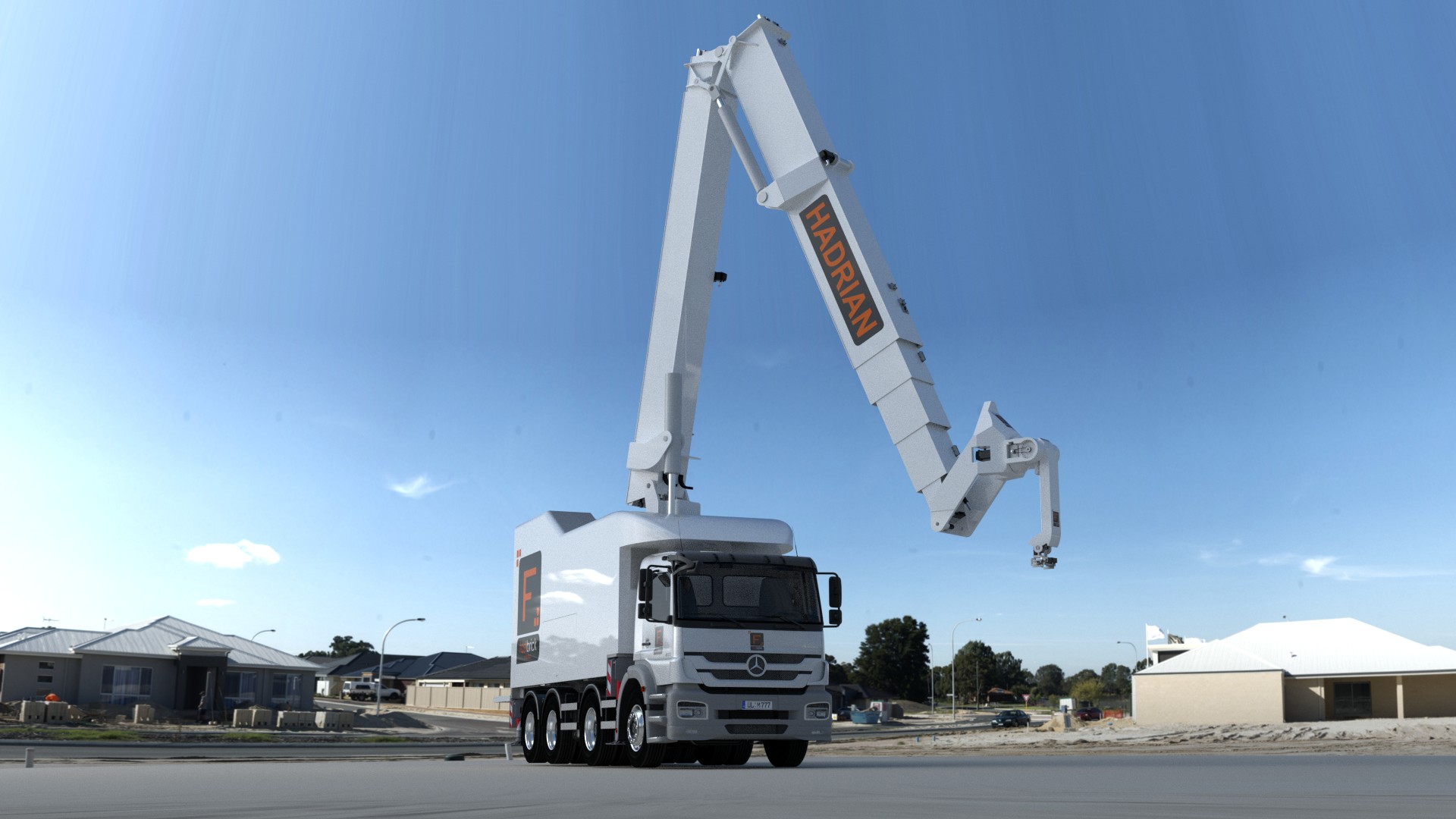
Hadrian X
“We are a frontier technology company, and we’re one step closer to bringing fully automated, end-to-end 3D printing brick construction into the mainstream,” said Fastbrick CEO Mike Pivac. “We’re very excited to be taking the world-first technology we proved with the Hadrian 105 demonstrator and manufacturing a state-of-the-art machine.”
Fastbrick Robotics plans to commercialize their patented technology, and they’re also developing an add-on for SOLIDWORKS software that uses 3D model data to create machine code for the size, cut, rotation and placement of the bricks.
 It hasn’t been long at all since 3D printed buildings were being talked about as something that would happen in the distant future, but it seems as though they became a reality almost overnight. A Chinese construction company recently 3D printed an entire two-story house in a mere 45 days, and the first 3D printed office building, constructed in 17 days, was recently unveiled in Dubai. An engineer 3D printed a tiny house in 24 hours, and a municipality in Italy is currently working on 3D printing an entire village. Not only are 3D printed buildings suddenly here, but the methods of printing them are as varied as the people that design them. Fastbrick Robotics brings yet one more new form of additive manufacturing that could quickly transform the construction industry into something very different, and more effective, than we’ve ever seen before. Is this is a mode of construction you would be interested in using? Let’s discuss in the 3D Automated Robotics Bricklaying Technology forum over at 3DPB.com.
Watch the Hadrian 105 below in a time-lapse of building action:
Subscribe to Our Email Newsletter
Stay up-to-date on all the latest news from the 3D printing industry and receive information and offers from third party vendors.
Print Services
Upload your 3D Models and get them printed quickly and efficiently.











You May Also Like
Campbell’s Exec Fired After “3D Printed Chicken” Claim — But What’s Really Going On?
Campbell’s is dealing with an unusual crisis this week, and somehow 3D printing ended up in the middle of it. It all began when a former employee, Robert Garza, released...
3D Printed Food for Those with Chewing Difficulties Now Available for Home Delivery
One interesting but overlooked use of 3D printing is in special food for hospitals and care facilities. This is a big potential market, as through additive, foods can be enriched...
UMAMI Bioworks to 3D Print Cultivated Fish Pet Food
UMAMI Bioworks is partnering with Friends & Family Pet Food Co. to produce 3D printed pet food. They will start with cat treats, which will be introduced to the markets...
3D Printing News Unpeeled: Tails, Wasteful 3D Prints & Salmonella
A photo on Reddit of a user making a color 3D printed model and getting 15 times the amount of waste has sparked a mini debate. But, with a 1000...