Young Minds Nourished with 3D Printing Vending Machine at UT Austin


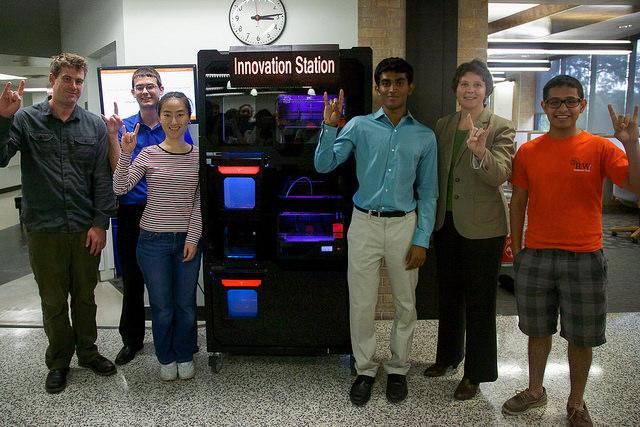
Photo courtesy of Cockrell School of Engineering, The University of Texas at Austin.
The Innovation Station is a vending machine your mother would approve of. Eschewing chips and chocolate bars, the public printers offer an introduction to 3D printing science, and it’s altogether possible you may one day see them commonly in many places–like hardware stores.
Unveiled at the Cockrell School of Engineering on Sept. 4, 2014, the Innovation Station is believed to be the third machine of its kind at an American university, after Virginia Tech and UC Berkeley. UT students can use the machine for free by uploading their own CAD designs to the printer. Once the product is “built,” they receive a message to pick it up at a public bin.
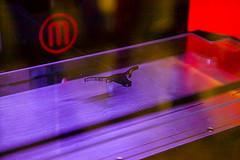
The Innovation Station employs a modified MakerBot Replicator 2 for 3D printing. Photo courtesy of Cockrell School of Engineering, The University of Texas at Austin.
At the special event to celebrate the launch, under the direction of mechanical engineering professor Carolyn Seepersad, the Innovation Station was on display, showing students and visitors how to choose their own design or use already-existing designs and watch their products 3D print for free. One of the most unique features is the patent-pending process for removing the 3D printed part from the build zone and pushing it to the receptacle where it’s retrieved.
The 3D printers used in the Innovation Station are modified Replicator 2’s, made by MakerBot. MakerBot started a veritable revolution with the desktop 3D printer, and now they are helping to revolutionize precise, immediate public printers as well in keeping with the idea of the 3D “community.”
Students are encouraged to use the new software and hardware to bring their ideas to life, and as many are novices to 3D printing, they are able to produce the 3D designs correctly, and see the fruits of their labor immediately, or well, in a few hours. Designed to provide on-demand web enabled 3D printing in a public place, the idea behind this innovative design from UT Austin was to remove barriers to learning about 3D printing, inspire great innovation and creativity, and help to encourage and teach future engineers.
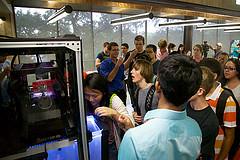
A UT student collects her 3D-printed design from the Innovation Station’s bin. Photo courtesy of Cockrell School of Engineering, The University of Texas at Austin.
The hardware process of the Innovation Station removes parts from the 3D printer and sweeps them into a bin where users can pick them up. The software, designed in partnership with Faculty Innovation Center (FIC) at UT Austin, created a web portal for students upload parts remotely and access detailed directions for creating parts.
“This is really lowering the barriers to 3-D printing to students. If they have a UT identification card, they can print out a part,” said Dr. Carolyn Seepersad, associate professor of mechanical engineering at UT”s Cockrell School of Engineering. “Anything you’d like to print, one or two or five or ten of something, especially if you’d like to customize something, is very easy to do using this.”
The most popular item students have been printing is the Longhorn replica! Will 3D printing machines like this eventually take over most colleges and universities? How about local hardware stores and convenient stores? Let’s hear your thoughts in the 3D printing vending machine forum thread on 3DPB.com.
Subscribe to Our Email Newsletter
Stay up-to-date on all the latest news from the 3D printing industry and receive information and offers from third party vendors.
Print Services
Upload your 3D Models and get them printed quickly and efficiently.













You May Also Like
Meet T-Pain: 3D Printing Influencer
Whereas imprisoned music mogul P. Diddy had red rooms and “freak-offs” of baby oil-fueled debauchery, another long-time rap artist has a different kind of room. King of Autotune T-Pain has...
The State of the Desktop Filament Market 2026, Part 4: An OS for Reality
OK, so in this four-part series, we used a cutting-edge stealth mode AI business intelligence tool that outperforms all commercially available LLMs. We then gussied up the data using Google’s...
Polymaker Releases HT-PLA Pro Filament for Better Performance & Thermal Stability
PLA became a favorite 3D printing material because people thought it was safer than ABS, since it didn’t give you headaches. And being made from plants, it felt safer and...
3D Printing News Briefs, June 4, 2026: Anniversary, Maritime, Marine Organisms, & More
In today’s 3D Printing News Briefs, Snapmaker is celebrating 10 years with a series of updates. XJet is collaborating with eqops for sales and support across the UK and Ireland,...