3D Printed Jewelry Shows There is no Divide Between Science And Art

 Science has long been a source of inspiration for art. Though some believe there is a sharp divide between art and science, both historical and present practice belie the existence of such a division. From the macro to the micro scale, the world is filled with inspiring natural occurrences; whether in mountainous cumulus clouds or in the voronoi patterns found in cell structures. The beauty of fractals and a variety of patterns created by what are known as “strange attractors” have inspired everything from textiles to garden design.
Now, a research scientist and a 3D artist and illustrator are pairing up to create jewelry designs that build upon their fascination with science and are helping them to invest in making science education more widely accessible. Idoya Lahortiga, the scientist and self-professed jill-of-all-trades, and designer Luk Cox, formerly a research scientist himself, have launched a jewelry line through Somersault18:24 with the idea that, “beautiful, smart, engaging, and sexy is not an impossible combination.”
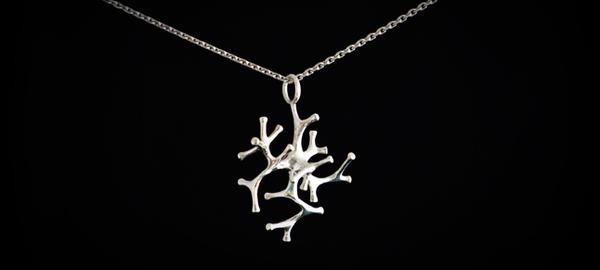
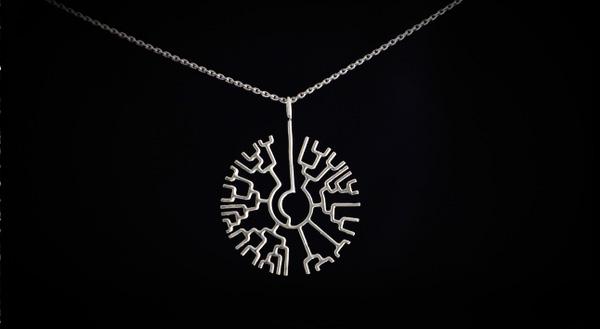
This pair brings two PhDs in biomedical science and a creative vision that just won’t quit, to the creation of pendants and earrings in the images of phylogenetic trees, neurons, and pi among other designs. All of the jewelry is 3D printed in silver through Shapeways and the profits go to fund a platform that provides visuals to aid in science education.
 The platform is a pay as you can resource that asks only that people be honest with themselves about the value of the resource and their abilities to contribute in relation to their usage. The duo’s philosophy is fantastically altruistic and you would have to be heartless to not find their enthusiasm and generosity moving. Their vision is shared on their site and aligns closely with the open source movement that has been such a strong influence in the 3D design community:
“We firmly believe that science education and communication are crucial for the advancement of science. Tools and resources that facilitate this process should be as free as possible, easily accessible, and easy to share and spread. We know that this platform can only continue to exist, grow, and ultimately excel if you, the user, step up, support, honor, and trust the system. We’ve created these resources for everybody, regardless of your financial situation. If you can’t afford it, take it now. If you love it, chip in later when you can.”
 They are currently working on adding even more material to their resource library in the form of a collection of major cell signaling pathways designed by Sandro Fedini and a second part to their already available library of science and medical illustrations.
Their most recent pair of releases are modeled by Idoya in a video on their site, a pair of chromosome earrings and a bacteriophage pendant. The chromosomes featured large in Idoya’s dissertation and she speaks of them with a fondness usually reserved for people’s conversations about a beloved pet. You might be surprised at the mechanical look of the bacteriophage, and that would be exactly what they are hoping for because chances are, after you see the necklace, you will not be able to resist learning more about these strange little creatures. Also part of the collection is a beautiful neuron pendants whose sensuous curves and asymmetrical form are captivating.
Subscribe to Our Email Newsletter
Stay up-to-date on all the latest news from the 3D printing industry and receive information and offers from third party vendors.
Print Services
Upload your 3D Models and get them printed quickly and efficiently.












You May Also Like
Reinventing Reindustrialization: Why NAVWAR Project Manager Spencer Koroly Invented a Made-in-America 3D Printer
It has become virtually impossible to regularly follow additive manufacturing (AM) industry news and not stumble across the term “defense industrial base” (DIB), a concept encompassing all the many diverse...
Inside The Barnes Global Advisors’ Vision for a Stronger AM Ecosystem
As additive manufacturing (AM) continues to revolutionize the industrial landscape, Pittsburgh-based consultancy The Barnes Global Advisors (TBGA) is helping shape what that future looks like. As the largest independent AM...
Ruggedized: How USMC Innovation Officer Matt Pine Navigates 3D Printing in the Military
Disclaimer: Matt Pine’s views are not the views of the Department of Defense nor the U.S. Marine Corps Throughout this decade thus far, the military’s adoption of additive manufacturing (AM)...
U.S. Congress Calls Out 3D Printing in Proposal for Commercial Reserve Manufacturing Network
Last week, the U.S. House of Representatives’ Appropriations Committee moved the FY 2026 defense bill forward to the House floor. Included in the legislation is a $131 million proposal for...