
EDAG Genesis, 3D Printed Concept Car Unveiled

The Geneva Motor Show is this week, and that means a look at some of the up and coming vehicle technologies within the industry. The show is known for its display of concept vehicles, and concept manufacturing  technology. It is aimed more towards manufacturers than the car buying public. This year, a company called EDAG will be on hand showing off something a little different than most show goers may be used to.
It has been known, by industry insiders, that 3D printing could be a major player in the manufacturing of vehicles, whether just for prototyping, or for actual parts. What EDAG will be showing off, however, is a concept for a 3d printed body of an entire vehicle, in which they named the EDAG Genesis.
The EDAG Genesis is an example of biomimicry, which means that the concept for this vehicle takes attributes from nature, in this case a turtle’s shell, and mimics them within its design. Although likely 10 to 20 years off, EDAG believes that 3D printers will one day manufacture the entire body of a vehicle, using a refined fused deposition modeling process. They envision a continuous strand of carbon fiber being used within the printing process, helping to create an ulrta strong outer shell of a vehicle in one piece.
“Unlike other technologies, FDM makes it possible for components of almost any size to be produced, as there are no pre-determined space requirements to pose any restrictions. Instead, the structures are generated by having robots apply thermoplastic materials. Complex structures are built up layer by layer in an open space – without any tools or fixtures whatsoever. By introducing endless carbon fibers during the production process, it is also possible to achieve the required strength and stiffness values. Even though industrial usage of additive manufacturing processing is still in its infancy, the revolutionary
advantages with regard to greater freedom in development and tool-free production make this technology a subject for the future.”” the company stated in their media release.
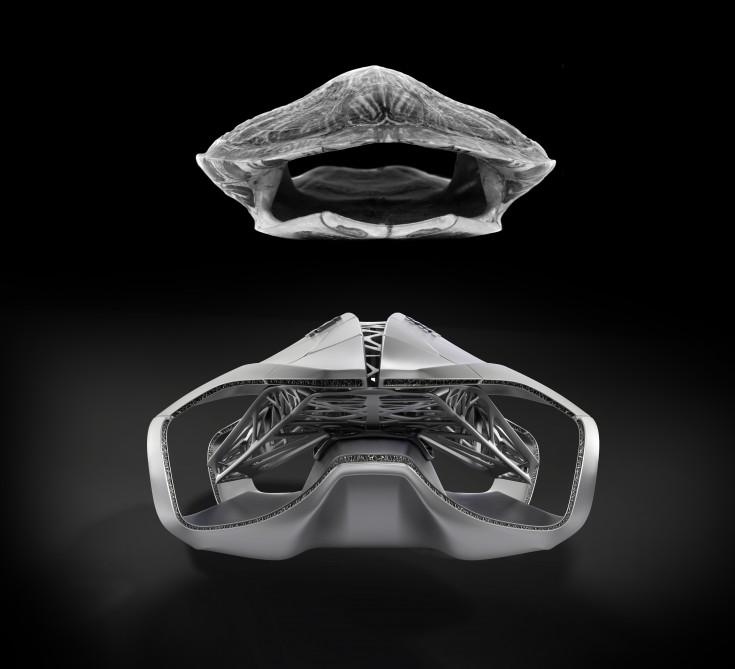
The design for the Genesis builds upon the attributes, including strength, cushioning, and protection, which is found within a turtle’s shell. Such a structure would not be able to be created using traditional tools and manufacturing methods. 3D printing allows designers to think outside the box and create structures which were unimaginable just a few years ago.
Although such a vehicle may not be feasible for another decade or even longer, EDAG envisions additive manufacturing playing a key roll in the production of components and parts for vehicles, both built now, and in the future. They envision playing a crucial role in the development of this technology. Discuss the EDAG Genesis at the forum.
Subscribe to Our Email Newsletter
Stay up-to-date on all the latest news from the 3D printing industry and receive information and offers from third party vendors.
Print Services
Upload your 3D Models and get them printed quickly and efficiently.













You May Also Like
3D Printing News Briefs, August 22, 2026: Polymers for CubeSats, Animal Mobility Devices, & More
We’re starting with defense news in this weekend’s 3D Printing News Briefs, before moving on to polymers for CubeSats and 3D printed prosthetics. We’ll end with a story about engineering...
Pusan National University & ORNL Develop Elastomeric Liquid Crystal Actuators
Researchers from Korea’s Pusan National University and Oak Ridge National Laboratory (ORNL) have developed 3D printed elastomeric actuators. In a paper published in Nature, the team used elastomeric liquid crystal...
Scientists Use BMF to 3D Print Seal Whiskers That Track Prey Long After It’s Gone
Seals use their whiskers to hunt. Not Navy Seals, although they may in some way also, but this article is about lowercase seals. Not Seal the musician either; as far...
Harvard’s Jennifer Lewis Lab Is 3D Printing Artificial Muscles That Twist and Bend on Demand
Researchers at Harvard John A. Paulson School of Engineering and Applied Sciences (SEAS) have developed a new way to 3D print materials that can move on their own, bending, twisting,...























































