Failure to Produce Biodiesel Leads Students to Make Low-Cost DLP 3D Printer

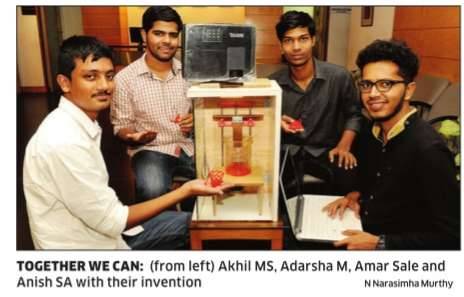 At some point in our lives, we’ve all set out to complete a task that turns out to be more than we can really achieve and had to settle for a plan B. Some of those times, our second approach turns out to be even better than the first one and we emerge feeling lucky and even a little elated. This same process of failure led a group of students at CMR Institute of Technology in Bengaluru, India to scrap their unsuccessful efforts to produce biodiesel and instead use the remainder of their project time, a mere 20 days, to create their own 3D printer. Akhil MS, Adarsha M, Anish SA and Amar Sale are all 20-year-old, third-year mechanical engineering students at CMRIT, working with Professor Sagar M Baligidad’s guidance on their project.
And their perseverance in the face of defeat, and the very real possibility of not receiving a passing grade, has paid off in the creation of a low-cost, fully-functioning 3D printer. The team had limited time and materials to work with and so had to substitute more expensive components for those that were already at hand, allowing them to produce their 3D printer for Rs 43,000 (about $640 USD), a price that is less than a quarter of the normal cost.
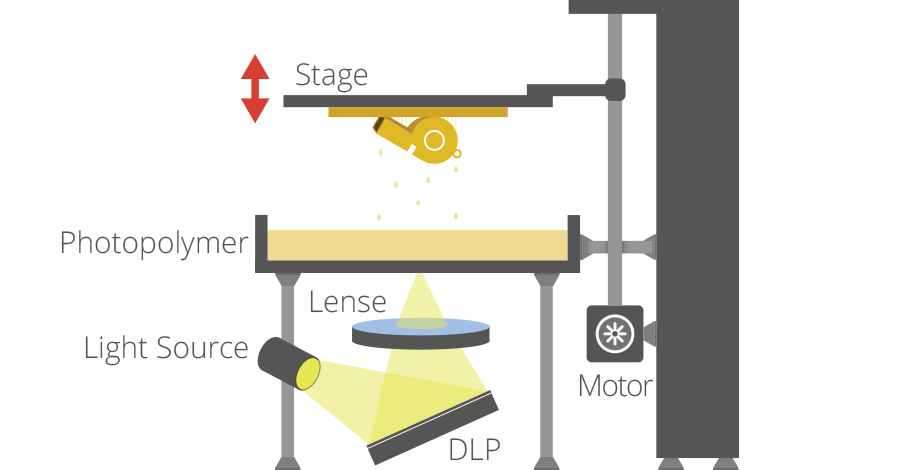 It might not seem like such a big deal to assemble a 3D printer in 20 days — after all, we’ve all seen the kits available. However the CMRIT students had to make do with whatever they could lay their hands on; a few planks of wood, a beaker, a projector and a stepper motor. Add that together with a rudimentary circuit board, et voila, their invention was born. Their printer operates using digital light processing (DLP) technology rather than the more conventional fused deposition modeling (FDM). The students hope that this will allow their printer to be less bulky and have a greater degree of accuracy. Anish SA, one of the students, explained:
“FDM printers are known to have low accuracy and [be] bulky. Here, we use ultraviolet light from a projector for printing. Each layer is then separately projected on the liquid resin and the projected area gets solidified. This is done for each layer. This approach prints models at a third of the time conventional printers take.”
 It wasn’t all smooth sailing after the initial shift in ideas. Instead, they experienced a series of issues such as a circuit board crash and a non-responsive motor, but with perseverance, and the knowledge gained during their engineering education, they were able to overcome each issue as it arose. In fact, they did more than just squeak by, they were able to enter their innovative device into a nation wide competition and come away with a cash prize. Possibly even more exciting is the recognition by experts of the value of their creation, as described by Tarun Kumar, a judge in the competition and a research scholar at IISc’s Centre for Product Design and Manufacturing:
“It’s a very innovative and creative way of reducing cost. It can be a game changer, something government funding agencies can support.”
While it will be a challenge to manufacture something like this on a larger scale while keeping the costs to a minimum, the potential for further democratizing the 3D printing capabilities this machine represents are indeed intriguing. The students plan on further exploring this and other possibilities for their machine as their final year project. What are your thoughts on this machine? Discuss further in the DLP 3DP Printer by Engineers from India forum over at 3DPB.com.
[Source: ET Tech]Subscribe to Our Email Newsletter
Stay up-to-date on all the latest news from the 3D printing industry and receive information and offers from third party vendors.
Print Services
Upload your 3D Models and get them printed quickly and efficiently.











You May Also Like
How Metal Additive Manufacturing Is Reshaping the Future of Aerospace and Defense Engineering
Additive manufacturing (AM) is steadily changing the way we think about producing metal parts for aircraft. Whilst aerospace and defense companies have been using metal AM for over twenty years,...
The AM Adoption Problem No One Models
Through its short history, Additive Manufacturing has been presented to the investment community as a classic high growth technology story. Manufacturing is a multi-trillion-dollar market. Even a small percentage looks...
The Business of Customized Sports Equipment: How 3D Printing Is Changing Athletic Gear
For years, 3D printing in sports has been linked mostly with prototypes, concept shoes, and one-off experiments for elite athletes. Helmets, cleats, and footwear midsoles often took over the headlines,...
The Maritime Industrial Base is on Full Display at Additive Manufacturing Strategies 2026
2025 is the year that the AM ramp-up by the U.S. Maritime Industrial Base Program (MIB) became common knowledge throughout the industry. But everyone who attended AMS 2024 was already...