Having Problems Fitting Your Oculus Rift Over Your Glasses? Try This Simple 3D Printed Adapter!


 Sometimes it’s rough having glasses. They fall off, they fog up, they get scratched, and it’s ridiculous trying to wear sunglasses over them – not to mention a virtual reality headset. People have been really excited about the Oculus Rift for quite some time now, but a Thingiverse user named Joshua Egstad (aka jegstad) noticed that there was a bit of an issue when he received his: it didn’t fit so well over his glasses.
Luckily for Egstad – and other bespectacled virtual reality fans – he has some experience with 3D printing, so he decided to design and print an adapter that would allow his Oculus Rift to sit more comfortably when he put it on. He detached the facial interface, which Oculus handily provides instructions for, though he found his own method worked best:
“In practice, what I’ve found works best is to hold the headset in both hands, face down with the top strap towards you, and apply firm upwards pressure with both your thumbs at the same time against the plastic rim of the facial interface until the tab starts to pop out,” he said in a comment.
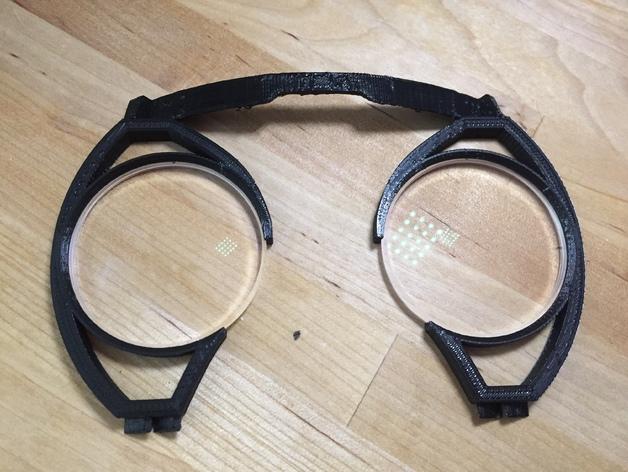
Note: before you print the adapter, you should probably make sure you have a spare pair of glasses, as the design involves removing the original lenses from your glasses and slotting them into the 3D printed adapter. (Egstad suggests marking the lenses with a Sharpie or some other implement before removing them from the frames, so you know which way is up.) The adapter itself looks to be an easy, one-piece printing job, and when it’s finished, your lenses can be fit into a groove on the adapter’s inner rim. It should be a loose fit at first, says Egstad; it will tighten once the adapter is fitted onto the facial interface.
Once the adapter, with lenses in place, is fitted to the facial interface, the whole assembly can be reattached to your Rift by pushing in a couple of tabs. Boom – perfect virtual vision.
“This adapter is designed to take 42 mm diameter round lenses, such as the ones that come with Zenni optical frame #450021. The adapter spacing matches that frames spacing as close as I could get it,” says Egstad. “I have a medium-strong prescription and clearance between my prescription lenses and the rift lens is somewhere around 1.5 mm. I’m not sure if would be clearance issues with stronger prescriptions. This adapter is the result of a couple weeks of design and tweaking to get it working for my face, and it’s also my first fully realized 3d design and 3d printing project, so I make no guarantee this adapter will work for anyone but me!”
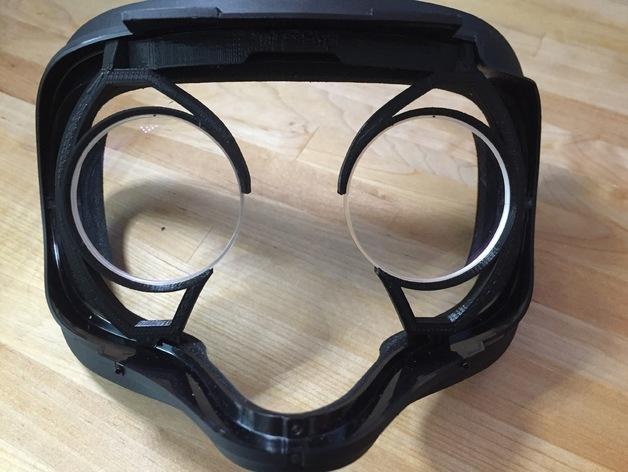
It’s worth a shot, though, and the design itself looks like it should be pretty easily adaptable if there are issues with fit or clearance. A simple solution for a potentially complex problem – as one commenter puts it, “You’re a (virtual) life saver!”
Is this something you might need? Discuss with us further over in the 3D Printed Oculus Rift Adapter forum at 3DPB.com.
Subscribe to Our Email Newsletter
Stay up-to-date on all the latest news from the 3D printing industry and receive information and offers from third party vendors.
Print Services
Upload your 3D Models and get them printed quickly and efficiently.













You May Also Like
The Drone Industry is Showing Where 3D Printing Delivers Real Value, AM Research Report Finds
The rapid rise of drones is creating one of the biggest opportunities for additive manufacturing (AM). Whether they’re used on battlefields, inspecting bridges or crops, or delivering supplies, drones need...
3D Printing News Briefs, June 27, 2026: Nanoscale 3D Printing, Defense Readiness, & More
We’re starting with a story about a grant for advanced nanoscale 3D printing in this weekend’s 3D Printing News Briefs, and then on to metal additive manufacturing (AM) for defense...
US Army Awards Continuous Composites 3D Printed Missile Component Contract
Despite the very loud, indignant claims from American defense officials that the US hasn’t depleted a significant portion of its munitions stockpiles, the US has depleted a significant portion of...
Rheinmetall Uses Ducting Made with Minifactory for Challenger 3 Tanks
Rheinmetall UK is using Minifactory Material Extusion as the primary production method for tank ducting on the Challenger 3 Main Battle Tank program. The Challenger 3 is the UK’s formidable...