FDA Gives 510(k) Clearance to 3D Printed Titanium Digital Fusion Implant – First Product from Additive Orthopaedics


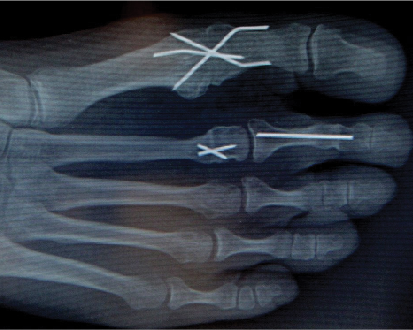
 Some of the most delicate bones in the body are those in the extremities. While a broken finger or toe is obviously not as debilitating as, say, a broken arm or leg, they’re still painful and, in some cases, can have complications. The bones in the toes are particularly tricky – there’s a lot that can go wrong with them, breaks or not. Those delicate little bones do a lot of work and carry a lot of weight, so it’s important to make sure they heal correctly, and sometimes a little extra help is required.
Digital fusion refers to a procedure in which the bones of the toe are fused together after a surgery, and occasionally they require stabilization from a pin or implant while they grow together and heal. New Jersey-based Additive Orthopaedics, LLC is a brand new company dedicated to the development of 3D printed orthopedic devices specifically for the extremities, and their first product, a 3D printed titanium digital fusion implant, has just been given 510(k) clearance from the FDA.
[Image: Podiatry Today]
“Additive manufacturing allows us to develop complex geometries at reasonable manufacturing costs not possible before now with traditional manufacturing,” said Greg Kowalczyk, President and Founder of Additive Orthopaedics. “Design teams really need to think outside the box when considering this innovative manufacturing process. And where better to do that then the Global US Extremity Market valued at $1.3 billion and growing at over 10% per year. We are confident that the market will respond well to this, our patient specific products in development, and our other devices currently being reviewed by the FDA.”
 Additive Orthopaedics is still in the earliest stages; they just moved past their initial seed funding rounds and have just announced their second round of funding. One of the company’s investors is Asimov Ventures, the venture capital firm launched last year to support early-stage startups in 3D printing and robotics. They’ve already invested in several promising companies that have really taken off, like Wiiv and Metamason, and with their flagship device already FDA approved, I expect Additive Orthopaedics is soon to take off as well. They’re certainly in the right market.
“3D printing has a major role in the future of orthopaedics,” said Dr. Selene Parekh, Professor of Surgery in the Department of Orthopaedic Surgery at Duke Orthopaedics and North Carolina Orthopaedic Clinic. “In today’s cost sensitive health care environment, 3D printing allows us to bring highly complex, lower cost technologies to the market very quickly, with patient specific features that will potentially improve patient outcomes.”
Discuss further in the Additive Orthopaedics Gains FDA Clearance for 3D Printed Implants forum over at 3DPB.com.
Subscribe to Our Email Newsletter
Stay up-to-date on all the latest news from the 3D printing industry and receive information and offers from third party vendors.
Print Services
Upload your 3D Models and get them printed quickly and efficiently.












You May Also Like
Electroninks’ EMI Shielding Materials Give it an Expanded Presence in Japan
In the current global economic context, which is being shaped primarily by national leaders trying out new forms of geopolitical leverage on a daily basis, advanced manufacturing partnerships between American...
3D Printing News Briefs, July 30, 2026: Orthodontics, Digital Implants, & More
We’re starting with business news in today’s 3D Printing News Briefs, followed by news about an in-house center for engineering digital implants. We’ll end with research about thermal cloaking. Read...
Product Market Fit: Nikon Advanced Manufacturing CEO Hamid Zarringhalam on How Defense Demand is Pushing Metal AM to Scale
After years in which the additive manufacturing (AM) industry gained a reputation for its hype outpacing its performance, an interesting development has emerged recently. In certain market segments, at least,...
AMPulse Asia: China’s Consumer 3D Printing Boom Leads APAC Roundup
The first half of July brought continued investment into Asia’s additive manufacturing sector, with major funding rounds, manufacturing expansion, and new metal 3D printing systems leading the news. Elsewhere, companies...