Build Something That Matters: The 2016 Hackaday Prize is Here


 Now in its third year, the 2016 Hackaday Prize is back and bigger than ever before. The goal, as always, is to use your skills with hardware, programming, design, fabrication and science to design and build something that will lead to social change and make other people’s lives better. Hackaday wants users to use their skills to find new and innovative ways to address problems that humanity faces, be that a technological solution to a long existing problem, or a solution to a problem caused by technology. As expected from a Hackaday challenge, there are no limits to what you can create, as long as the goal is to make people’s lives better or to solve problems that will impact people’s lives.
There will be a new technical design challenge starting every five weeks, each with a different theme and skillset requirement. You can start a project on your own and do it all yourself, showing off your vast array of technical and engineering knowhow, or you can pick up collaborators from the Hackaday community while your project progresses. Because Hackaday is a global community of like-minded makers and designers, your project’s process will be available for the entire world to see, and pitch in if necessary.

Build Something That Matters.
The first round of the 2016 hackaday Prize starts today, March 14th, and ends on April 25th. The theme is The Design Concept and all that you need to enter is an idea, an image and some documentation of the project. But the Hackaday judges are really looking to see what exactly your project is, what you want it to do, how you intend to get there and how you will solve problems related to it along the way. You can join just by opening a Project Profile on Hackaday.io and submitting it to the 2016 Hackaday Prize.
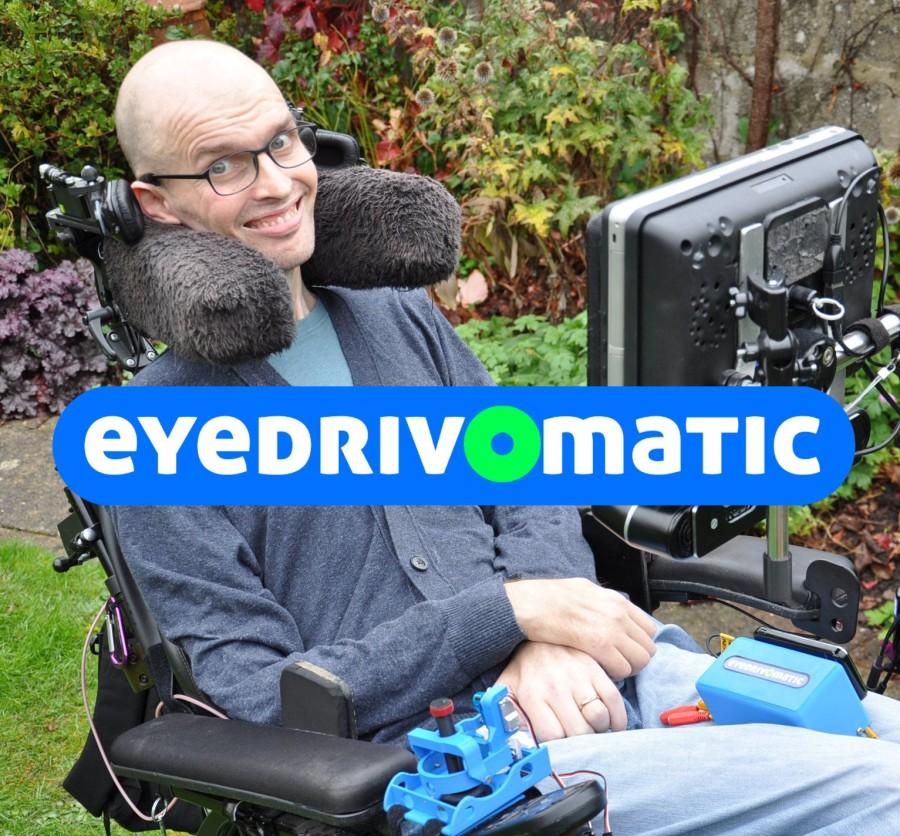
2015 Hackaday Prize winner – The Eyedriveomatic by Patrick Joyce
Round two, starting April 25th and ending on May 30th, is Anything Goes, where you are encouraged to build whatever you want, just make sure that you include a fully formed idea, an image, documentation and at least four build logs. Next up is Citizen Scientist, starting May 30th and ending July 11th, where you are challenged to create something new, totally undiscovered or recreate and verify existing scientific studies. The Automation challenge starts July 11th and ends on August 22nd, and should be self-explanatory. Just build something that does something automatically, be it a robot, a device or a program that automates digital actions. Finally, the Assistive Technologies challenge, starting August 22nd and ending October 3rd, encourages the development of a project that will help those with disabilities, whether it be to increase their mobility, improve their quality of life or simply allow them more access to the world.
At the end of each challenge, twenty projects will be selected and awarded $1000 per project. After all five rounds are complete a total of one hundred projects will then advance to the finals and narrowed down to the five top winners. They will be awarded $150k for first place, $25k for second place, $10k for third place, $10k for fourth place and $5k for fifth place. Additionally, first place will receive a coveted residency at the Supplyframe Design lab in Pasadena, California to continue to develop their project further at the state of the art makerspace/hackerspace/startup accelerator.

Star Wars-themed Open Bionics prosthetic arm.
Winning a Hackaday Prize could be a life-changing event for any maker, inventor or startup, as seen by one of last year’s semi-finalists, Open Bionics. The original Open Bionics project was able to make a surprisingly functional bionic hand for less than a few hundred dollars, and the idea was so good that it was added to the Disney Accelerator Program and is now being incorporated into Disney-themed bionic arms for children. Last year’s winner also saw his life change in some big ways. His project was a device that allowed a wheelchair to be controlled by the user’s eyes. Patrick Joyce created the Eyedrivomatic, which uses specific eye movements to steer, speed up, slow down or recline a wheelchair used by a quadriplegic.
Here is the official Hackaday Prize challenge video:
Once all five of the challenges are wrapped up, the top one hundred projects will be sent to the expert judges on October 10th, and the five winners will be announced after October 22nd. You can find the full Hackaday Prize 2016 details and requirements here, you can check out the full challenge rules here, and you can keep an eye on the competition and see what other Hackaday users are submitting here. Do you have a good idea for winning the prize? Discuss in the Hackaday Prize & 3D Printing forum over at 3DPB.com.
Subscribe to Our Email Newsletter
Stay up-to-date on all the latest news from the 3D printing industry and receive information and offers from third party vendors.
Print Services
Upload your 3D Models and get them printed quickly and efficiently.












You May Also Like
Printing Money Episode 39: Q1 2026 Public Markets 3D Printing Earnings Analysis with Troy Jensen, Cantor Fitzgerald
Welcome to Printing Money Episode 39, (or, “The one where they all went to market”). It’s that quarterly time, so Troy Jensen (Managing Director, Cantor Fitzgerald) joins Danny for a review...
Goldilocks’ Flywheel: Refractory Complex Concentrated Alloys (RCCAs) & The Race for the Future
Recently, Metalysis, Skyrora, and Thermo-Calc Solutions started to try to commercialize Tanbium. This alloy has been created for use in combustion chambers and rocket nozzles. Tanbium is a Refractory Complex...
Printing Money Episode 35: Notable VC and M&A Deals, with Arno Held and Alex Kingsbury
Welcome to Printing Money Episode 35 and let us be the last to wish you a happy new year. For this episode Danny is joined by Arno Held (Managing Partner,...
Snapmaker Secures Series B Backed by Xiaomi Founder’s Network and China’s Investment Elite
Desktop 3D printer manufacturer Snapmaker has gotten a series B round. The round is led by Hillhouse Ventures and Meituan. Cowin Capital and Orient Securities Capital dipped in for another round,...