NanoParticle Jetting Innovator XJet Raises $25 Million in New Funding

 Israeli metal 3D printing technology manufacturer XJet announced that they have just completed a successful and lucrative round of funding that has brought them $25 million in new investments. The primary source of the new investments was led by Catalyst CEL, an Israeli-Chinese private equity fund. XJet also received significant financial backing from software development company Autodesk. The investment will be used for their continued development of their new NanoParticle Jetting metal 3D printing process. The partnership with Catalyst CEL is expected to aid them in bringing their technology to the global market and in penetrating the Chinese industrial additive manufacturing market.
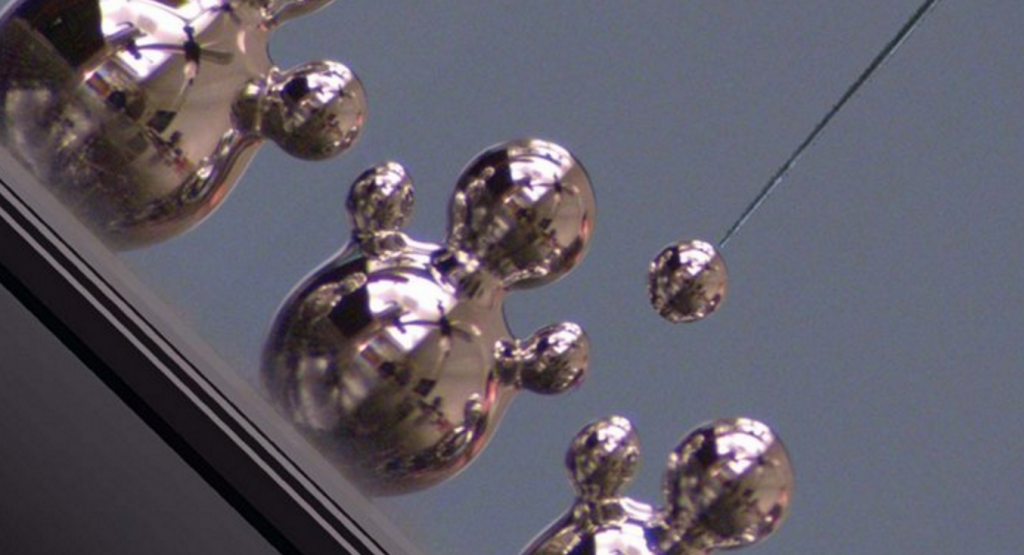
XJet liquid metal inks.
The XJet NanoParticle Jetting metal 3D printing process was just announced late last year and has already gotten industrial manufacturers’ tongues wagging with possibilities. The technology uses liquid metal inks that are printed using inkjet technology. The ink material is made from a solid metal nanoparticle that is suspended inside of a liquid. The liquid metal ink is stored securely inside of removable and reusable cartridges that can be loaded and unloaded similarly to other cartridges used in inkjet printers. The sealed cartridge system eliminates the need for machine operators to come into contact with messy and potentially toxic metal powders and materials.
The process works by depositing a super-fine layer of liquid metal droplets onto the printing envelope using ink jet printing technology similar to a standard 2D printer. The ink is printed on to the build envelope along with a support substrate material that maintains the integrity of the part while it is being fabricated. The process is completed with a simple sintering process, once the ink is exposed to extremely high levels of heat the liquid material evaporates and forces the metal nanoparticles to bond into a metal object. The support material can easily be cleaned away after the printing has been completed.
-
- Sample print detail
-
- Sample metal part
-
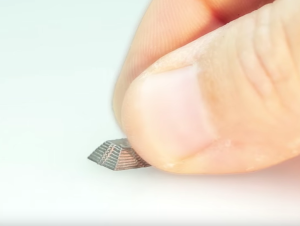
- super-fine detail
XJet says that the finished object is a fully solid metal part with metallurgy that is indistinguishable from traditionally manufactured metal parts. Because the process uses basic bed 3D printing technology there are virtually no limits to the printed parts’ geometries or shapes. The result is metal parts that are quickly manufactured and require very little post-processing time. Currently the liquid metal material is restricted to a stainless steel ink, however XJet is developing similar liquid metals and is expected to soon offer several different varieties of metal nanoparticles.
Here is a video about XJet and their NanoParticle Jetting metal 3D printing process:
The company now known as XJet was originally founded by Hanan Gothait back in 2005. As a veteran of the inkjet printing industry, Gothait hoped to leverage his experience to to develop a printing process that could quickly fabricate solar panels. In 2013 they expanded their business into additive manufacturing and quickly raised 22 million dollars to transition into their new sector and develop their advanced metal 3D printing technology. XJet presented their NanoParticle Jetting process at 2015’s Go4Israel conference where they found several companies looking to invest and utilize their technology. Discuss in the XJet 3D Printing Manufacturer forum over at 3DPB.com.
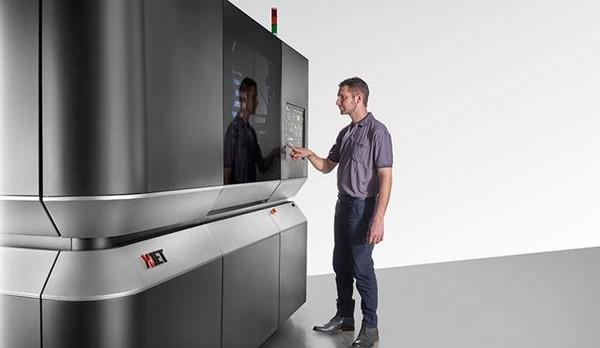
XJet metal 3D printer.
Subscribe to Our Email Newsletter
Stay up-to-date on all the latest news from the 3D printing industry and receive information and offers from third party vendors.
Print Services
Upload your 3D Models and get them printed quickly and efficiently.











You May Also Like
Scaling 3D Printing Takes More Than You Think; HP’s Webinar Looks at Making It Work Long Term
3D printing is no longer new. In fact, most manufacturers already know what it is, where it fits, and what it can do. But knowing the technology and actually scaling...
How AtomForm’s 12-Nozzle System Cuts Multi-Color FDM Transition Waste by Up to 90%
Pull up the print stats on multi-color FDM jobs. The number that stings isn’t time; it’s material efficiency. On six-color models, single-nozzle systems consume significant filament during transition flushing, expelling...
RAPID 2026: Democratizing Metal Laser Powder Bed Fusion 3D Printing with Mastrex
Aside from a quick mention in an episode of our Printing Money podcast, I didn’t know much about Mastrex. But when I heard that the company had developed a $39,000...
3D Printing News Briefs, April 25, 2026: Competition Winners, AI Platform, X2D Printer, & More
In this weekend’s 3D Printing News Briefs, AMUG announced the winners of its Technical Competition, and Authentise launched AI platform Whisper at RAPID. Bambu Lab wasn’t at RAPID, but launched...