ColorFabb Announces New Advanced Co-Polyester 3D Printer Filament colorFabb HT

 One of the fastest growing areas of the 3D printing industry is in the development of filaments and materials. Only a few years ago most 3D printers would only have a handful of materials available to them due to the limitations of both technology and a lack of material development. But these days, material options have skyrocketed thanks to companies from all over the world taking advantage of new 3D printers capable of printing at higher temperatures using newly developed advanced materials. Many of these new materials were previously only available with industrial 3D printers, but now variations of them have been specifically created to work with standard desktop 3D printers.
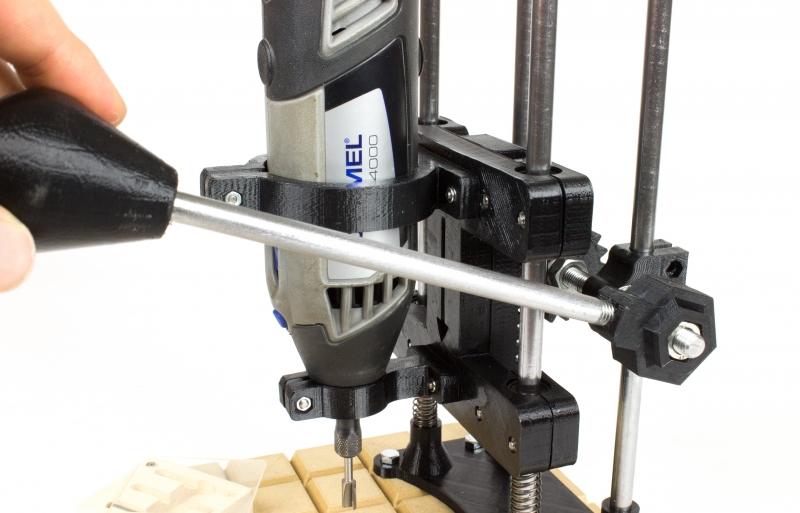
colorFabb HT can be used to make durable, end-use parts
One of the more prolific producers of this new wave of advanced, high-functioning 3D printing filaments is colorFabb, a Dutch materials company that was launched back in 2012. They have already had a highly successful line of high quality PLA filaments that has been combined with PHA to improve durability and smooth extrusion. They are also one of the first companies to develop specialized materials that incorporate real metal powders, like their Brassfill and Copperfill materials, or material mixed with real wood like their Bamboofill, Corkfill and Woodfill. Most recently they introduced a line of highly advanced co-polyesters that were created using Eastman Amphora, a polymer material developed specifically for highly functional 3D printing applications.
The latest addition to colorFabb’s line of co-polyester, functional filaments is their new colorFabb HT material. The new filament was formulated using Amphora HT5300, which is a low-odor, styrene-free and BPA-free material that has been shown to provide high dimensional stability. With high stability, 3D printed parts can be designed to precise and exacting standards, which is vital to companies looking to create high functioning prototypes that are capable of live testing, or multi-component parts that need to be assembled and tested. HT also has superior chemical resistance to other 3D printing materials, a strong and tough finish and is capable of resisting temperatures as high as 212°F (100°C) without melting or deforming.
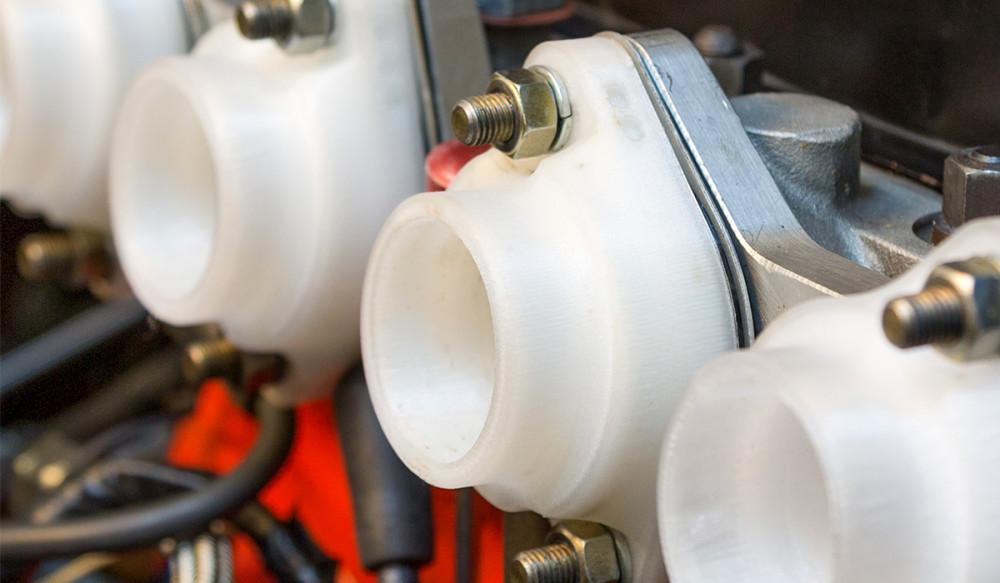
Fully functional inlet manifold prototypes.
The finished quality is so high that 3D printed prototypes can be tested in real world environments, like working engines or machinery. During testing it was even used to 3D print custom designed inlet manifolds by designers Wouter Wolfs and Dennis van Bergen van der Grijp, who were then able to test them out on a running car engine. Not only did the parts offer a working proof of concept for improving the performance of their Mini track car, but the parts remained intact and did not interfere with the operation of the engine. That meant that they wouldn’t need to create metal parts until the design was nearly finalized, and would likely only need to produce a single set of metal prototypes.
ColorFabb HT was specifically created for advanced 3D printer users who are looking for an industrial quality material that can be used on a standard desktop 3D printer and is in complete FDA compliance, so it is suitable for a wide variety of applications. HT filament will be available in five different colors: clear, white, light gray, dark gray and black. Pre-orders will start soon, and colorFabb is expecting HT to be available on March 21 in their online store, and from their network of resellers. You can find out more about colorFabb HT here. Discuss in the ColorFabb HT 3D Printing Filament forum over at 3DPB.com.
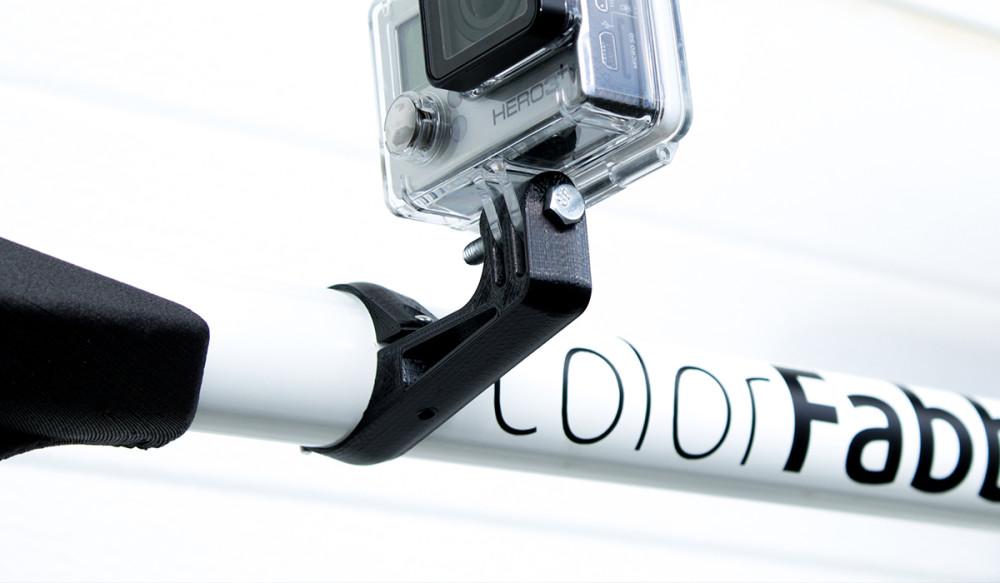
colorFabb HT is strong enough for end use prototyping and testing
Subscribe to Our Email Newsletter
Stay up-to-date on all the latest news from the 3D printing industry and receive information and offers from third party vendors.
Print Services
Upload your 3D Models and get them printed quickly and efficiently.











You May Also Like
From Material Maturity to Fleet Execution: What Comes Next for Additive Manufacturing in the U.S. Navy
Additive manufacturing is steadily moving from experimental use toward routine application in U.S. Navy shipbuilding, sustainment, and much more. In recent years, the Navy, working through its Maritime Industrial Base...
Industrial Additive Manufacturing Reaches Its Most Important Inflection Point
Additive manufacturing is entering the most consequential period in its evolution. After years of experimentation and uneven adoption, the industry is showing renewed momentum, shaped by supply-chain pressures, and a...
Scaling Beyond 10 Printers: When Support Becomes a Bottleneck
The leap to industrial-scale 3D printing is a support problem, not a hardware problem. A 3D print farm is a centralized facility that uses a large number of 3D printers...
Reshoring Requires Rules of Engagement
Reshoring manufacturing in the U.S. is a stated national priority. Policymakers, industry leaders, and defense planners agree that domestic production capacity is essential for economic resilience, national security, and long-term...