ZMorph 2.0 S Hybrid Offers Precision & Quality as Student Makes Orthosis with 70 Pieces

 We all look forward to hearing of the latest case studies from ZMorph. While they are always entertaining and full of information, we learn a lot about what today’s innovators are interested in making—as well as how ZMorph’s extremely versatile technology is helping them to do so, from making amazing 3D printed mechanical clocks with the ZMorph Hybrid printer to a cool neon office sign made with their Dual Pro Extruder. Today though, we’re interested in a new case study that ZMorph has presented that offers all the innovation but with much more serious impact—and potential for further designs down that line that will help people in need of 3D printed correction devices.

Eliza Wrobel
We follow many stories about 3D printed prosthetics. In this case, however, biomedical engineering student Eliza Wrobel had quite the project ahead of her when she agreed to make an orthosis for a 33-year-old male who’d been in an accident and was suffering from tetraplegia, which usually means partial paralysis for the patient. With an orthosis, movement can be guided, assisted, or restricted as well as offer correction to a limb, depending on the patient’s needs.
Working under Bogdan Dybala, PhD. Eng. at the Faculty of Mechanical Engineering of Wroclaw University of Technology in Poland, Eliza’s mission was to help the patient by creating an orthosis that allowed him to do things like play his favorite sport—table tennis—as well as grab objects and hold onto light dumbbells. To allow for these specific requirements, Eliza had to employ reverse engineering. The process consisted of making a plastic cast and mold which was then 3D scanned at the university.
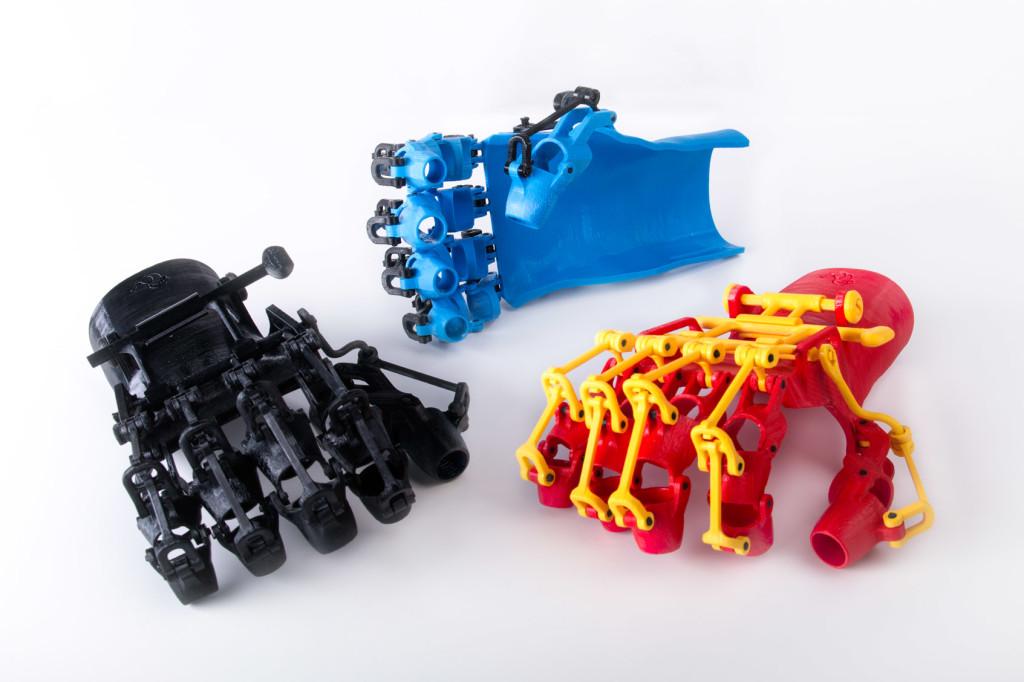
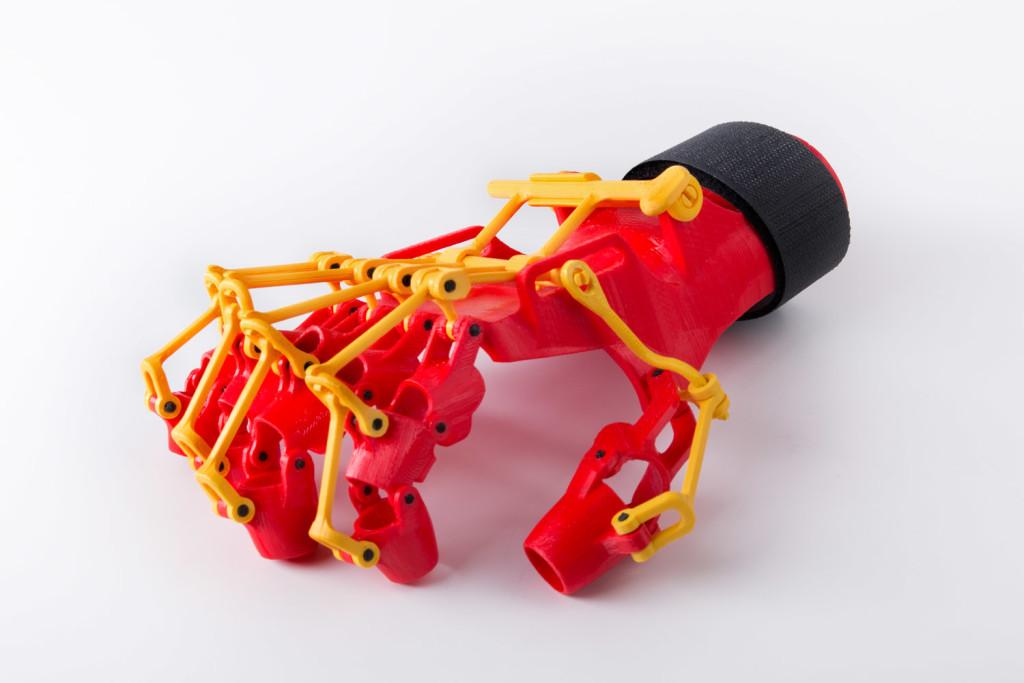 Once the 3D model was completed, Eliza was able to begin designing various solutions in CAD. Her challenge was in finding a good balance between designs used for prosthetics and standard orthosis as the ‘husk’ of the device had to be closely fitted to the wrist while fingers were duly supported; subsequently, Eliza had to make two joints for the thumb and three joints in every other finger. With all of this connected, she used one large lever at the top to control a series of other levers which manipulate the multiple parts.
This device ended up using a stunning 70 3D printed parts in its construction. According to the ZMorph team, Eliza used their Voxelizer software to prepare them for 3D printing and then they were fabricated on the ZMorph 2.0 S hybrid 3D printer with single head extruder using 1.75mm ABS filament in a variety of colors. To connect the tinier levers and casings to each other, Eliza used numerous, small 3D printed pins. Because of the precision afforded by the ZMorph printer, she was able to use few parts that weren’t 3D printed.
A Velcro strap was used to attach the orthosis to the hand, and the patient is already using Eliza’s prototype for limited functionality in his hand, allowing him to do moderate activities. Indeed, Eliza may also use this prototype to eventually produce many more orthotics for those in need. You can also explore other ZMorph case studies right here. Discuss in the 3D Printed Orthosis forum over at 3DPB.com.
Subscribe to Our Email Newsletter
Stay up-to-date on all the latest news from the 3D printing industry and receive information and offers from third party vendors.
Print Services
Upload your 3D Models and get them printed quickly and efficiently.











You May Also Like
Top 10 3DPrint.com Stories of 2025: Kickstarter, Consumer Goods, Bankruptcy, & More
As Vanesa Listek wrote, last year was a major turning point for additive manufacturing (AM), as the industry is working to sort itself out. Customers want proven use cases and...
Stratasys’ RadioMatrix Could Mark the Beginning of the End for Cadavers in Imaging Training
Stratasys has expanded its radiopaque 3D printing material, RadioMatrix, to full commercial availability in the United States. The move could change medical imaging training by giving hospitals and researchers access...
Axtra3D Brings Full “Axtra Workflow” and New Materials to Formnext 2025
Axtra3D hits Formnext 2025 with a big shift in strategy. The company isn’t just selling printers anymore; it’s selling a complete workflow. At the show, Axtra3D unveiled its new Axtra...
Metalysis, Skyrora & Thermo-Calc to Develop Tanbium Alloy Powder for ESA-Funded Project
Metalysis is to develop Tanbium alloy powder for launch vehicle manufacturer Skyrora. Metalysis uses an FFC solid-state electrolysis process, originally developed at Cambridge University and known as the FFC Cambridge...