Nano Dimension and Tel Aviv University Developing a 3D Printable Nickel Nano Ink

 We’ve been hearing a lot about Nano Dimension lately. Just yesterday the Israeli company announced that they will soon begin trading on NASDAQ, greatly expanding their presence in the United States market. This is fantastic news for both Nano Dimension and the US market, as the 4-year-old company’s revolutionary, eagerly anticipated circuit board 3D printer and proprietary conductive inks have already been generating a great deal of excitement in the electronics industry.

Nickel nanoparticles [Image: NanoLab]
The main issue that makes nickel ink difficult to work with, in inkjet printing at least, is its tendency to form particle clusters that can clog up printer head nozzles. Researchers at Tel Aviv University have found a way to circumvent this problem, though. Professor Gil Markovich, who heads up the university’s School of Chemistry, has produced numerous research studies on nanoparticles. He and his research group have developed a novel method of producing nickel nanoparticle suspensions that do not clump, which would be ideal for the creation of a nickel ink.
 The suspensions were developed using a wet chemical synthesis process based on the nickel compounds’ reduction reaction, plus a capping agent. The result: well-defined nickel nanoparticles that do not cluster together. Nano Dimension’s fully-owned subsidiary, Nano Dimension Technologies, has signed an agreement with Ramot, Tel Aviv University’s technology transfer company, to collaborate on an application technology for the new material, i.e. a printable ink.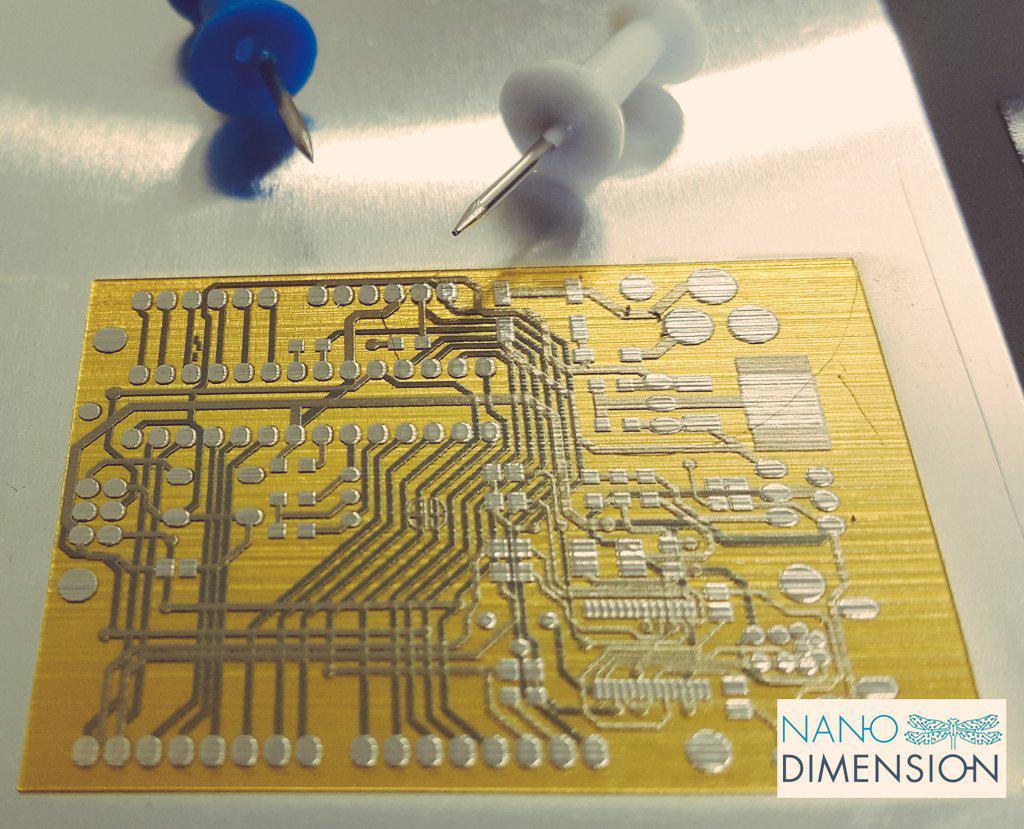
“This collaboration with Tel Aviv University, in combination with Nano Dimension’s intellectual property and know-how, could help advance development of new ink formulations tailored to Nano Dimension’s printing technologies and a wide range of new 3D printing applications,” states Nano Dimension. “Potential applications of nickel nanoparticles include sensors with a high spatial resolution, using advanced print heads and a precision micrometer scale. Implementing this innovative technology with Nano Dimension’s 3D printing process will make it possible to embed sensors within the layers of a PCB, a process not possible with conventional manufacturing, opening up a world of possibilities for the monitoring of various energies and their derivatives, such as capacitance, magnetism, temperature and radiation.”
Nickel also acts as a barrier against oxidation, which could greatly help in the production of printable circuit boards (PCBs). Protection from oxidation is critical, particularly in the production of elements made with nano-metric corrosive metals, which oxidize instantly as soon as they are exposed to air. This is exciting news for the electronics industry, and further cements Nano Dimension’s position as a leader in 3D printed electronics. Discuss in the Nickel Nano 3D Printing Ink forum over at 3DPB.com.
Subscribe to Our Email Newsletter
Stay up-to-date on all the latest news from the 3D printing industry and receive information and offers from third party vendors.
Print Services
Upload your 3D Models and get them printed quickly and efficiently.













You May Also Like
EOS Bets on Mexico’s AM Market with Axiomatek Sales Channel Deal
Mexico is one of the biggest beneficiaries of the push to diversify manufacturing out of China. This development is perhaps inevitable given the current global trade environment, but even with...
Stratasys Showcases 3D Printed Automotive Applications & New Printer at IMTS 2026
Just ahead of last week’s International Manufacturing Technology Show (IMTS) in Chicago, Stratasys launched the F870, a new large-format, production-grade FDM 3D printing platform designed to drive industrial manufacturing at...
3D Printing Financials: $28M in China, U.S. Deals and a Metal AM Comeback
Money continues to go into additive manufacturing (AM). From a $30 million raise for a Chinese metal 3D printing company to new funding for naval AM and a European company...
Let the Games Begin! Xi Throws Down the Advanced Manufacturing Gauntlet
Sangmin Lee went to TCT Asia back in March and reported on the event for 3DPrint.com. He wrote two articles arguing that China’s AM industry looks “ready to scale.” This...