Tinkerine Suite Version 2.0: New Minimal Interface With Powerful Features, Firmware Update for Ditto Pro 3D Printer


 As soon as I see the name Tinkerine, I think 3D printing education and Canada. And indeed, this is a team that’s doing it right not only in North America but also globally, with an unwavering dedication to seeing that students and teachers alike have curricula and apps to work from, as well as comprehensive support and encouragement via Tinkerine U. But lest we forget, Tinkerine is a multi-faceted company and a worldwide presence, manufacturing a line of 3D printers with the Ditto Pro and the DIY Ditto and Litto 3D printer kits. Along with that, Tinkerine also produces a line of filament and offers numerous accessories helpful to every 3D printing enthusiast—from tools to tape.
So once you’ve got that sleek new Ditto 3D printer set up, with filament and all the right stuff chosen, purchased, and at the ready—it’s time to turn to an incredibly important part of the process—the software. While often no one really pays too much attention to this when they are shopping, doing comparisons over features, function, and price—aside from hardware issues, this is what can really make or break your experience.
When things go right with software, it’s a delight. When they don’t—it’s tempting just to throw in your hat and walk away. No one wants to deal with issues in software, and companies like Tinkerine—especially one so engrossed in education—want the digital aspects to run smoothly. Their mission, after all, is to offer accessibility through user-friendliness and affordability.
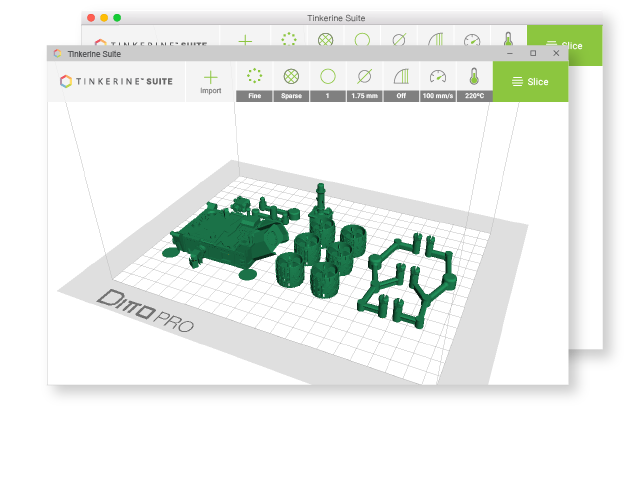 The Tinkerine Suite offers exactly what users 3D printing with the Ditto and Litto want: a minimal interface with powerful features. We should be able to choose what we want to do with ease, and then watch the software—and 3D printer—do all the work as our friends and co-workers ooh and aaah over our resulting creations.
“It’s the perfect ally to your Ditto and Litto series 3D printers,” says the Tinkerine team, regarding the software.
And today, you can count on that ally being even stronger as Tinkerine releases Tinkerine Suite Version 2.0, with a list of features that should leave you feeling secure in knowing that your 3D model is going to come to fruition with ease—not headache and frustration.
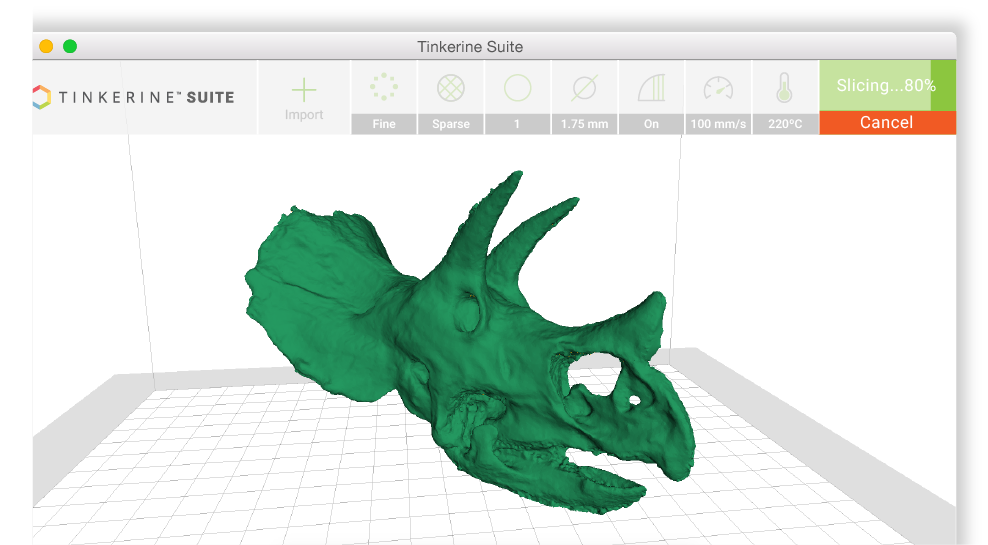
When it comes to slicing, especially for the novice, a software package that does most of the work is most attractive in figuring out areas like speed, temperature, and setting definitions for your design like wall thickness, fill patterns, and more. This software suite should offer what most users are definitely looking for, with reliable and fast slicing, overall efficiency, and superior quality in prints. Tinkerine promises you, in fact, that this is the most user-friendly slicing software available.
The idea with version 2.0 is to offer users an overall even better experience, with more simplicity but full printing control, with a host of great features, such as:
- 3D visualization
- Basic model manipulation
- Multi-model printing
- Support structure
- Print time estimation

“The elegant design is far more than refined aesthetics: it is a complete upgrade to your printing experience,” states the team in their latest press release.
Tinkerine Suite is compatible with both your Mac and PC, is open-source, and works with a many different 3D modeling software packages.
Are you using the Ditto Pro? If so, Tinkerine has also released a firmware update, offering a card reader stability upgrade and calibration for improved surface finish. If you are interested in downloading the free new release, or the firmware update, find out more here. Discuss in the Tinkerine Releases New 3D Software forum over at 3DPB.com.
Subscribe to Our Email Newsletter
Stay up-to-date on all the latest news from the 3D printing industry and receive information and offers from third party vendors.
Print Services
Upload your 3D Models and get them printed quickly and efficiently.













You May Also Like
Apple’s 3D Printed Hinge Cover & the Inauguration of the Ternus Era
Marc Andreessen notwithstanding, it turns out that hardware is, in fact, eating the world. Perhaps after being starved for so long, the hardware side of tech innovation is now overcompensating,...
The Exploration Company Raises $450M to Rival SpaceX
The space industry is currently worth about $650 billion globally, growing nearly 50 percent since 2020, which is certainly impressive. But over the next decade, the total market opportunity in...
3D Printing News Briefs, September 10, 2026: Tax Credits, Polymer Research, Microneedles, & More
We’re starting off this week’s 3D Printing News Briefs with a little business from Axtra3D and Beehive Industries, before moving on to a scientific collaboration agreement between Roboze and a...
The Formlabs Shuffle
For the latest development on 8/31/26, please see an update at the end of this article. Formlabs is doing a management shuffle, pointing the firm even more surely towards an...