POWDERSOLVE Software Ensures Safety and Quality of Metal 3D Printing Materials


 The casual user of a desktop 3D printer may not think of 3D printing as something that requires stringent regulations, and, when it comes to casual desktop use, it isn’t. Industrial additive manufacturing, however, particularly metal additive manufacturing, is a different beast. Because metal 3D printing is used for critical equipment in industries like medicine and aerospace, safety is of the utmost importance, and so the metal powders used in additive manufacturing need to be high quality, free of contaminants and material degradation.
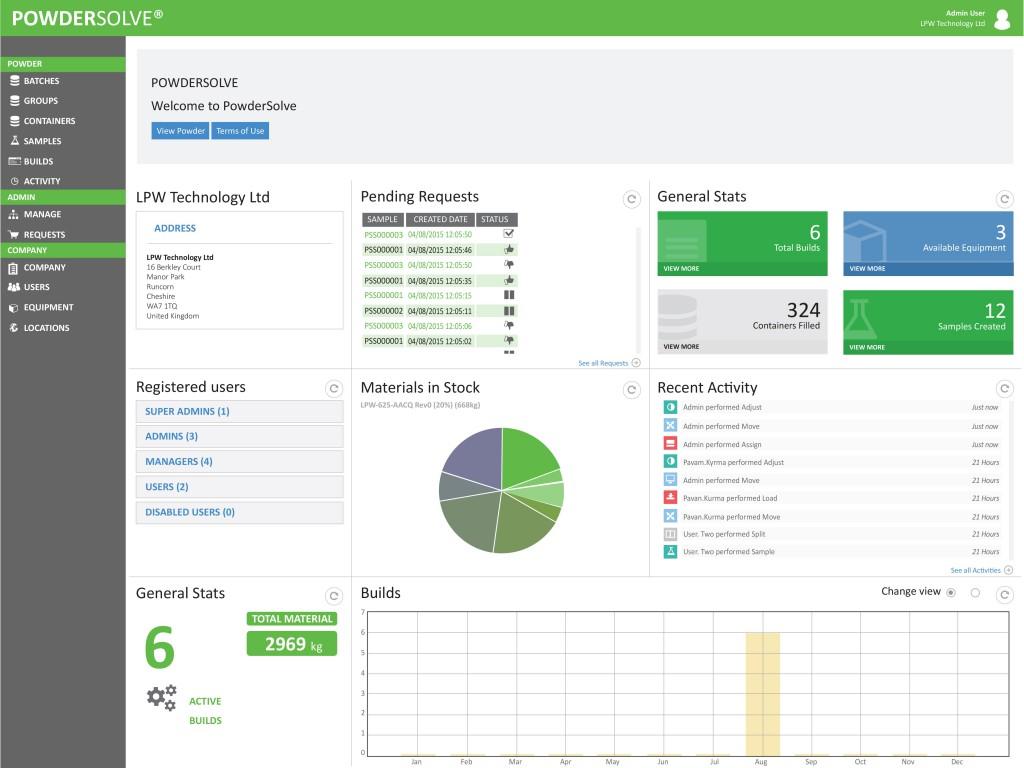
LPW Technology is one of the leading suppliers of metal powders for the additive manufacturing industry, and they’re well aware of the things that can go wrong with metal powders, as well as how to prevent and fix them. Last year, they introduced their POWDERSOLVE software at RAPID 2015, and it’s now on the market. POWDERSOLVE is a comprehensive quality control tool that allows users to fully track, test and monitor their powder supplies, which is a must for industrial manufacturers, particularly in the medical and aerospace fields.
Why is traceability so important? If you’re in a plane with 3D printed engine components, you’re going to want to know that those components were printed with fresh, quality materials that won’t corrode. Likewise, if you’re going into surgery, you better hope that nothing contaminated the powder used to print any of the metal tools being used inside your body. Thus, manufacturers who 3D print with metal must prove that their powder supplies have been carefully monitored from beginning to end.
POWDERSOLVE helps industrial clients to more easily track and monitor their powder supplies. The software logs every batch of powder from the time it was blended, as well as who blended it and what the material percentages are. From there, users can track the powders’ use, reuse, what products were made with each batch, and any changes to their material properties over time. Reports are automatically generated, as are labels containing unique, traceable codes for every batch of powder.
“POWDERSOLVE does exactly as the name suggests – it solves the problems created by powder traceability,” said Phil Kilburn, Commercial Director for LPW. “This unique software takes away the unknowns, offers the user total control and removes any ambiguity from the manufacturing process. It is another example of LPW listening to the problems of their customers and offering a solution. There is great demand for POWDERSOLVE.”
The software is also proving to be valuable to research institutions studying the effects of powder degradation and changing material properties during metal additive manufacturing. Test results can be easily and securely stored within the software, and all activity is automatically logged so that no one can tamper with data without detection. While POWDERSOLVE was designed as a standalone software program, it can also be customized to link with established QMS and ERP systems.
POWDERSOLVE is part of LPW’s Total Powder Management (TPM) System, which is the company’s own system of monitoring every powder they supply, from initial production to disposal. LPW holds themselves to a very high standard of accountability, and POWDERSOLVE enables their clients to do the same. Discuss this new material in the POWDERSOLVE Metal 3D Printing forum over at 3DPB.com.
Subscribe to Our Email Newsletter
Stay up-to-date on all the latest news from the 3D printing industry and receive information and offers from third party vendors.
Print Services
Upload your 3D Models and get them printed quickly and efficiently.













You May Also Like
AM Investment Strategies 2026 Sets the Stage for AMS 2027
AM Investment Strategies 2026 Nov. 5 · 12 p.m. ET · Free online event RESERVE YOUR SPOT ↗ A one-hour online discussion featuring some of the biggest names in 3D...
With Its Latest $200M Round, ICON May Be Running Away With the 3D Printed Construction Market
I used to view ICON, the Austin-based additive construction (AC) firm, as one of a handful of companies that could realistically consider itself the leader of the 3D printed construction...
How Should Businesses Build New Business? Dirk Simon Weighs In — Part 1
Dirk Simon had deep experience in materials and chemistry before joining the 3D printing industry. Instrumental in BASF and Farsoon’s market introduction, Dirk has spent a lot of time thinking...
3D Printing Services Near $2.5B as AM Market Shifts Beyond Hardware
The additive manufacturing market may be growing again, but one of the more interesting numbers behind that recovery has little to do with selling 3D printers. AM services generated nearly...