Latest Developments in Solar Powered 3D Printing Released by Michigan Tech


 One of the things that has made 3D printing so helpful is its portability. The impact the technology has made in developing countries is largely due to the fact that printers can be taken into remote areas, and crucial parts can be churned out in a matter of hours. Organizations like Field Ready and Enabling the Future, among many others, are built on their ability to reach even the most isolated people, in refugee camps, rural mountainous communities, or disaster-damaged towns. There’s one problem that does present itself, however. Frequently, the areas in most need of help are lacking in electricity, or only have inconsistent access.
There have been some creative solutions to work around the lack of electricity; Field Ready, for example, has powered its printers by hooking them up to car batteries. Solutions like that have their limits, though, especially when trying to take printers directly into people’s homes. Moreover, part of the goal of the aforementioned relief organizations is to introduce 3D printing as a permanent solution that can be implemented by locals, rather than a temporary one dependent on the presence of outside agencies.
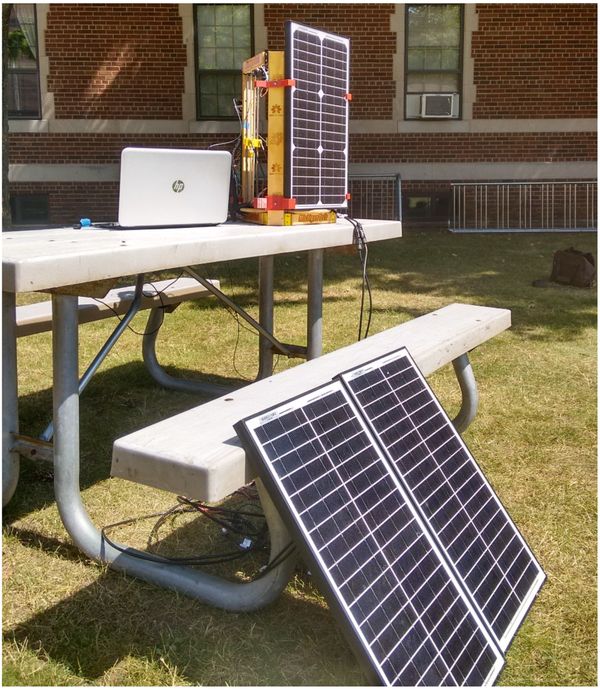
That’s where solar power comes in. As we’ve seen, solar power has been right up there with 3D printing in terms of sustainable technology. Researchers at the Michigan Tech Open Sustainability Technology Lab (MOST) have developed an open source solar powered 3D printer that can be transported easily and operated in zero-electricity environments. The research group has been working on solar powered printers for a while, and their latest developments have been published in a paper called High-Efficiency Solar-Powered 3-D Printers for Sustainable Development.
 MOST is run by Dr. Joshua Pearce, a champion of the RepRap movement in 3D printing. The solar powered printers were developed from MOST’s convertible delta RepRap printer; links to all files, schematics and instructions for the group’s open source technology are available for free here. The newest iteration of the solar powered printer is even more efficient and effective, in that it can operate consistently through a single battery, even when there is a low amount of sunlight available.
“The open source electric control systems enables the 3-D printer to be autonomously powered from a battery when the PV modules are not supplying enough power, and then switch to charging the battery whenever there is excess power,” the study states. “Buck converters are used to control the voltage from the PV modules and the battery, while simplifying the electrical design compared to previous work.”
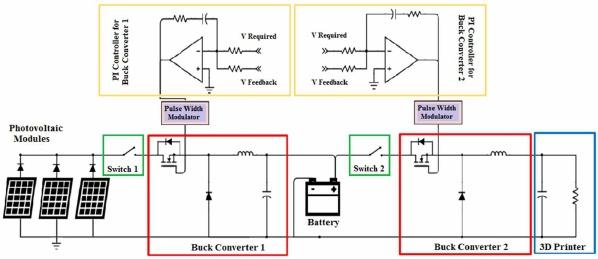
“The results show the system performed as required under all conditions providing feasibility for adoption in off-grid rural communities,” says Dr. Pearce. “3-D printers powered by affordable mobile PV solar systems have a great potential to reduce poverty through employment creation, as well as ensuring a constant supply of scarce products for isolated communities.”

Subscribe to Our Email Newsletter
Stay up-to-date on all the latest news from the 3D printing industry and receive information and offers from third party vendors.
Print Services
Upload your 3D Models and get them printed quickly and efficiently.













You May Also Like
How One Artist Is Using 3D Printing to Tell Stories About the Ocean
Artist Kimberly Callas sees something different when she looks at a 3D printer. Where others see a machine for making parts, she sees a way to tell stories about the...
Bambu Lab Wants Home 3D Printing to Feel Less Like a Workshop with PLA Pure
As desktop 3D printers become increasingly common in homes, Bambu Lab is focusing attention on something beyond print speed and hardware features. This week, the company launched a new filament,...
AM Asia Watch: China Exported 2.46 Million 3D Printers in Four Months
China’s consumer 3D printer industry seems to be reaching a new level of global dominance. According to Chinese state media outlet China Global Television Network (CGTN), China exported 2.46 million...
Bambu Launches A2L: What the New Printer Reveals About Its Strategy
Bambu Lab continues its relentless march for 3D printing domination with the launch of the A2L. The 330 × 320 × 325 mm printer will have a nozzle temperature of...