A Plague of Swarming and Jumping 3D Printed Locust Robots? Yes, Really!

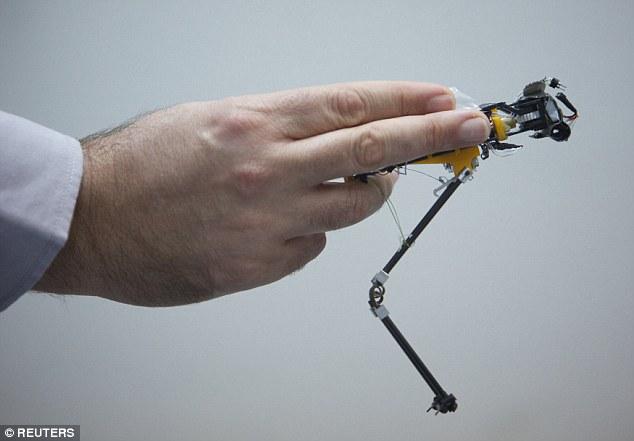 Sometimes in order to express possibilities for the future we can reach back into the past, in this case the Biblical past, for images to capture the stage that today’s technology is setting. In this case, the science fiction image is a plague of (robot) locusts. Israel has recently announced that it has achieved something remarkable in the category of 3D printed robots. Tel Aviv University and ORT Braude College have collaborated on the design and creation, under the watchful eye of Professor Amir Ayali, of a locust-inspired robot that can jump up to 11.5 feet. Say that again?
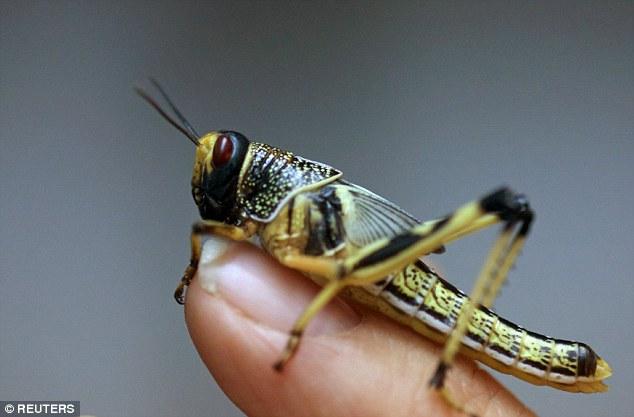
Using steel springs, carbon rods, and 3D printed plastic pieces, this robot weighs less than an ounce and is 4 inches long. The initial idea of drawing from the locust’s swarming capabilities inspired the team to create a robot that runs off a motor that generates and stores mechanical energy and is powered by a lithium battery. The stored mechanical energy is what’s behind the robot’s ability to spring high into the air, since its legs are patterned after the locust itself. The robot’s lead designer, Professor Ayali, explains:
“The locust being a large insect that has wonderful jumping performance had offered itself as wonderful inspiration for this specific idea of a jumping…miniature jumping robot… What you do with it is whatever is needed whenever you want to engage any kind of robotic system with no human interference.”
Even more impressive is the contention that the locust robot, named TAUB, can jump up to 1,000 times on one battery. Hmmm: are you starting to wonder where you can get one of these for yourself?
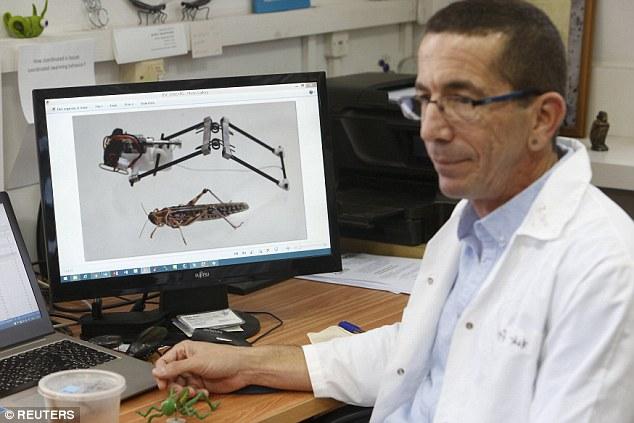
Well, as luck would have it, Professor Ayali told Reuters that mass production of the robot would not be so difficult due to its cheap parts and easy to manufacture design. Ayali predicted that the robots could sell for about $100 USD, which doesn’t seem like much for a locust-inspired robot that can jump 11.5 feet 1,000 times on one battery!
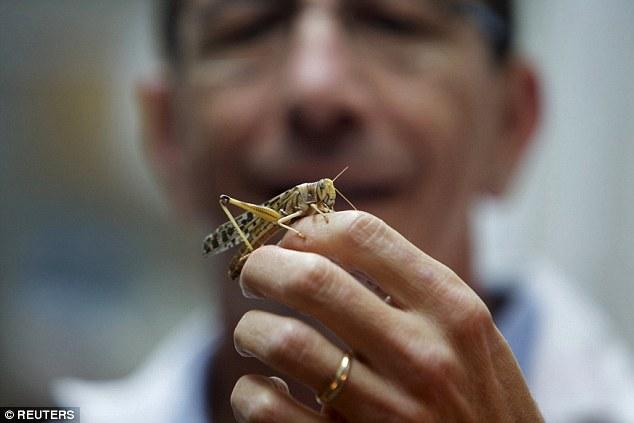
 Dr. Gabor Kosa, of Tel Aviv University’s Faculty of Engineering, imagines that GPS navigation systems and cameras can be installed on a swarm of solar-powered robots that can carry out sureveillance duties. Other duties include more eco-apocalyptic scenarios like the next large oil spill: really, the sky’s the limit for a small robot that can jump 11.5 feet. To this end, Kosa expressed his interest in evolving this creation into a robotic system that can jump many times and mimic the locust by spreading its wings and flying, as well.
For now, it seems like the team is off to an incredible start with TAUB: a robot with 3D printed plastic parts capable of implementing the mechanisms of swarming capabilities, via a study of the locust’s own instincts, in robotic systems. Discuss this story in the 3D Printed Locust Bot forum on 3DPB.com
Subscribe to Our Email Newsletter
Stay up-to-date on all the latest news from the 3D printing industry and receive information and offers from third party vendors.
Print Services
Upload your 3D Models and get them printed quickly and efficiently.













You May Also Like
How Drone Proliferation Is Forcing a Rethink of Defense Manufacturing
The rapid proliferation of low-cost drones is forcing manufacturers to rethink their approach to design, production, quality, and scale. For defense manufacturing teams, the challenge is both how quickly a...
What 3D2GO Says About 3D Printing’s Growth in Southeast Asia
The Philippines offers an interesting case study in how 3D printing can develop in Southeast Asia, and Manila-based 3D2GO helps illustrate it. 3D printing in Southeast Asia doesn’t have to...
3D Printing News Briefs, September 12, 2026: Rebranding, Cybersecurity, Project Call, & More
We’ve got a lot of business news from ATLIX to start off this weekend’s 3D Printing News Briefs, with a new identify for its additive manufacturing (AM) portfolio and some...
Silencer Market Set to Test Metal Additive’s Readiness for Production Prime Time With Enormous Market Expansion
Throughout the history of additive manufacturing (AM) technologies, there are only a couple of really interesting case studies in which we see a market significantly disrupted and revolutionized by AM....