3D Printed Liberator Handgun Creator Cody Wilson Gets Some Support from Republican Members of Congress



The 3D printed Liberator hand gun.
Two years ago, Cody Wilson, the inventor of the 3D printable Liberator handgun, uploaded the 3D printable files for the Liberator to his website Defense Distributed. After only two days, and 100,000 downloads, the US State Department ordered Wilson to remove the files from his website and cease distributing them immediately. They cited a law that regulates international arms trafficking which they said that the Liberator violated. After attempting to resolve the issue with the State Department for more than a year, Wilson decided to file a lawsuit back in May 2015 and he has been fighting his way through the courts ever since.

Rep Thomas Massie.
Last week Wilson received some unexpected, but significant, support for his case in the form of Rep Thomas Massie from Kentucky and 14 other member of Congress. The lawmakers signed onto an amicus brief with the Fifth Circuit Court of Appeals, where Wilson is currently attempting to overturn a lower court ruling that sided with the State Department. Of course the courts are under no obligation to consider the filed brief; however as a Member of the Committee on Science, Space & Technology, and himself an engineer, Massie’s support is not insignificant and certainly adds weight to Wilson’s assertions that his constitutional rights are being violated by the State Dept and their regulation.
“The State Department’s interpretation of the Arms Export Control Act permitting such regulation through the International Traffic in Arms Regulations (‘ITAR’) is inconsistent with the text of the AECA, inconsistent with the AECA’s legislative history and purpose, and is inconsistent with the way the Department of Justice itself has interpreted and litigated the AECA in the past. This is not a question of due deference to an administrative agency: the State Department’s interpretation boldly (and impermissibly) departs from Congress’s intent to the detriment of all Americans’ First, Second, and Fifth Amendment rights. The district court adopted the Executive’s argument wholesale in its judgment. It cannot be upheld,” argued the Congressmen in their brief.
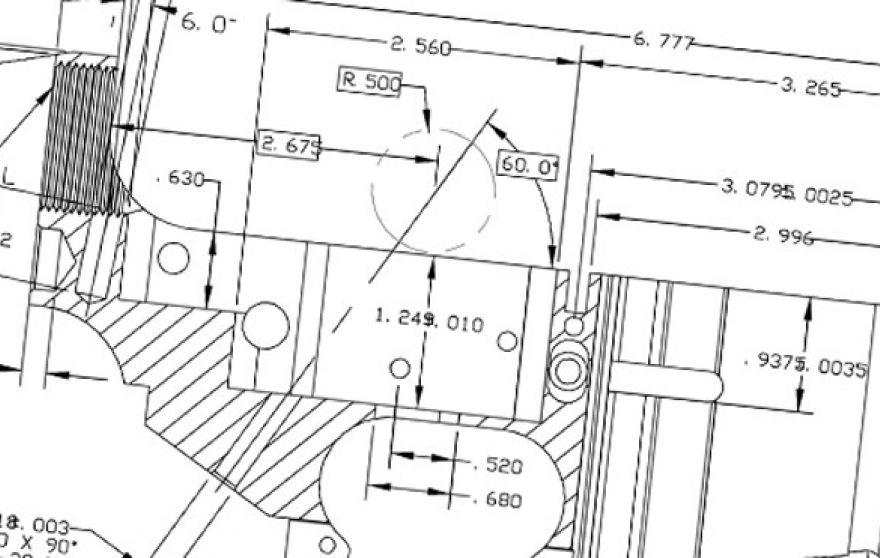
Partial blueprints for the Liberator.
Their objection seems to stem from a notice that was posted in the Federal Register back in June, only a month after Wilson launched his lawsuit, that listed a series of changes to the International Traffic in Arms (ITAR) regulations. ITAR was designed to control the types of technology and information that is allowed to be exported out of the US. The changes specifically added language that explicitly prohibited the posting of 3D printable firearm schematics online. The group of lawmakers contend that the State Department ignored specific legislative intent when they used the AECA to prevent Wilson from distributing the Liberator files.
“We expect the Court to recognize that the State Department exceeded the authority granted to it by Congress and violated the First, Second, and Fifth Amendments to the Constitution. If the State Department’s violations are allowed to stand, it could have dramatic implications for free speech on the Internet,” Massie told FoxNews.com.

Cody Wilson.
The brief also makes the argument that administrative agencies like the State Department only have the powers that are granted to them by Congress. According to the Congressmen they did not delegate the power to ban the publication of the 3D printed firearm files from the internet using the AECA. They also believe that if the AECA was actually capable of banning 3D printed firearm files then it would itself be unconstitutional. According to the brief, the Congressmen believe that if interpreted that way the AECA would “chill technological innovation.”
This case is an exceptionally complicated one that hinges on several legal rulings that honestly I don’t see being resolved until it is kicked up to the Supreme Court. Namely, are digital files considered free speech or are they considered objects, and are 3D printable guns covered under the Second Amendment? Several court cases have been working their way through the courts asking similar questions for different reasons, but as of yet there has been no precedent set–though on the other side of the world New South Wales, Australia has been working to ban 3D printable gun files.
Not only are these 15 Republican Congressmen backing Wilson’s case up, but he also has the support of the Cato Institute, the pro-gun group the Madison Society Foundation and the conservative think tank Texas Public Policy Foundation. Although not unexpected, but still significant considering his other conservative defenders, Wilson has also secured the support of the Electronic Frontier Foundation. Discuss this story in the Cody Wilson forum thread on 3DPB.com.
Subscribe to Our Email Newsletter
Stay up-to-date on all the latest news from the 3D printing industry and receive information and offers from third party vendors.
Print Services
Upload your 3D Models and get them printed quickly and efficiently.













You May Also Like
Polish Electronics 3D Printing OEM XTPL Sells 10 More Printhead Modules to First Chinese Customer
Smartphones, laptops, and all other such devices are only getting more expensive. As evidenced by Apple’s cautioning of higher prices for this year’s new iPhone line, the problem is largely...
Lyten’s Graphene Filaments Power Modovolo’s US-Made 3D Printing Platform
Drone manufacturer Modovolo has selected Lyten as the primary filament supplier for its industrial 3D printing platform, a move the companies say will strengthen U.S.-based manufacturing for aerospace, defense, and...
AM Research Data Shows 3D Printing Markets Increased from $4.29B in Q4 2025 to $4.35B in Q1 2026
Leading industry analyst firm Additive Manufacturing Research (AM Research or AMR) has been providing market reports for the 3D printing/AM sector since 2013. It recently published the “Q1 2026 3DP/AM...
3YOURMIND Demonstrates that Distributed 3D Printing is Ready at AM Village 2026
Given that additive manufacturing (AM) is so closely adhering to the classic industrialization blueprint whereby military adoption pushes a new technology to commercialization, I’ve thought for a long time that...